Bloom’s Taxonomy: Levels, Verbs & Examples
The complete guide to Bloom’s Taxonomy — the six levels, action verbs for each level, the three domains, and how to write learning objectives that actually measure what learners can do.

Most training programs tell learners what they need to know. Bloom’s Taxonomy asks a different question: what do they need to be able to do with it?
That shift — from content delivery to capability building — is why this framework, first published in 1956, still shapes how L&D professionals, instructional designers, and educators structure learning today.
This guide covers the six cognitive levels, the three domains, the action verbs that make objectives measurable, and how to apply the taxonomy in practice.
This article will help you learn:
- What is Bloom’s Taxonomy?
- Original vs. Revised
- The six levels
- Bloom’s Taxonomy verbs
- The three domains
- Higher order thinking
- Writing learning objectives
- Why it matters in corporate training
What is Bloom’s Taxonomy?
The core idea: learning is a progression. You can’t apply what you don’t understand. You can’t analyze what you haven’t learned to apply first.
Educational psychologist Benjamin Bloom and his colleagues developed the framework in 1956.
It was originally designed to give university professors a shared vocabulary for talking about assessment goals. It has since become the standard reference for instructional design across schools, universities, and corporate training programs worldwide.
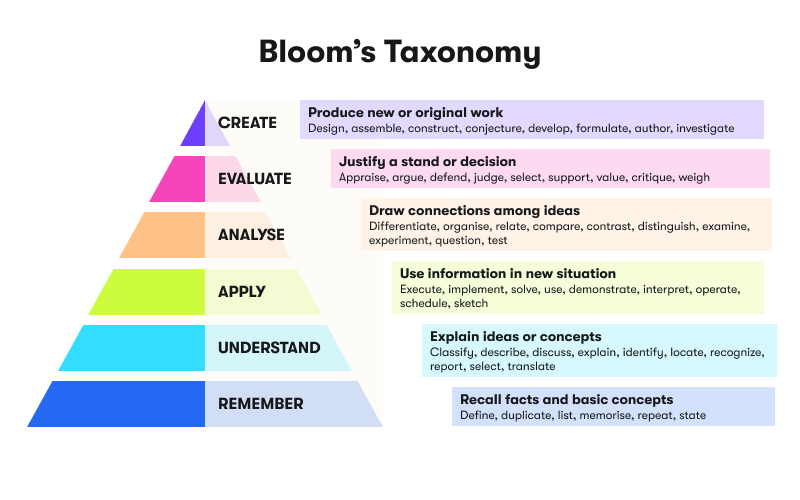
In the context of learning and development, Bloom’s Taxonomy gives L&D teams a practical tool for aligning what they teach to what the job actually demands. The pyramid below shows the revised version used today.

Training evaluation form
Get a handy printable form for evaluating training and course experiences.
Download nowOriginal vs. Revised Bloom’s Taxonomy
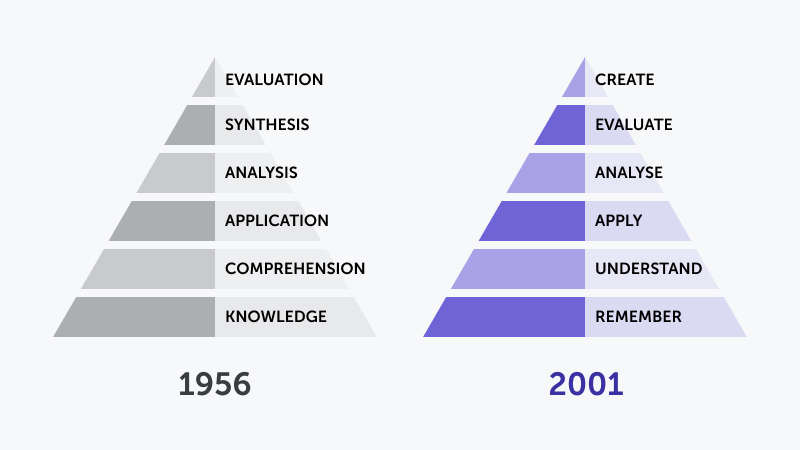
The taxonomy has been through one significant revision since 1956. Here is how the two versions compare:
| # | Original taxonomy (1956) | Revised taxonomy (2001) |
|---|---|---|
| 1 | Knowledge | Remember |
| 2 | Comprehension | Understand |
| 3 | Application | Apply |
| 4 | Analysis | Analyze |
| 5 | Synthesis → moved to top | Evaluate |
| 6 | Evaluation → swapped | Create |
Comparison image of the original vs. revised Bloom’s Taxonomies
What changed in 2001 — and why it matters
The research group led by David Krathwohl (one of the original authors) and Lorin Anderson made two structural changes:
- Nouns became action verbs. “Knowledge” became “Remember”. “Comprehension” became “Understand”. The shift from nouns to verbs made each level directly usable when writing learning objectives — you can build a measurable task around a verb.
- The top two levels swapped. Evaluation moved to level five. Synthesis — renamed Create — moved to the top. The reasoning: producing something original requires evaluative judgment, making creation the more cognitively complex task.
The 2001 revision is what most practitioners use. When you see Bloom’s Taxonomy referenced in instructional design, corporate training, or curriculum design today, it is almost always the revised version.
The six levels of Bloom’s Taxonomy
Each level builds on the one below it. A learner who can evaluate something has, by definition, already moved through remembering, understanding, applying, and analyzing it. The levels are not a checklist — they are a sequence.
1. Remember
The foundation. Learners recall facts, definitions, procedures, and concepts from memory — without needing to interpret or use them yet.
Corporate training examples: Recalling safety protocols. Naming the steps in a compliance checklist. Recognizing product specifications during an assessment.
Question stems: What is…? List the steps of…? When did…? Who was responsible for…?
2. Understand
Learners can explain ideas in their own words — not just repeat them. They can summarize, interpret, classify, and give examples without prompting.
Corporate training examples: Explaining why a company policy exists, not just what it says. Summarizing the key points from an onboarding module. Describing the difference between two product tiers to a new colleague.
Question stems: How would you explain…? What is the main idea of…? Can you give an example of…? What do you understand by…?
3. Apply
Using knowledge in a new but related context. This is where training moves from theory to practice. The task is familiar enough to recognize but requires execution, not just recall.
Corporate training examples: Using a sales technique in a role-play scenario. Applying a troubleshooting procedure to a real equipment fault. Completing a compliance checklist without prompting.
Question stems: How would you use…? What would happen if you applied this to…? Can you demonstrate…?
4. Analyze
Breaking down information to understand its components and the relationships between them. Learners examine, compare, and draw conclusions — they don’t just use information, they interrogate it.
Corporate training examples: Identifying why a project missed its deadline by examining the contributing factors. Reviewing customer feedback data to identify patterns. Comparing two onboarding approaches to determine which produced faster time to competence.
Question stems: What are the components of…? How does X compare to Y? What evidence supports…? What conclusions can you draw from…?
Training evaluation form
Get a handy printable form for evaluating training and course experiences.
Download now5. Evaluate
Making judgments based on criteria. This requires both knowledge and a position. Learners do not just describe — they assess and defend.
Corporate training examples: Assessing whether a proposed process change meets quality standards. Critiquing a project plan before sign-off. Deciding which vendor proposal best fits the organization’s needs and being able to justify that decision.
Question stems: Which approach is more effective, and why? How would you defend…? What criteria would you use to judge…? Is this the best solution?
6. Create
Producing something new. The most cognitively demanding level — it requires synthesizing knowledge, applying judgment, and generating an original output that did not exist before.
Corporate training examples: Designing a training program for a new product launch. Developing a strategy to reduce onboarding time in a specific department. Building a process improvement proposal from scratch, drawing on analysis of existing workflow data.
Question stems: How would you design…? What would you propose if…? Can you construct a plan that…? What solution would you recommend?
Bloom’s Taxonomy verbs
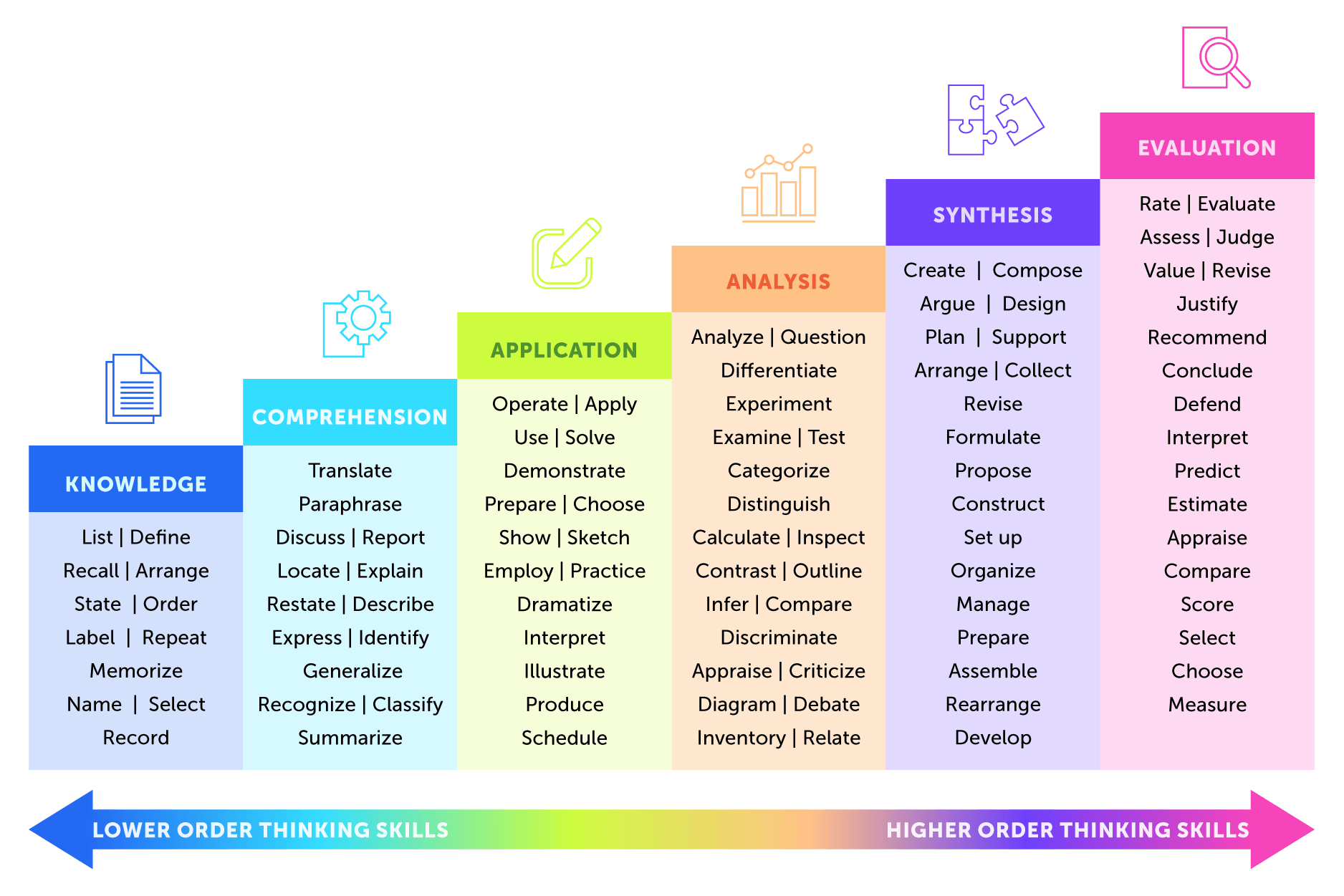
Each level has a set of action verbs that signal the cognitive demand of a task.
These are the verbs instructors use when writing learning objectives — they make the expected outcome specific and assessable rather than vague and unmeasurable.
| Level | Sample action verbs |
|---|---|
| Remember | define, duplicate, list, memorize, recall, repeat, reproduce, state, name, recognize, identify |
| Understand | classify, describe, discuss, explain, identify, locate, recognize, report, select, translate, summarize, interpret |
| Apply | execute, implement, solve, use, demonstrate, interpret, operate, schedule, sketch, write, carry out |
| Analyze | differentiate, organize, relate, compare, contrast, distinguish, examine, question, test, outline, deconstruct |
| Evaluate | appraise, argue, defend, judge, select, support, value, critique, weigh, assess, justify, prioritize |
| Create | design, assemble, construct, conjecture, develop, formulate, author, investigate, plan, produce, generate |
The three domains of Bloom’s Taxonomy
Most guides treat Bloom’s Taxonomy as the six cognitive levels.
That is the framework most people learn first — but the original work covered three separate domains of learning.
Understanding all three matters for instructional designers and L&D teams building complete training programs. A course that only targets cognitive skills may miss what actually drives behavior change.
1. The cognitive domain
The most widely known domain. It covers thinking skills: knowledge, comprehension, and the intellectual ability to analyze, evaluate, and create.
This is the six-level framework described above.
2. The affective domain
The affective domain covers attitudes, values, and emotional responses to learning. It was developed by Krathwohl, Bloom, and Masia in 1964, with five levels that describe how learners internalize and adopt new values:
| Level | What it means | Corporate training example |
|---|---|---|
| 1. Receiving | Open to an experience or idea | Attending a diversity workshop without dismissing its relevance |
| 2. Responding | Actively participating | Asking questions during safety training; applying feedback from a manager |
| 3. Valuing | Attaching importance to something | Choosing to report a near-miss even when not required to |
| 4. Organizing | Reconciling new values with existing ones | Integrating a new company value into how you approach client decisions |
| 5. Characterizing | Values become part of how you consistently behave | Proactively sharing knowledge without being asked — it is just how you work |
In corporate training, the affective domain matters most in culture change programs, safety culture development, and any training where the goal is not just “knows the rule” but “acts on it consistently without being told to.” Compliance programs that only target cognitive recall often fail here.
3. The psychomotor domain
The psychomotor domain covers physical skills and coordination. It is most relevant in manufacturing, healthcare, construction, and technical training — any context where learning requires performing a physical task correctly, not just understanding how to.
Psychomotor objectives describe skill development in stages: from observing and imitating a procedure to performing it automatically, with precision, under variable conditions.
Corporate training examples: Operating machinery safely. Performing a clinical procedure. Using tools and equipment to a specified standard. Physical product assembly.
Higher order thinking vs. lower order thinking
Bloom’s six levels split naturally into two groups, and the distinction has practical implications for how training gets designed and assessed.
| Lower order thinking skills (LOTS) | Higher order thinking skills (HOTS) |
|---|---|
| Levels 1–3: Remember, Understand, Apply | Levels 4–6: Analyze, Evaluate, Create |
| Working with existing knowledge — recalling, explaining, and using what has been learned | Doing something with knowledge — questioning it, judging it, building from it |
Most traditional training programs — and most multiple-choice assessments — sit entirely within lower order thinking. Learners can pass by recognizing the right answer from a list.
That is not the same as knowing what to do when the situation doesn’t match the textbook.
The distinction matters when you are auditing whether your training matches the actual cognitive demands of the role.
A manager who can recall a company’s values: Remember level.
A manager who can explain what those values mean in their department: Understand level.
A manager who can evaluate whether a specific business decision aligns with those values — and defend their position: Evaluate level.These are not the same capability. If the job requires Evaluate but the training only tests Remember, the program is measuring the wrong thing.
Writing learning objectives with Bloom’s Taxonomy
A learning objective states what a learner will be able to do after completing training — in measurable, observable terms.
Bloom’s Taxonomy provides the verb that makes the objective specific and assessable.
The format:
The verb does the heavy lifting. “Understand the data privacy policy” is not a measurable objective.
You cannot assess understanding without specifying what a learner demonstrating understanding actually does.
“Explain the company’s data privacy policy in their own words” is measurable — and it signals that the training needs to build comprehension, not just recognition.
Examples by level
| Level | Objective (weak) | Objective (strong — Bloom’s verb applied) |
|---|---|---|
| Remember | Know the emergency shutdown steps | List the three emergency shutdown steps in the correct order |
| Understand | Understand the data privacy policy | Explain the company’s data privacy policy in their own words |
| Apply | Be able to handle a customer complaint | Complete a customer complaint form following the standard process |
| Analyze | Know about different product configurations | Compare two product configurations to identify which fits a customer’s stated requirements |
| Evaluate | Assess a proposed design | Assess whether a proposed product design meets the published safety criteria |
| Create | Build an onboarding plan | Develop a 30-day onboarding plan for a new direct report |
For learning and development teams, writing objectives at the right Bloom’s level means the assessment matches the actual job demand — not a simplified version of it.
This is particularly important during the design stage of any new program, when the temptation is to default to knowledge checks because they are easiest to build.
Common mistake: setting objectives at a lower level than the job requires
A new hire who can list the company’s sales process is at Remember level. Handling a live objection from a skeptical buyer requires Evaluate. If training only tests the former but the job demands the latter, the gap shows up in performance — not in the training metrics.
Using Bloom’s levels to map employee onboarding programs against role expectations is one of the most practical applications of the taxonomy. It makes the gap between “completed training” and “ready to perform” visible.
Why corporate training teams use Bloom’s Taxonomy
Bloom’s Taxonomy solves a problem that most training programs have but rarely name: training activities and assessments are often set at a lower cognitive level than the job actually demands.
This is not deliberate.
It happens because lower-order learning is easier to design, easier to deliver, and easier to measure. A multiple-choice quiz on policy content is straightforward to build. An assessment that requires a learner to evaluate a real scenario and defend a judgment is harder — but it is also the level the role requires.
Auditing existing training against job demands
L&D teams can use Bloom’s Taxonomy to audit training programs: take each learning module, identify the cognitive level of the activities and assessments, and compare that to the level the job actually requires.
A compliance course that only tests recall is not meeting the standard if the regulatory risk comes from failures at Apply or Analyze level — when an employee knows the rule but does not apply it correctly under real conditions. That gap is measurable.
Compliance training programs in particular benefit from this audit. Most test recognition. Most compliance failures happen at application and judgment levels.
Skills management and Bloom’s Taxonomy
For organizations building skills management programs, Bloom’s levels give a practical language for describing capability — not just “does this person know about X” but “can this person evaluate X under real conditions.” That difference matters when making decisions about who is ready for what.
Mapping a role’s required cognitive levels to the learning programs that build them is how L&D teams connect training activity to business readiness. It turns Bloom’s Taxonomy from a theoretical framework into a planning and measurement tool.
Bloom’s Taxonomy in instructional design
Instructional designers use Bloom’s Taxonomy at every stage of the design process: setting objectives at the correct level, choosing activities that develop those cognitive skills, building assessments that actually test whether the objective was met.
The taxonomy is particularly useful when working with subject matter experts who default to information transfer — ‘here is everything the learner needs to know’ — when the actual requirement is capability development. Bloom’s levels give designers a framework for pushing back with a clear rationale.
One of the most common L&D questions from business leaders is: when will this person be ready? Bloom’s Taxonomy gives teams a structured answer. If the role requires Apply-level competence and learners are currently at Understand, the gap is one cognitive level — measurable, plannable, and trackable.Platforms like Valamis map learning paths to specific competency levels, so L&D teams can see exactly where each learner is across the taxonomy — and what they need next to move from trained to ready.