How to improve employee engagement
Learn how to improve employee engagement with practical tips, real-life strategies from managers, and insights on how L&D can drive long-term motivation.


Employee engagement isn’t just a buzzword. It’s the difference between people showing up to work and people showing up to contribute. But how do you get there, really?
It’s not about beanbags, pizza Fridays, or adding another “fun” survey. Engagement grows from everyday actions: how people are treated, how much they feel valued, and whether their work has meaning.
Below you’ll find practical strategies supported both by research and by real managers sharing their experiences on Reddit. That can help you lift engagement in a genuine way.
How to improve employee engagement: Strategies that actually work
Involve employees in decisions
One of the strongest engagement drivers is ownership.
When employees feel like decisions are simply handed down from above, disengagement creeps in.
On the flip side, when they’re invited into the process, whether it’s setting team priorities, shaping workflows, or even giving input on policies, they feel invested.
Try this: In your next team meeting, hand over one decision to the group. Let them choose the project format, the tool, or even the meeting structure. Watch what happens to buy-in.
Recognize more often (and more authentically)
A theme that came up again and again on Reddit: recognition matters.
Not just annual bonuses, but frequent, genuine acknowledgment. One manager said they turned things around by simply giving out monthly awards and personal thank-yous.
And the truth is, you don’t need a budget for this. A public shout-out, a quick Slack message, or a handwritten note can be more powerful than a gift card.

At Valamis, employee recognition is a monthly tradition — award winners are celebrated in Slack and highlighted on LinkedIn.
Pay fairly and transparently
Here’s the uncomfortable part: no engagement strategy can compensate for unfair pay.
Several managers admitted the biggest leap in engagement happened only after they adjusted salaries and made reward structures clearer.
Ask yourself: would I feel motivated to go the extra mile if I suspected my colleague was paid significantly more for the same work?
Make meetings count
Meetings are often the silent killer of engagement.
In that Reddit thread, multiple people pointed out how endless, repetitive meetings drained their teams.
Solutions that worked:
- Cutting meeting frequency in half
- Rotating who runs the agenda
- Keeping discussions sharp and focused
When meetings are purposeful and inclusive, they become energizers rather than time-wasters.
Listen and dig deeper
Engagement issues are usually symptoms, not the root cause.
A manager shared how they kept running the same surveys and hearing “we’re bored.”
It wasn’t until they asked why, then asked why again, that they realized people wanted more challenging work and recognition for doing it.
Pro tip: Use the “five whys” technique. Don’t stop at the first answer. Keep digging until you uncover the real barrier.
Set high expectations (and show you believe in your team)
This one is surprising: some people disengage not because work is hard, but because it’s too easy or because leaders don’t expect much from them.
When you challenge people with clear, meaningful goals and trust them to deliver, you send a powerful message: “We believe in you.”
That belief fuels motivation more than any perk.
Protect work-life balance
Nothing kills engagement faster than burnout.
Managers were vocal about this: overworked employees disengage, no matter how great the culture looks on paper.
Quick wins:
- Respect boundaries outside working hours
- Encourage vacations (and model it as a leader)
- Offer flexible options when possible
Healthy employees are engaged employees.
Build belonging, not just perks
A strong culture isn’t about free snacks. It’s about fairness, inclusivity, and a sense of team. Managers who fostered cross-team projects, peer mentoring, or casual ways to connect noticed a big jump in engagement.
Because when people feel they’re part of something bigger, they naturally want to contribute.
Communicate better (and in smarter formats)
One of the more creative tips from Reddit: ditch long email dumps in favor of short, personal video updates from leadership.
Employees found these easier to digest, more human, and more transparent.
It’s a simple shift that says: “We want you to actually hear from us, not just skim another memo.”
Putting it all together
If there’s one takeaway from all this, it’s that engagement isn’t about flashy, one-time initiatives. It’s about consistency. Listening, adjusting, and showing people that what they do matters.
Before you dive into bigger initiatives like learning and development, check these basics:
- Are you recognizing people often enough?
- Are your meetings adding value?
- Are you paying fairly?
- Are you giving people space to own decisions and maintain balance?
Get these right, and the more advanced strategies (like L&D) have fertile ground to grow in.

L&D strategy framework
You will receive a list of questions along with a spreadsheet template to help you analyze your L&D strategy.
DOWNLOAD FRAMEWORKHow to improve employee engagement with L&D: 5 ways
All of these basics like recognition, fair pay, better meetings, balance set the stage. But to keep people genuinely engaged, you need more than a good atmosphere.
Employees also want to grow, to learn new things, and to see a clear path ahead. That’s where learning and development (L&D) makes all the difference.
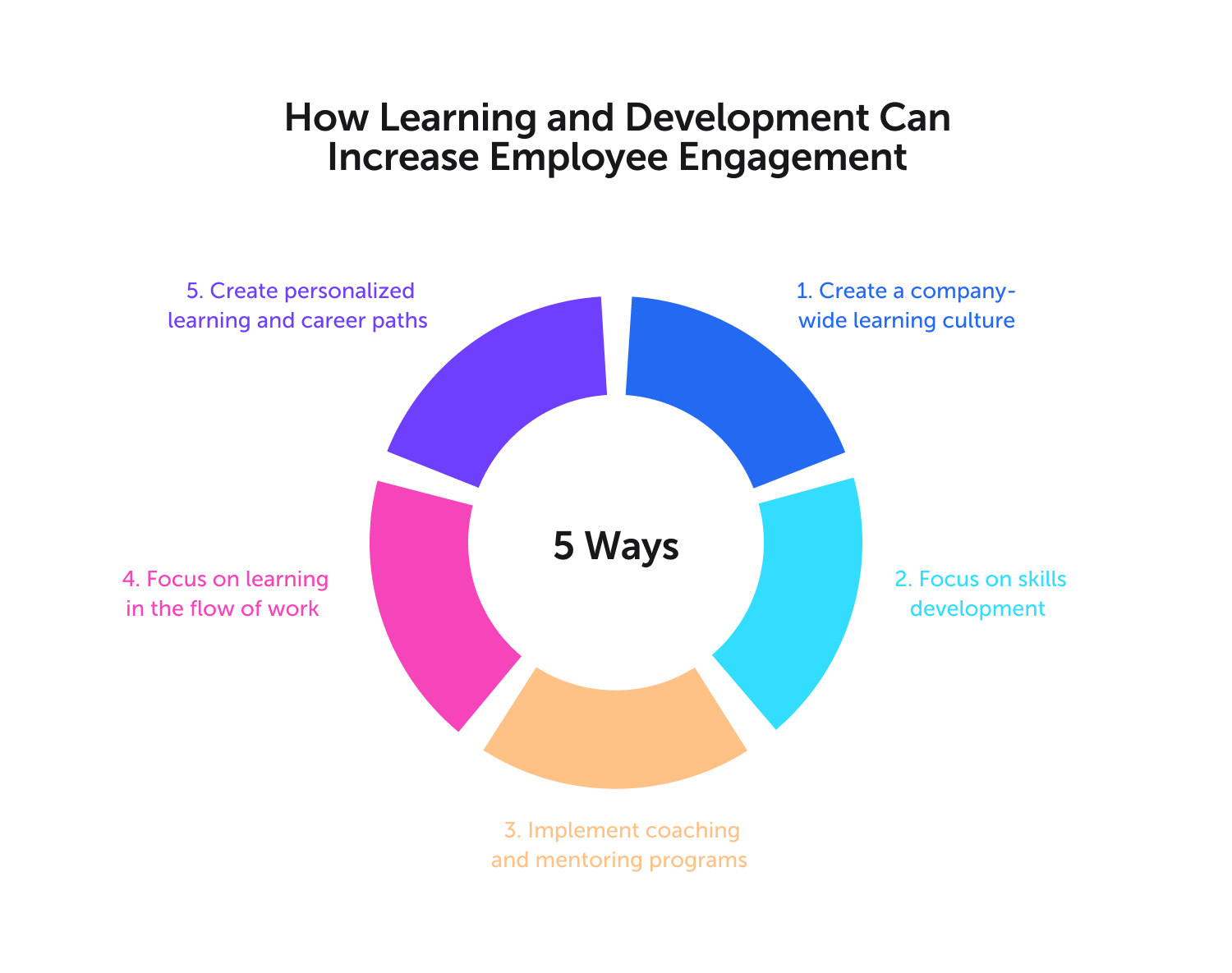
1. Create a company-wide learning culture
One of the most popular definitions of “learning culture” is attributed to CEB (now part of Gartner): “Learning culture is a culture that supports an open mindset, an independent quest for knowledge, and shared learning directed toward the mission and goals of the organization.”
Opportunities to learn and grow as part of everyday work increase employee engagement. The whole organization needs to be involved, individually and collectively.
Offering learners the choice in how, when, and what they learn builds a culture of self-directed, continuous learning and increases motivation which leads to a deeper knowledge and helps learners to do their work better.
Modern learning platforms are crucial to building a learning culture. They provide engaging learning experiences by giving access to media-rich content, which learners can easily find whenever they need it.

Build a culture of compliance and continuous learning
See how Valamis helps you deliver, track, and automate compliance training across your organization.
EXPLORE COMPLIANCE TRAINING2. Focus on skills development
In a 2019 Global Human Capital Trends Survey, more than 50% of respondents said it was easier for employees to find jobs outside of their organizations than inside, but for organizations, hiring and onboarding new talent is time-consuming and expensive.
To ensure their workforce is competitive and they can keep their best talent, upskilling and reskilling should be strategic focus areas for organizations.
Upskilling involves improving existing skills by deepening and broadening the abilities within a specific area of expertise. Reskilling focuses on adopting new skills to cover a unique role in the organization.
In the long run, upskilling and reskilling improve employee engagement and help companies attract and keep top talent.
One of the organizations Deloitte interviewed has reached a nearly 30% increase in employee engagement by implementing a robust internal career program to help employees reskill themselves for new positions within the organization.
3. Implement coaching and mentoring programs
In today’s working environment, the pace of change is often overwhelming for employees.
Coaching and mentoring can help employee develop new skills to cope with constant pressure and change and keep them engaged in their work. A two-way learning opportunity keeps employees and managers engaged.
ATD (Association for Talent Development) points out that coaching and mentoring have similar goals and different roles.
Mentoring focuses on establishing connections and creating mutually beneficial, two-way relationships to build long-term career development. Coaching focuses on helping learners find solutions and create action plans by listening and identifying their needs.
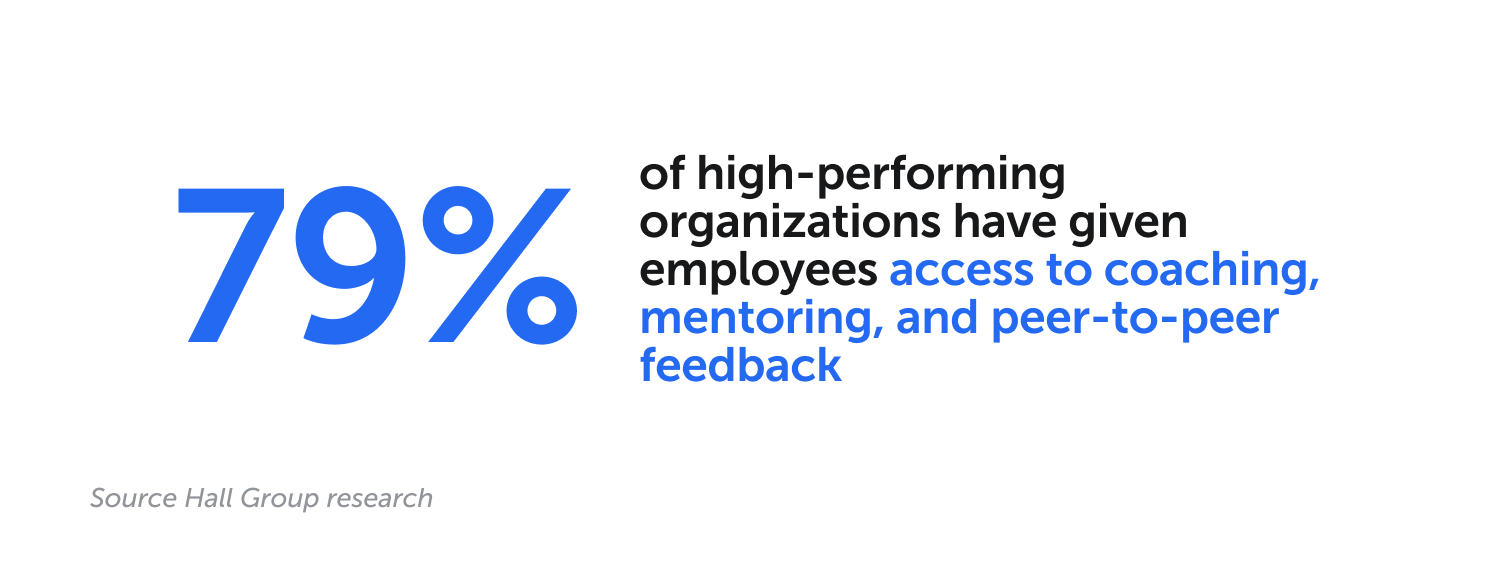
Based on Brandon Hall Group research, organizations see better business results where coaching and mentoring are valued, encouraged, and practiced from the top leadership on down. 79% of high-performing organizations have given employees access to coaching, mentoring, and peer-to-peer feedback.
4. Focus on on-the-job training, microlearning, and learning in the flow of work
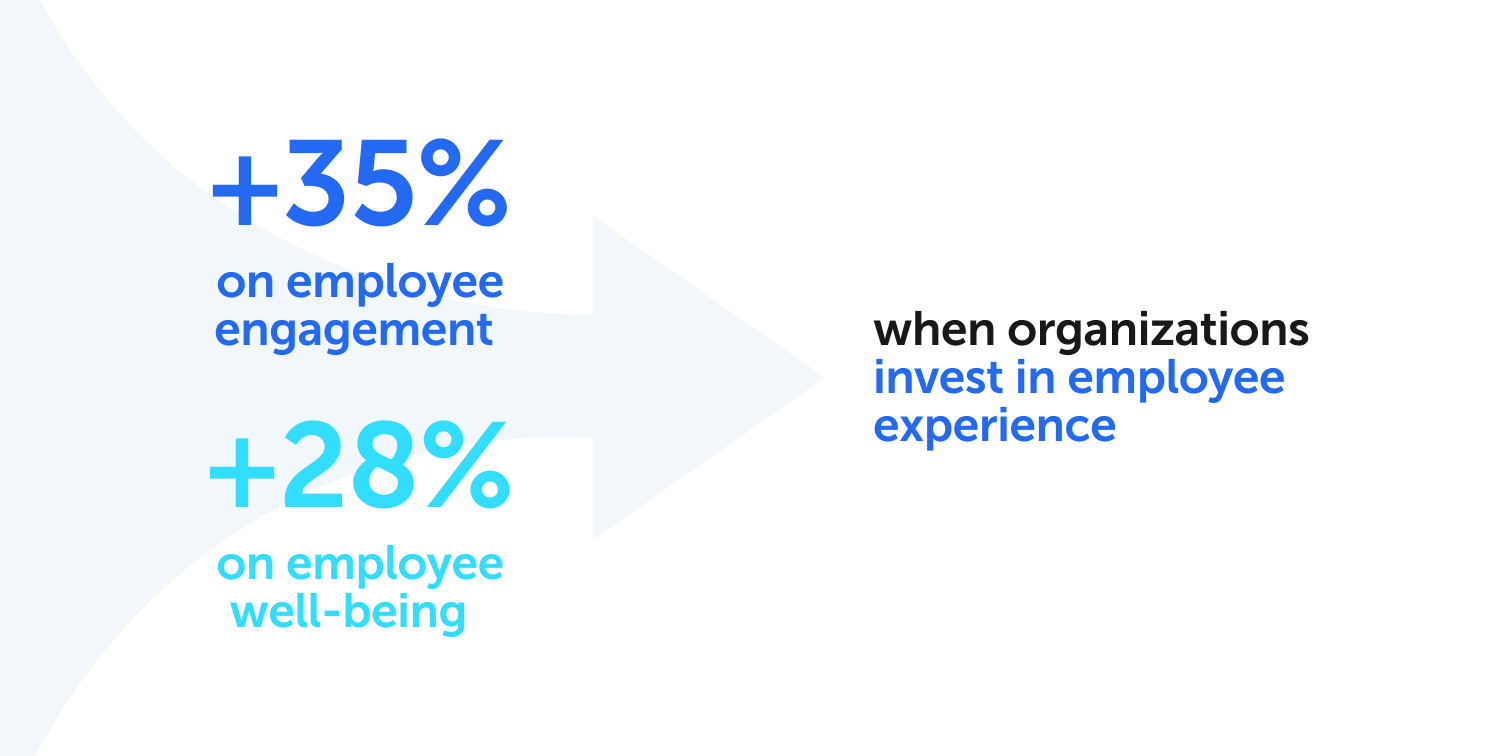
A modern learning experience is a critical part of the whole employee experience. Organizations that invest in employee experience are more likely to experience a net positive impact on employee engagement (+35%) and employee well-being (+28%).
In recent years learning platforms have evolved to enable “learning in the flow of work,” which delivers learning through existing tools when needed. Their ability to provide high-impact microlearning at the point of need makes learning accessible while working.
On-the-job training (OJT) is a practical approach to acquiring new competencies and skills needed for a job in a natural or close-to-real working environment. This brings cost savings over time, as employees are not taken away from their jobs to learn. Modern learning technologies enable experiential learning also from a distance.
Based on Brandon Hall Group’s research, 73% of high-performing organizations have allowed employees to experience potential roles through stretch assignments, job rotations, and team participation.
5. Create personalized learning paths, learning programs, and career paths
According to Brandon Hall Group research, personal and career growth are top drivers of employee engagement. Personalized learning programs are an excellent way to help employees shape their professional futures and create their career paths.
Personal and career growth are top drivers of employee engagement.
Even in the best-case scenario, training programs are often designed for general needs, so creating personalized learning paths is needed to provide a good learning experience.
Individual training needs and focus areas identified during mentoring and coaching sessions should be addressed by assigning learning sessions so all the activities complement each other. This way, learners receive the most appropriate support tailored to their needs.
Organizations focusing on these five areas are more likely to improve business performance, not just employee engagement. By combining modern learning technology with these activities, organizations can make learning scalable to build employee engagement and support their evolving business needs over time.
To learn more about ways to improve employee development, read this article.
Read more: How to measure employee engagement