Employee learning and development trends for 2026
Stay ahead of change with 2026’s top L&D trends. Discover how AI, data, and human-centred learning are redefining employee growth and workplace skills.

Learning and development is becoming more intentional.
Over the past few years, organizations have tested new ways to learn — from AI tools and hybrid programs to skills-based planning.
In 2026, those ideas are no longer pilots, they’re part of everyday strategy.
The focus now is connection.
How can people, platforms, and data work together to make learning more relevant, efficient, and human?
At Valamis, we see that the most successful organizations aren’t chasing the latest tools. They’re refining what already works and building ecosystems that make learning part of how the business runs.
Note: This blog is regularly updated to reflect the latest information and trends.
How L&D has evolved
We’ve been following Learning and development trends since 2023 and updating them each year to reflect what’s happening across our customers and the wider market.
Let’s look at early trends first and remember what we predicted then.
The key Learning and Development trends we highlighted in 2023.
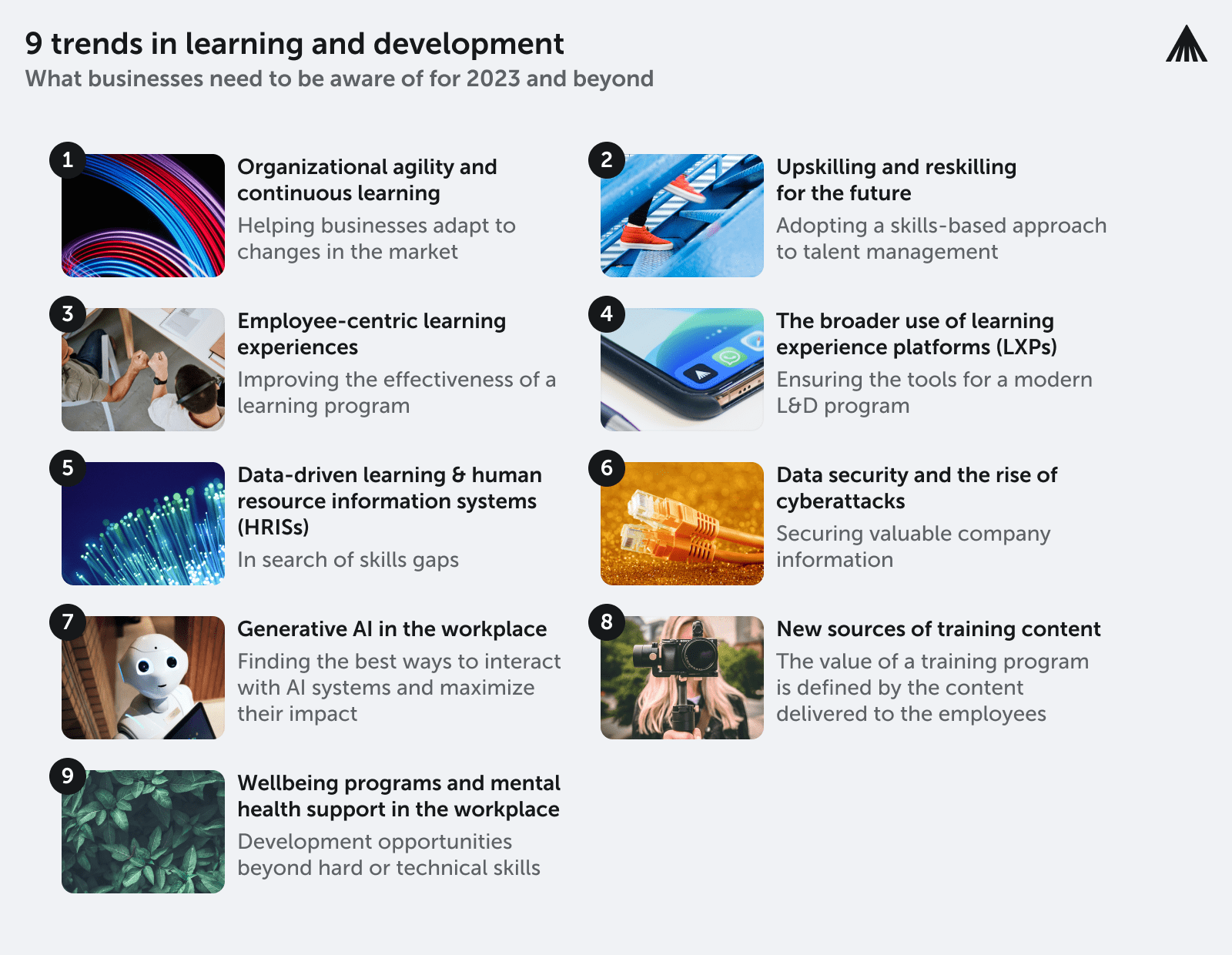
Looking back at the 2024 L&D predictions.
Here’s the 2024 video where our management discussed the next wave of L&D trends — a good reminder of how quickly things move.
From 2023 to 2026 trends
The picture has shifted significantly.
The table below shows how those earlier ideas have changed by 2026: what stayed, what merged, and what grew into something new.
It’s a quick snapshot of how learning has shifted from programs to ecosystems, from training to intelligence, and from short-term fixes to long-term growth.
| 2023–2025 Trend | 2026 Direction | Valamis comment |
|---|---|---|
| Organizational agility and continuous learning | Continuous learning as a cultural advantage | Agility has become a mindset embedded into everyday learning. Companies that learn and adapt quickly stay ahead. |
| Upskilling and reskilling for the future | Skills intelligence ecosystems | Upskilling has evolved into dynamic skills intelligence using data and AI to see, measure, and build skills in real time. |
| Employee-centric learning experiences | AI-driven personalization | Learning experiences are now shaped by data and algorithmic insights. Everyone gets a path that fits their goals, pace, and role. |
| Learning Experience Platforms (LXPs) | Integrated learning ecosystems | The LMS vs. LXP debate is over. The future is about connected systems that unite learning, performance, and analytics. |
| Data-driven learning & HRIS integration | Learning impact analytics and skills intelligence | Data now drives smarter decisions, helping L&D leaders prove impact and plan strategically. |
| Data security and cyber awareness | Trust, ethics, and data transparency in AI | As AI embeds into learning systems, openness and ethical design are essential to building trust. |
| Generative AI in the workplace | AI copilots and generative design | Generative AI now supports daily work helping teams create, curate, and personalize content faster. |
| New sources of training content | Creator learning culture ane contextual microlearning | Learning content is shorter, fresher, and often user- or AI-generated. Knowledge becomes more democratized. |
| Wellbeing and mental health programs | Sustainable learning culture | Wellbeing and development are merging. Sustainable learning supports growth without overload. |
| Hybrid work & continuous learning | Learning in the flow of work | Hybrid work is standard. Learning happens within the tools and tasks people already use. |
| Gamification for engagement | Reframed as design principle | Gamification is no longer a trend — it’s a design layer to maintain engagement and feedback momentum. |
What this tells us
L&D has matured quickly.
We’ve moved from testing new technologies to making them work together, from tracking participation to measuring performance, and from building skills reactively to anticipating what’s next.
The next step is clear: learning needs to be connected, data-informed, and sustainable.
Top Learning and Development (L&D) trends for 2026

AI-driven personalization becomes the norm
AI tools are now quietly shaping how people learn.
Instead of delivering one-size-fits-all content, learning platforms use AI to suggest the right material at the right time, based on each person’s skills, goals, and recent activity.
Fosway’s 2025 9-Grid report notes that “AI, skills, and personalisation are now deeply embedded in the roadmaps for learning systems.”
That said, Fosway also warns that most AI capabilities vendors promise are still on the roadmap — only about 10–11% are live with customers.
For L&D teams, AI also makes design work faster summarizing content, translating materials, or adjusting tone for different audiences.
Used thoughtfully, these tools free up time to focus on what still needs a human touch: understanding context, coaching, and culture.
Explore how Ask AI Insights transforms Valamis reporting and how AI is simplifying multilingual learning for your global teams.
Tips:
- Start small — use AI for content recommendations before full automation.
- Keep a human in the loop to check quality and tone.
- Communicate clearly how AI makes learning suggestions to build trust.
Good additional reading: Annual report on AI in L&D by Donald H. Taylor and Egle Vinauskaite.
Compliance is where automation pays off fastest. See which compliance training software is leading on AI-powered workflows and auto-reminders.
Skills intelligence ecosystems take center stage
Skills-based learning is no longer just a trend, it’s becoming infrastructure.
Organizations are bringing together data from HR, learning, and performance systems to create a single view of workforce capabilities.
This skills intelligence allows L&D teams to identify emerging gaps, prioritize investment, and align development directly with business goals.
The shift isn’t about collecting more data. It’s about using what we already have to make better workforce decisions.
Fosway’s Digital Learning 9-Grid mentions that AI skills strategy and implementation are growing skill “seams” demanding focus.
Also, McKinsey emphasizes that generative AI pressures businesses to build truly data-centric models and architectures.
Tips:
- Begin with a clear skills taxonomy before integrating tools.
- Regularly update your skills data — it becomes outdated fast.
- Use analytics to link skills growth with business outcomes.
Further reading: How to connect your learning data to your business success

How to conduct a skills gap analysis and what to do next
Start building your foundation for strategic workforce development.
Download guideLearning in the flow of work
Employees expect learning to be as easy to access as the apps they use every day.
McKinsey’s work on reimagined L&D mentions they deployed an AI-enabled evaluation tool to streamline repetitive tasks — raising the bar for how learning tools can plug into processes.
In 2026, learning fits naturally into the flow of work: short videos, tooltips, or quick refreshers that appear exactly when needed.
It’s not about making courses shorter. It’s about making learning relevant and timely.
When training feels like part of the job, engagement and retention both improve.
Tips:
- Identify where employees spend most of their workday and embed learning there.
- Design short, searchable resources for instant access.
- Gather feedback on when and where learning is most helpful.
Explore how the built-in authoring tool in Valamis Studio simplifies content creation, translation and publishing all in one place.
Capability academies replace traditional programs
More organizations are setting up capability academies, structured hubs that focus on the skills and behaviors that drive the business forward.
They combine learning, mentoring, and project work in a way that connects development directly to outcomes.
These academies are flexible, often cross-functional, and driven by internal experts.
They represent a more strategic, measurable approach to capability building — less theory, more application.
Tips:
- Choose a few core capabilities that align with business goals.
- Combine structured learning with real-world application.
- Celebrate internal experts who share knowledge, it builds credibility.
Sustainable learning: balancing growth and wellbeing
The push for continuous learning has brought real progress, but also pressure.
Employees are dealing with information overload, multiple tools, and constant change.
Fosway’s Digital Learning Realities report found 48% of learning professionals say AI will influence their work “a lot” or more — showing high expectations but also pressure.
The most forward-thinking organizations are now focusing on sustainable learning helping people grow without burning out.
That means shorter learning bursts, realistic expectations, and recognition for steady progress.
A healthy learning culture values curiosity as much as completion rates.
Tips:
- Offer flexible pacing and allow pauses between modules.
- Recognize learning effort, not just completions.
- Integrate wellbeing topics like focus, resilience, and mindfulness into your programs.
Trust, ethics, and transparency in AI learning
As AI becomes embedded in learning systems, trust becomes essential.
People want to understand how recommendations are made and what happens to their data.
In 2026, transparency isn’t just compliance — it’s part of good design.
An academic survey on Responsible AI (RAI) highlights a global maturity model and warns many organizations have gaps in governance, privacy, bias mitigation, and oversight.
McKinsey and others also point to trust and safety as critical barriers in AI adoption — employees worry about inaccuracy and data usage.
Explaining how algorithms work and being open about data use helps build confidence and keeps learning fair and inclusive.
Check our commitment to data security.
Tips:
- Be upfront about how AI works in your learning systems.
- Use explainable AI models wherever possible.
- Establish internal guidelines for ethical data use in L&D.
The rise of the learning ecosystem
The question is no longer “LMS or LXP?” but “How well do they work together?”
The best organizations are building connected learning ecosystems that link content, analytics, performance data, and AI recommendations.
This approach makes learning easier to find, measure, and improve — and helps tie development directly to business impact.
The goal isn’t more technology; it’s smarter, more connected technology.
Fosway’s 9-Grid shows that many vendors now include AI and personalization in their roadmap, not as optional add-ons.
Valamis itself is cited in the 2025 9-Grid as an “accelerating Core Challenger” due to our integrated approach combining AI, skills, and experience.
Further reading: Complete learning solution: 8 benefits of having an all-in-one platform
Tips:
- Audit your tools — keep what adds value, retire what doesn’t.
- Focus on integration, not quantity.
- Create a single access point for learners to reduce friction.
Continuous learning as a competitive edge
Continuous learning has become a marker of strong organizational culture.
Companies that make learning part of daily life through open feedback, shared knowledge, and curiosity adapt faster to change.
It’s less about scheduling training and more about supporting the habit of learning.
That shift turns development from an HR initiative into a business advantage.
Tips:
- Encourage peer-to-peer learning and open sharing.
- Measure learning engagement alongside performance metrics.
- Build learning into daily rituals — short check-ins, reflections, or demos.
Further reading: How to build a learning culture in 10 steps
Final thoughts
L&D in 2026 will be less experimental and more strategic.
Valamis co-founder Mika Kuikka works through what that shift looks like in practice, from productivity as L&D’s real measure to how to evaluate a platform, in Where L&D is headed.
AI, data, and skills intelligence are becoming the foundation of how learning happens, but people remain the real drivers of progress.
At Valamis, we believe the most successful organizations will combine technology with trust, data with context, and learning with wellbeing.
Because meaningful learning isn’t just about gaining knowledge — it’s about building capability, confidence, and connection.