5 ways L&D teams can build talent velocity
Only 14% of organizations lead on talent velocity. See five ways L&D teams can close the gap through skills, learning and mobility.


LinkedIn’s recent Talent Velocity Report puts a number on something many L&D teams will already recognize: skills are changing faster than most organizations can keep track of. Just 14% of companies have built the systems and culture needed to keep pace. This article looks beyond the headline figure to what talent velocity means in practice for L&D, from making skills data more useful to helping managers become better career development partners.
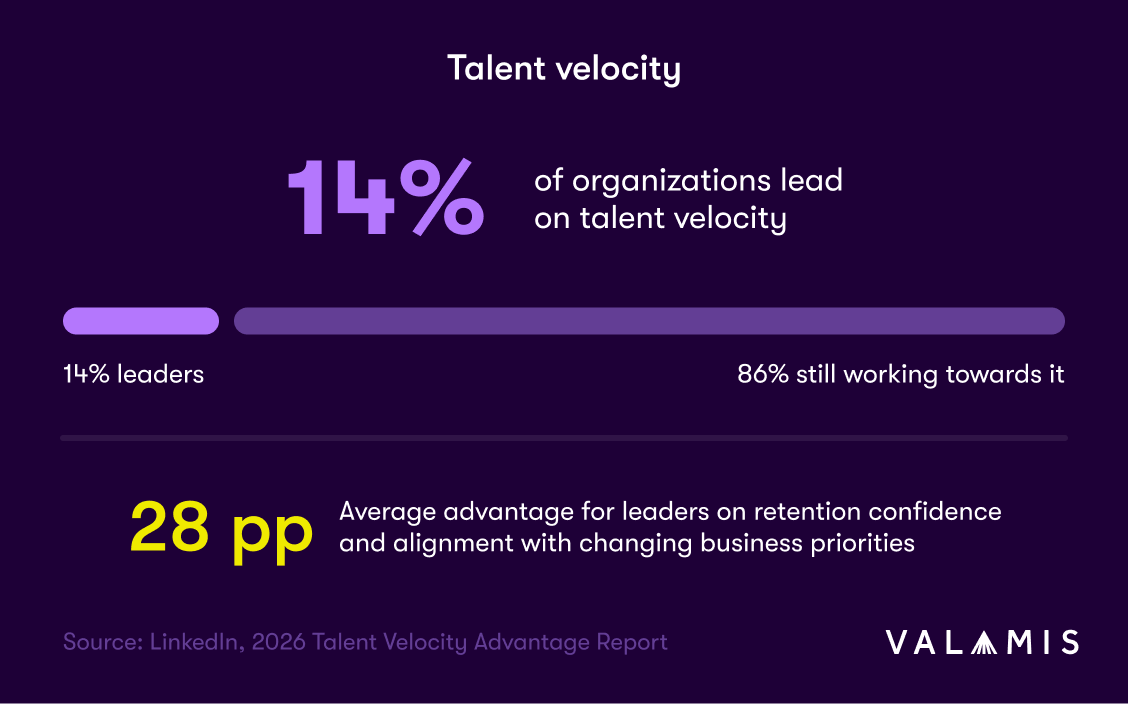
LinkedIn’s 2026 Talent Report has already attracted plenty of attention. One figure in particular stands out: only 14% of organizations have what LinkedIn describes as talent velocity, while the remaining 86% are still working toward it.
The real question for L&D teams is what separates those organizations from everyone else, and perhaps more importantly, what can realistically be done about it.
LinkedIn’s report covers five accelerators at a high level. This article looks at what talent velocity means day to day for the people responsible for skills, learning and career development. Improving talent velocity can sound like a company-wide change program, but L&D teams can take practical steps without waiting for every part of the organization to move at once.
What is talent velocity?
LinkedIn defines talent velocity as an organization’s ability to understand the skills it has, build or acquire the capabilities it needs, and move people to where those capabilities can have the greatest impact, at something close to real time.
In practice, that brings together three areas that are already familiar to most L&D teams: visibility into skills, learning that develops the right capabilities, and opportunities for people to apply those capabilities through career and internal mobility.
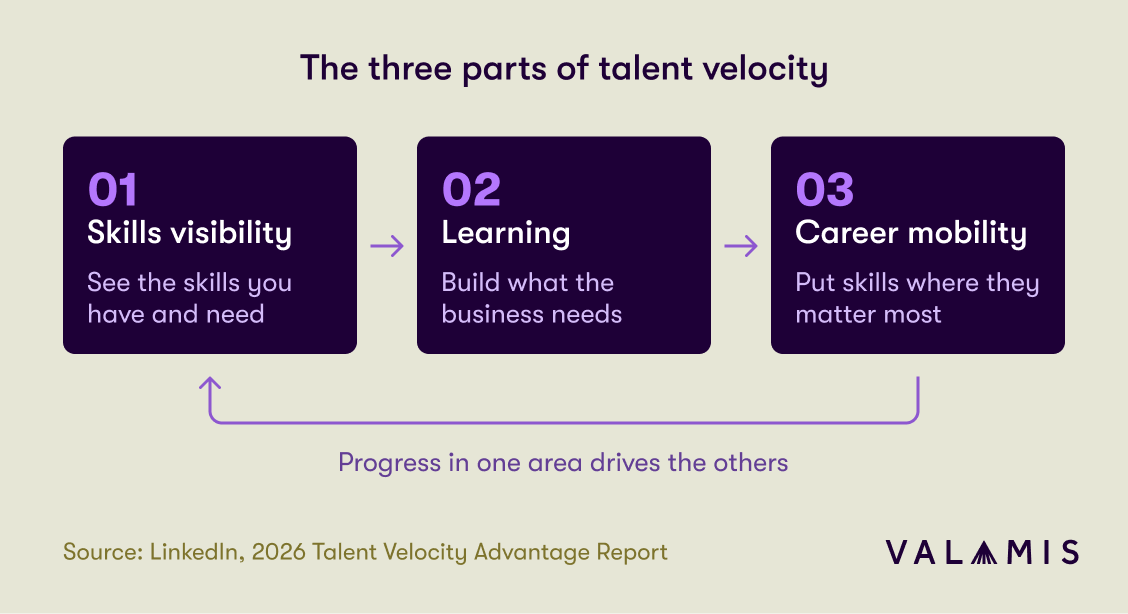
The organizations moving fastest are mostly doing familiar things. What sets them apart is that skills, learning and mobility work together consistently and at scale, even when they sit in different systems or parts of the business.
LinkedIn compares talent velocity leaders with what it calls “laggards,” the organizations at levels 1 to 3 on its Talent Velocity Curve. Leaders show a 28 percentage point average advantage on measures including confidence in talent retention and alignment with changing business priorities.
The advantage is unlikely to come from any one program in isolation. Instead, skills data, learning and development and career mobility reinforce one another, so progress in one area can lead to progress elsewhere.
The job for L&D is to make sure learning draws on useful skills data and leads somewhere, such as a new project or role where employees can put what they’ve learned into practice.
Five ways to build talent velocity
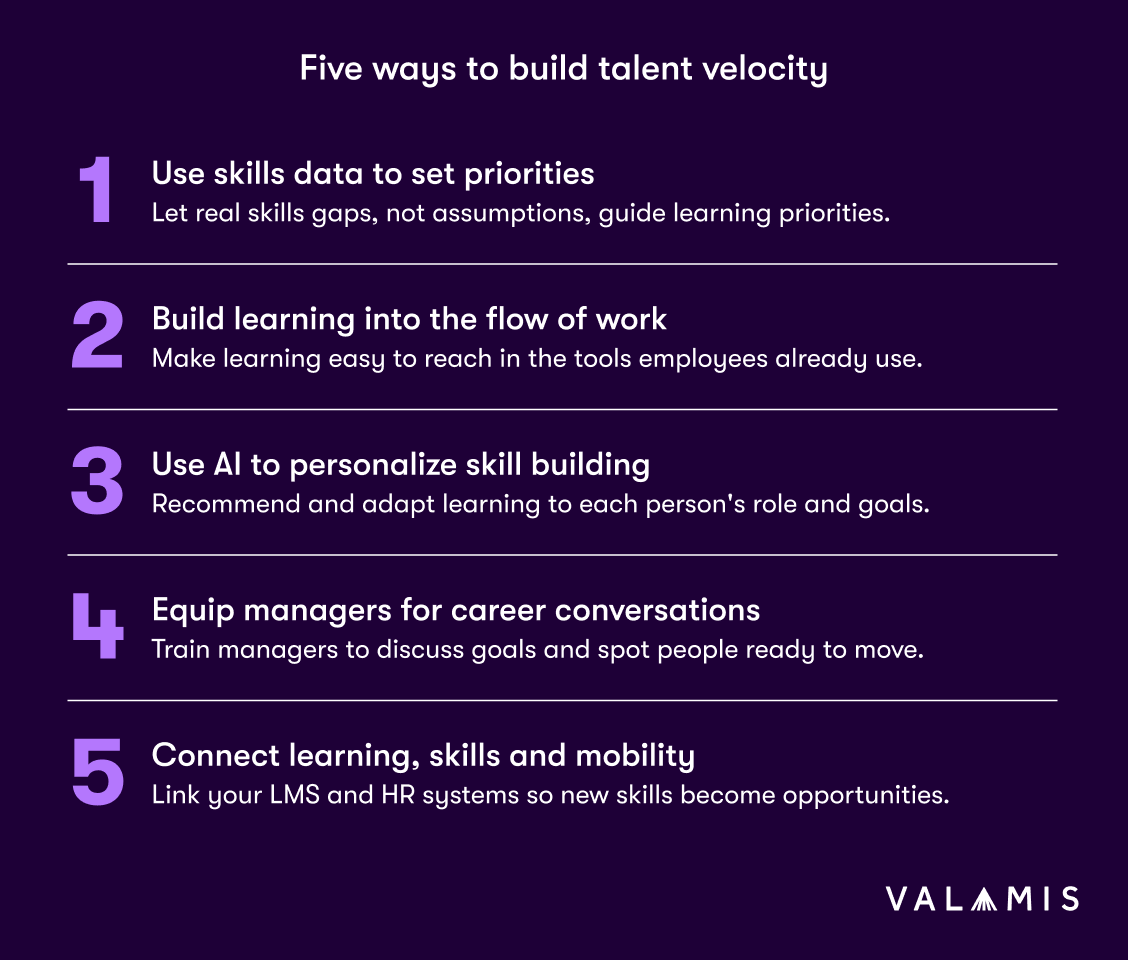
Use skills data to decide where capability needs to be built
Skills data usually exists somewhere already, whether in an LMS, an HR system or a spreadsheet kept by individual teams. The harder part is connecting it to the decisions L&D, HR and business leaders need to make.
LinkedIn’s report found that talent velocity leaders are much more likely to use shared workforce data and talent architecture to see the skills available across the organization. Talent architecture means the structured mapping of roles, skills and career paths, and 43% among talent velocity leaders are already investing in it, compared with 23% of ‘laggards’.
Skills visibility tells L&D where the gaps are, which makes it easier to set learning priorities. A skills matrix, for example, can show which skills are already strong, where proficiency is uneven and where important capabilities are missing.
That lets L&D base training priorities on real skills gaps. It also helps HR teams and business leaders see where existing talent could be moved and where external hiring may be needed.
Build learning into the flow of work
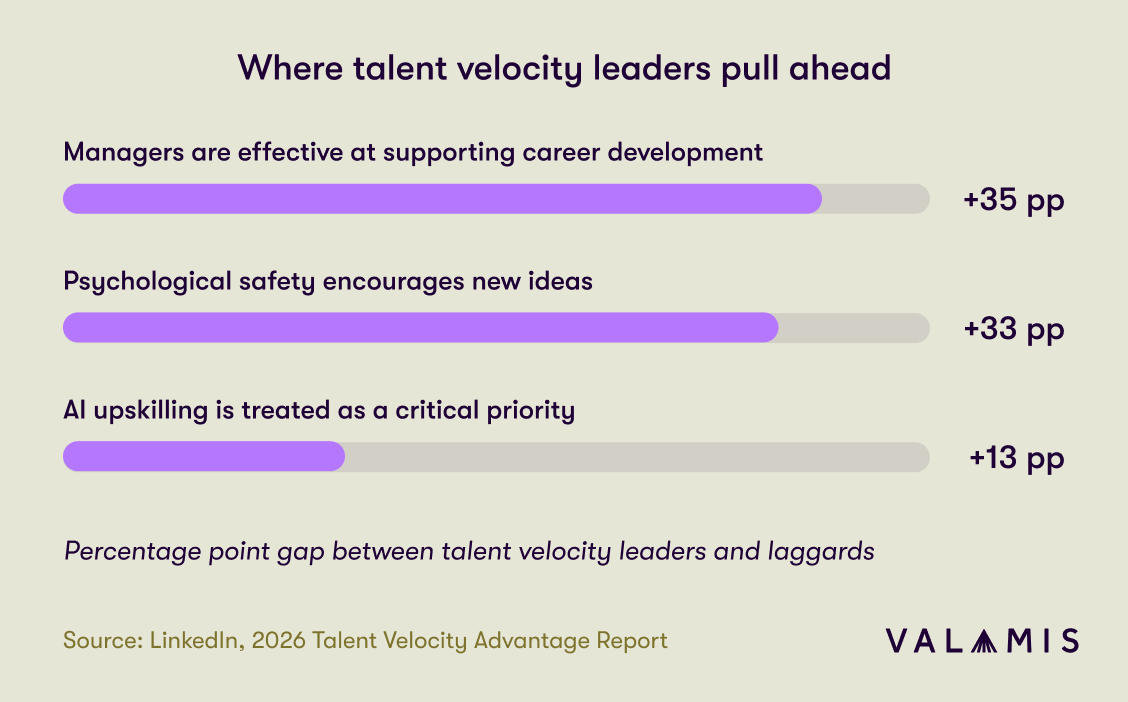
LinkedIn identifies psychological safety as a major differentiator between talent velocity leaders and laggards, with a 33 percentage point gap on the statement that psychological safety encourages new ideas within the organization.
Although psychological safety is primarily a cultural measure, it also affects learning and development. Employees need to feel comfortable asking questions, trying new approaches and acknowledging gaps in their knowledge. When an employee recognizes a skills or performance gap, relevant learning needs to be easy to find and access while the need is still immediate.
That is where comes in. It brings development closer to the moment it is needed, rather than limiting learning to scheduled training. Sometimes that might mean quickly accessing guidance or learning that helps with an immediate task. At other times, developing a new skill will require a more structured course or learning path.
Learning in the flow of work brings development closer to the moment it is needed, alongside scheduled training. Sometimes that means quick guidance that helps with an immediate task. At other times, developing a new skill will require a more structured course or learning path.
Technology can make both easier to deliver. An LMS gives employees a central place to access relevant learning, while integrations with tools such as Microsoft Teams or Slack can bring learning closer to the environments where employees already spend their time.
For L&D teams, the aim is not to replace formal training, but to make the right type of learning easier to access at the right time, whether an employee needs help with something they are doing now or needs to develop a capability they will use in the future.
Use AI to personalize skill building
AI tools are already common at work. Far fewer have connected their AI adoption to a broader strategy for skills and career development.
LinkedIn’s data shows a 13 percentage point gap between velocity leaders and laggards when it comes to treating AI upskilling as a critical priority.
Access on its own is unlikely to be enough. Adoption tends to stick when it comes with training and time to practice, tied to how AI supports each person’s role.
That makes AI literacy a capability L&D needs to build deliberately, since it won’t emerge on its own as new tools arrive. Structured training is still rare. A 2026 UK government survey found that just 11% of employers had staff undertake AI training in the previous 12 months.
AI can also be used to make learning more relevant. L&D teams can use it to recommend learning based on an employee’s role, skills, goals and development needs.
Agentic AI takes that a step further. Beyond recommending what someone could learn next, AI systems can increasingly adapt learning paths and guide development as an employee progresses and skills needs change.
Used in that way, AI can support the broader talent velocity goal of making skill development more personalized and responsive to what both the individual and the organization need next.
Equip managers to have meaningful career conversations
Managers have an important role in talent velocity because they are often closest to both the skills their teams need and the career ambitions of the people within them.
LinkedIn found a 35 percentage point gap between leaders and laggards on the statement that managers are effective at supporting career development.
Managers often lack the support to take that on. In a late-2023 survey of US employees by INTOO and Workplace Intelligence, 46% said their manager does not know how to help them with their career development. Nearly half of Gen Z respondents said they get better career advice from AI tools such as ChatGPT than from their manager.
The takeaway is about managers. When employees don’t get career guidance from the people responsible for their growth, they look for it elsewhere.
This gives L&D a clear opportunity. Managers can be trained to structure career conversations, ask better questions about employees’ goals and spot when someone may be ready for a new project or role.
Better career conversations can also give organizations a clearer view of future talent. When managers understand employees’ aspirations, strengths and development needs, they are better placed to identify potential successors for critical roles and help build the skills those employees will need.
Those conversations also help with succession planning. When managers understand employees’ aspirations and strengths, they are better placed to identify potential successors for critical roles and help build the skills those employees will need.
Connect learning, skills and career mobility
LinkedIn describes the organizations at the top of its Talent Velocity Curve as making progress across all five accelerators. Their advantage comes from how the parts of the talent system work together.
Ideally, when an employee develops and verifies a new skill, it shows up in their skills profile, where managers and HR can match them to projects or internal roles.
Those connections are hard to build when learning platforms, HR systems and talent tools were introduced at different times for different purposes. Learning records and skills data end up in separate systems, and it becomes harder to see what the workforce can do.
That does not necessarily mean replacing the technology already in place. Integrating an LMS with systems such as SAP SuccessFactors can help connect learning data with the wider employee record, so development activity is not isolated from the systems HR and managers already use.
L&D then gets a reliable record of how skills are developing across the organization. Learning plans can start from existing skills data, and managers and HR can use the same information when weighing development and internal moves.
What L&D teams can do next
Talent velocity matters because skill requirements and business priorities keep changing. When workforce skills are visible and connected to learning and internal mobility, organizations can build capability sooner and close critical gaps before they become harder or more expensive to fix.
None of the five steps in this article requires L&D teams to reinvent their approach. Most are familiar priorities: understanding workforce skills, making learning easier to reach during everyday work, building AI capability, helping managers with career development and connecting the systems behind learning and talent decisions.
What matters is how well those areas work together. Skills data earns its keep once it shapes learning priorities, and learning earns its keep once employees can apply what they have learned or use it to progress.
Start by finding where the biggest gap is today. Skills data may not be shaping learning decisions. Employees may have good learning available but little guidance from managers on how it fits their development. Or new skills may be built without any way for HR and business leaders to see where they could be used.
Once you know where the disconnect is, you can focus on strengthening that part first and build from there.
See where your skills gaps are
Book a demo and we’ll show you how Valamis links skills data to learning, so you can see where the gaps are and what will close them.
Frequently asked questions
What is talent velocity?
Talent velocity is an organization’s ability to see the skills it has, build or hire the capabilities it needs, and move people to where those capabilities matter most, at close to real time. LinkedIn uses the term to describe how quickly a company can respond when skill requirements change.
How is talent velocity different from internal mobility?
Internal mobility is one part of it. Talent velocity also covers skills visibility and the learning that builds capability in the first place. Moving people around without knowing what skills they hold, or without a way to develop new ones, tends to stall quickly.
Where should an L&D team start?
Find the weakest connection first. That is usually one of three things: skills data that no one uses to set learning priorities, learning that employees cannot apply, or new skills that never become visible to the managers who could use them. Strengthen that link before adding anything new.
Do we need to replace our HR systems to improve talent velocity?
Usually not. Most organizations already hold the data across an LMS, an HR system, and a talent tool. Integrating what is in place is generally faster and less disruptive than replacing it, and it addresses the same problem, which is that the data sits apart.
How Valamis helps build talent velocity
Valamis connects skills management with personalized learning, giving L&D teams a clearer view of the skills employees have, where skills gaps exist and what development can help close them.
Skills data can be used to guide learning recommendations and development paths, while progress can be tracked against the capabilities the organization needs. This helps L&D focus learning investment where it can have the greatest impact.
Valamis also connects learning with the tools employees already use every day. Through integrations with the AI tools and assistants your organization already uses, employees can discover relevant learning, check their progress and access support within their existing workflow.
We are also building toward more agentic learning experiences, where AI can use skills, learning and contextual data to respond more proactively to development needs and guide employees toward the most relevant next steps.