Best LMS for Corporate Training in 2026: 13 platforms compared
Compare Valamis, Docebo, Cornerstone, and 10 more LMS platforms on compliance, analytics, and total cost of ownership to build your shortlist.

L&D teams never intentionally set out to have learning tools that don’t talk to each other and no clear answer for what happens if an auditor asks for training records. It happens gradually, as the organization grows faster than the systems supporting it.
Choosing a corporate training LMS is where that gets fixed, or where it gets worse. The wrong platform means paying for features nobody uses and a rollout that stalls because nobody adopts it. The right one becomes infrastructure your L&D team barely has to think about, freeing time for the training itself rather than the admin around it.
This guide compares 13 corporate training LMS platforms across the five things that decide whether an implementation succeeds: compliance readiness, system integration, analytics depth, content authoring, and total cost of ownership. Whichever platform fits, the goal is the same: a shortlist based on your organization’s actual requirements, not whichever homepage is easiest to find.
Why does corporate training need a dedicated LMS?
Spreadsheets, shared drives, and ad hoc training work when a company is small. They stop working once training has to be consistent across departments, locations, or regulators, and once someone has to prove it happened.
A dedicated LMS solves four problems that grow with company size:
- Consistency at scale: Every employee gets the same training, delivered the same way, regardless of location or manager. That matters for onboarding, for product knowledge, and especially for compliance, where inconsistent training is itself a risk.
- Time back for L&D and managers: Automated enrollment, reminders, and completion tracking remove the manual chasing that eats a training team’s week, so time goes toward designing better learning rather than administering it.
- Evidence, not assumptions: A spreadsheet tells you a course was assigned. An LMS with real analytics tells you whether people completed it, how they performed, and whether the training changed anything measurable, which (in reality) is what leadership and auditors both ask for.
- A foundation that scales with the business: The right platform handles a workforce of 500 the same way it handles one of 10,000, without a re-platforming project in between. That’s the difference between an LMS that’s a long-term investment and one that becomes next year’s replacement project.
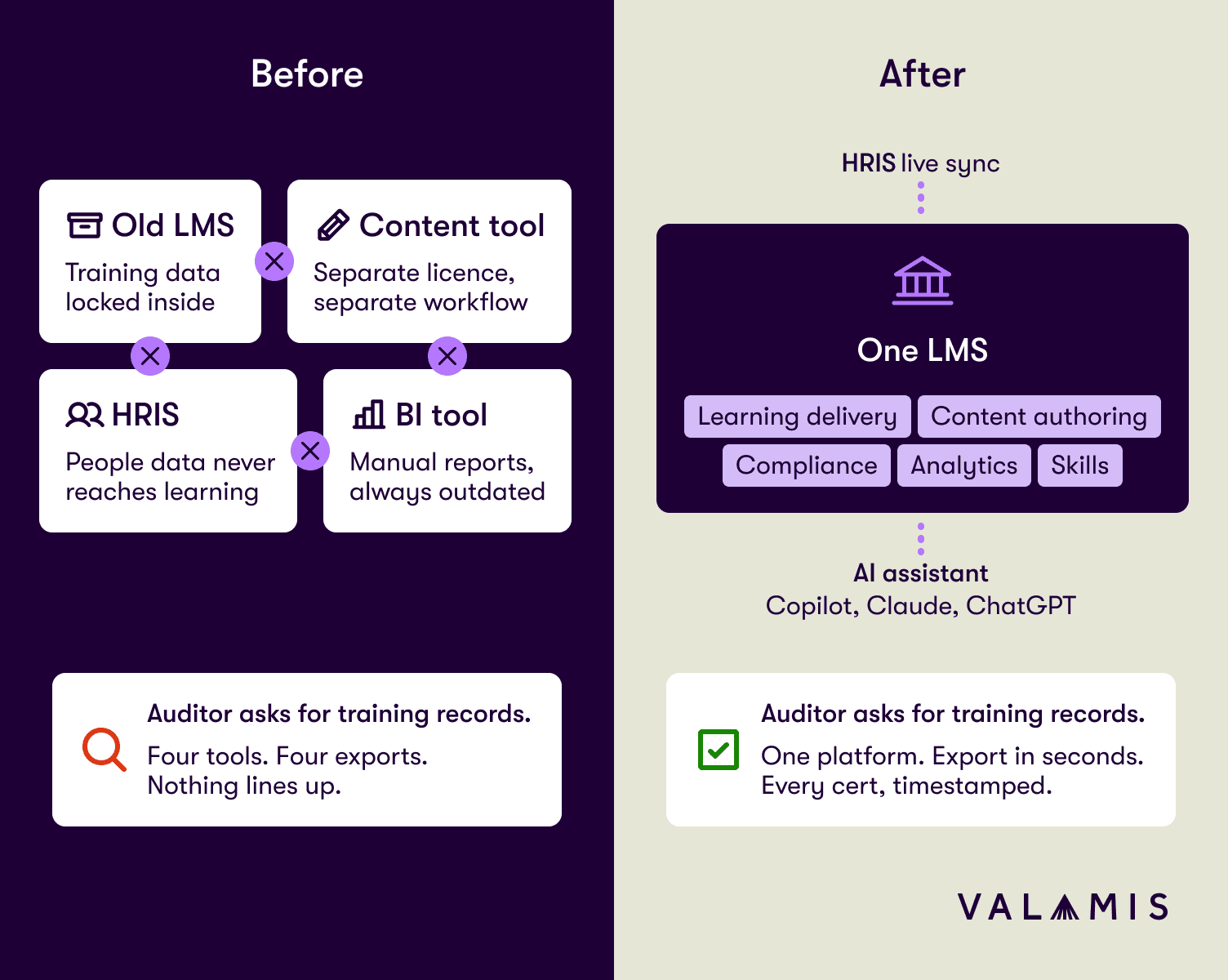
None of this requires the most feature-rich platform on the market. It requires the right one for your industry, your compliance load, and your existing systems, which is what the rest of this guide is built to help you find.
What should you look for in a corporate training LMS?
The right LMS depends on three things: how regulated your industry is, how much you want built into one platform versus stitched together from several tools, and how predictable you need your costs to be.
Look for these five areas before anything else:
Compliance and audit readiness.
Can the platform prove training happened, not just record that it was assigned? Look for automatic recertification, expiration alerts, and audit trails that hold up under inspection rather than endless completion reports.
Integration with your existing systems.
Your LMS needs to talk to your HRIS, and increasingly, to the AI tools your teams already love to use. A platform that only works inside its own interface creates a second silo instead of removing one.
Analytics that go beyond course completions.
Completion rates tell you who clicked through. xAPI-based tracking and a Learning Record Store tell you what people learnt, including activity outside the platform itself, with real-time progress tracking so managers and compliance teams see status as it happens rather than in a monthly export.
Content authoring, built in or bought separately.
Some platforms include a content authoring tool. Others expect you to license one from a third party. That choice affects both your budget and how many vendors your L&D team has to manage.
Total cost of ownership (not the sticker price).
Many platforms quote a base price and treat analytics, extended enterprise, or deeper integrations as paid add-ons. Ask what the total looks like once you have what you need.
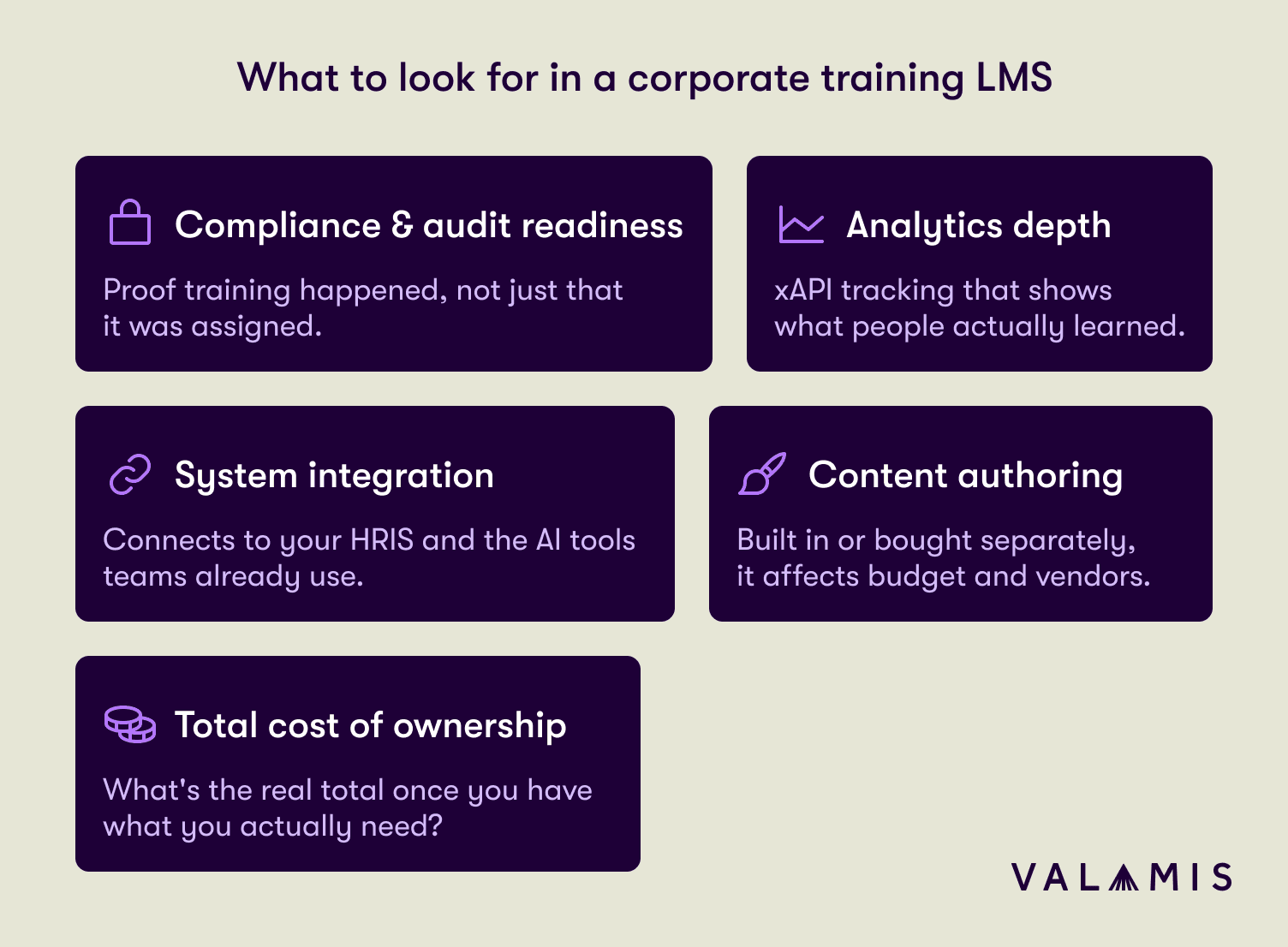
Use these five as your scorecard. The list below is organized around them and unranked in terms of order.
The 13 best LMS platforms for corporate training in 2026
1. Valamis
Best for: compliance-heavy enterprises in manufacturing, healthcare, and professional services that want built-in authoring and analytics depth in one platform.
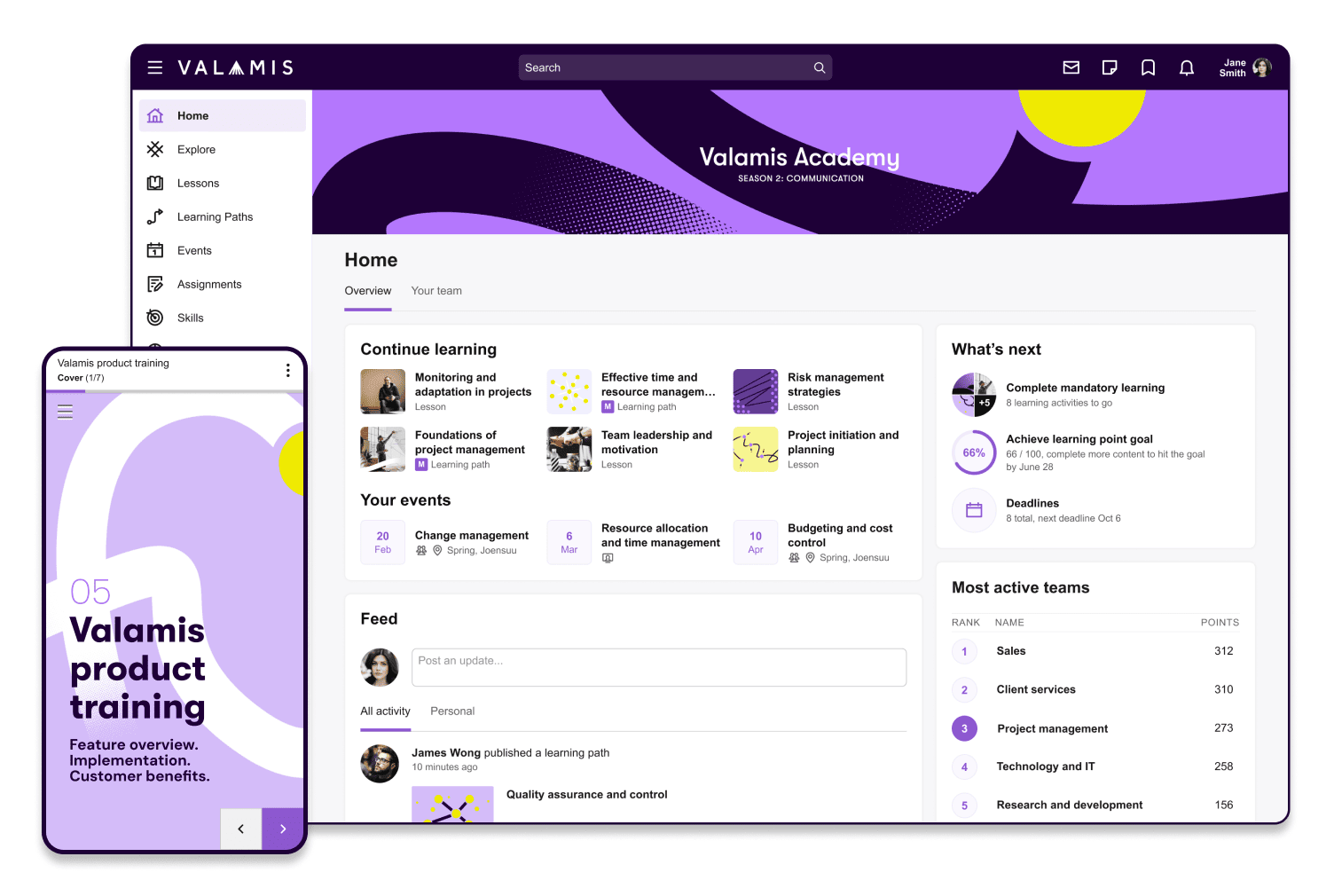
Valamis is an enterprise LMS built around three things: compliance training, skills management, and learning analytics. It includes Valamis Studio, a built-in content authoring tool, so teams can build lessons, quizzes, and assessments inside the platform rather than licensing separate authoring software.
Analytics run on xAPI with a native Learning Record Store, which tracks learning activity beyond course completions, including simulations and informal learning. Valamis is API-first, with a headless deployment option: through MCP (Model Context Protocol) connectivity, employees can check training status and find learning through Microsoft Copilot, or Claude, with published connectors for both, and through any other MCP-compatible assistant the organization configures. Read more about how Valamis approaches AI.
Pricing is quote-based, with implementation, the mobile app, and 24/7 support included in one annual subscription rather than priced as separate modules. Valamis is built for organizations where compliance and audit requirements shape the learning programme, from mid-market through to global enterprise. Deployments run from several hundred learners to programmes spanning tens of thousands across multiple countries and languages, serving customers across manufacturing, professional services, healthcare, and the public sector.
The trade-off: Valamis has a smaller market presence and content marketplace than the largest players on this list. Organizations prioritizing a large library of pre-built third-party courses may want to weigh that against the compliance and analytics depth.
2. Docebo
Best for: large global enterprises that prioritize learner experience, social learning, and a wide content marketplace.
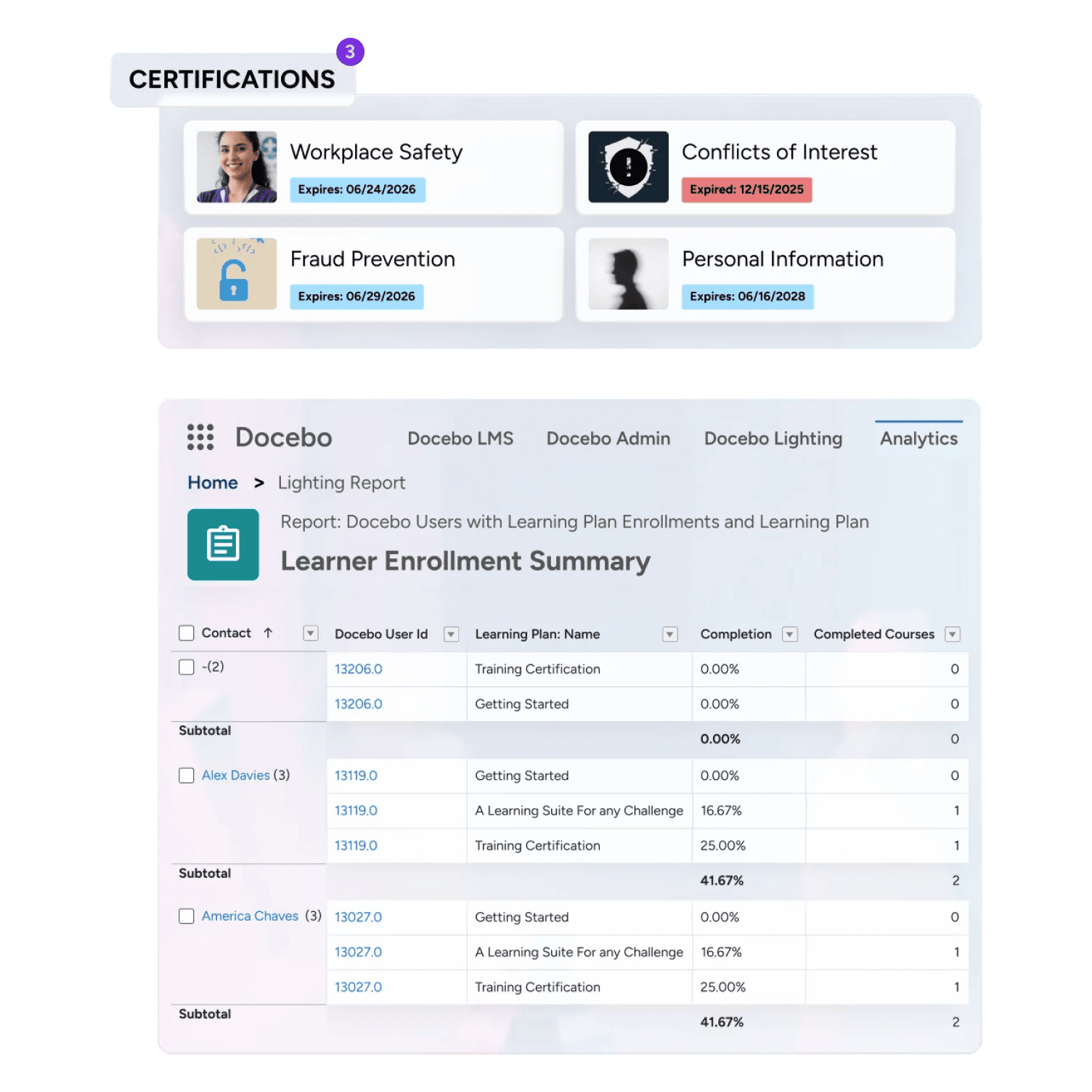
Docebo is a publicly traded LMS with strong market presence and a polished, modern learner interface. It handles extended enterprise training well, supporting employees, customers, and partners from one platform, and its content marketplace offers pre-built courses from multiple providers in one storefront.
Docebo has invested heavily in AI positioning, with features for content recommendations, auto-tagging, and enrollment automation. At its Inspire 2026 event in April, it launched AgentHub alongside an MCP Server that connects Docebo data to Claude, Microsoft Copilot, ChatGPT, and other MCP-compatible assistants, in public beta then and generally available from July 2026. It is worth asking any vendor, Docebo included, to show AI features working with real customer data rather than in a demo.
Pricing is modular and quote-based, with capabilities like advanced analytics and extended enterprise priced separately from the core tier.
The trade-off: reporting and analytics are functional but reviewers frequently flag them as a weak spot, with reports that are hard to customize and inflexible scheduling.
See our full Valamis vs Docebo comparison for a deeper look.
3. Cornerstone
Best for: large enterprises that want an LMS bundled inside a broader HR and talent management suite.
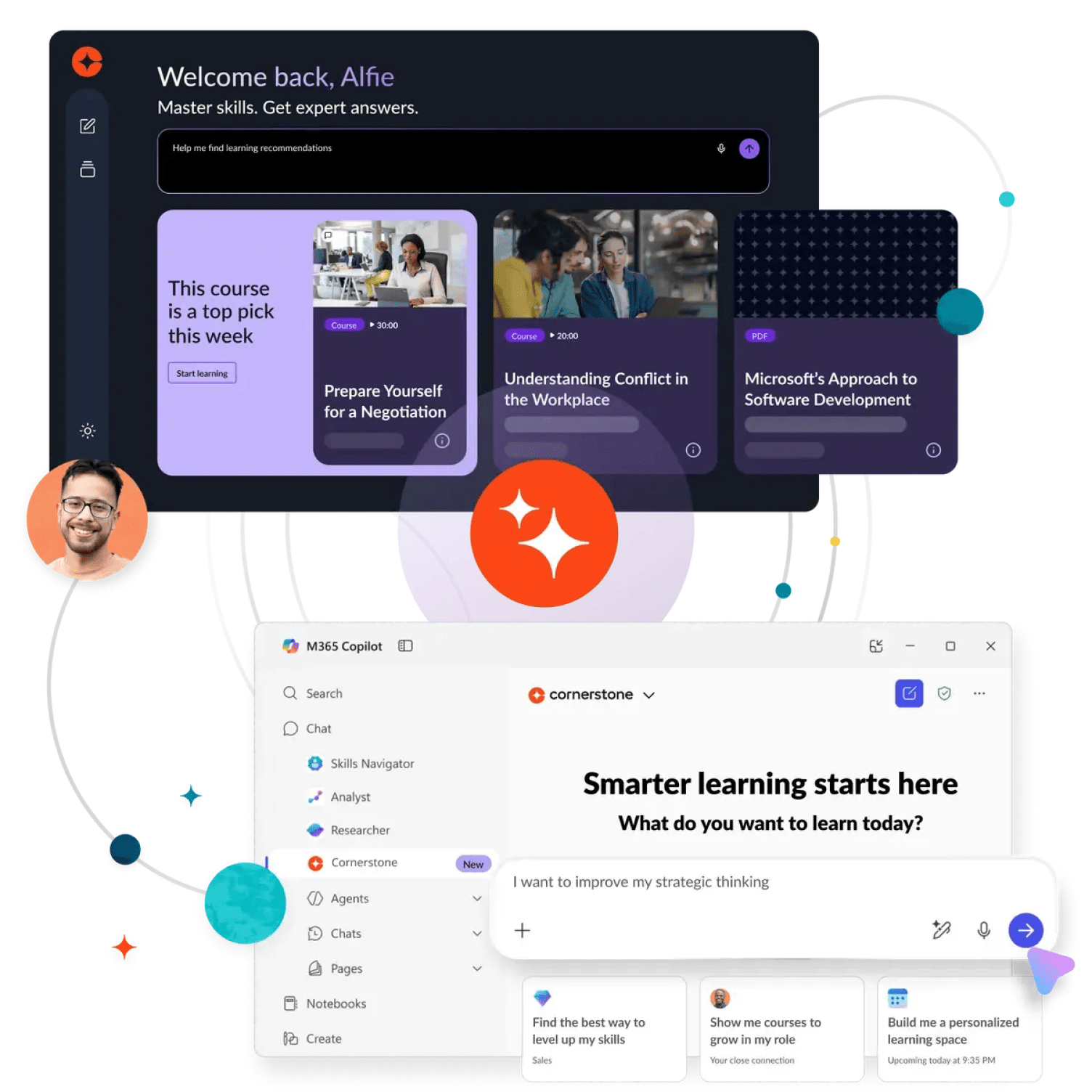
Cornerstone OnDemand combines learning with performance management, succession planning, and talent development in one system. For organizations that want L&D tightly integrated with the rest of HR rather than as a standalone tool, this is a real advantage.
The platform supports large-scale compliance training and has a long track record in regulated industries. It reached that scale partly through acquisition, including Saba, SumTotal and EdCast, and is now consolidating those product lines onto a newer platform, marketed as Cornerstone Galaxy and more recently Cornerstone Workforce AI. Cornerstone presents migration onto that platform as the path forward for Saba and SumTotal customers. If you are already a Cornerstone customer on one of those older platforms, a migration is coming either way, which makes this a natural moment to evaluate the wider market rather than default to the incumbent.
Pricing is quote-based and typically scoped around the modules an organization needs from the wider Cornerstone suite.
The trade-off: because Cornerstone is talent-suite-first, organizations that only need an LMS may find themselves paying for and navigating a larger system than their use case requires.
See our full Valamis vs Cornerstone comparison for a deeper look.
4. Absorb LMS
Best for: mid-market and enterprise organizations that want a clean, modern interface with less setup complexity than the largest suites.
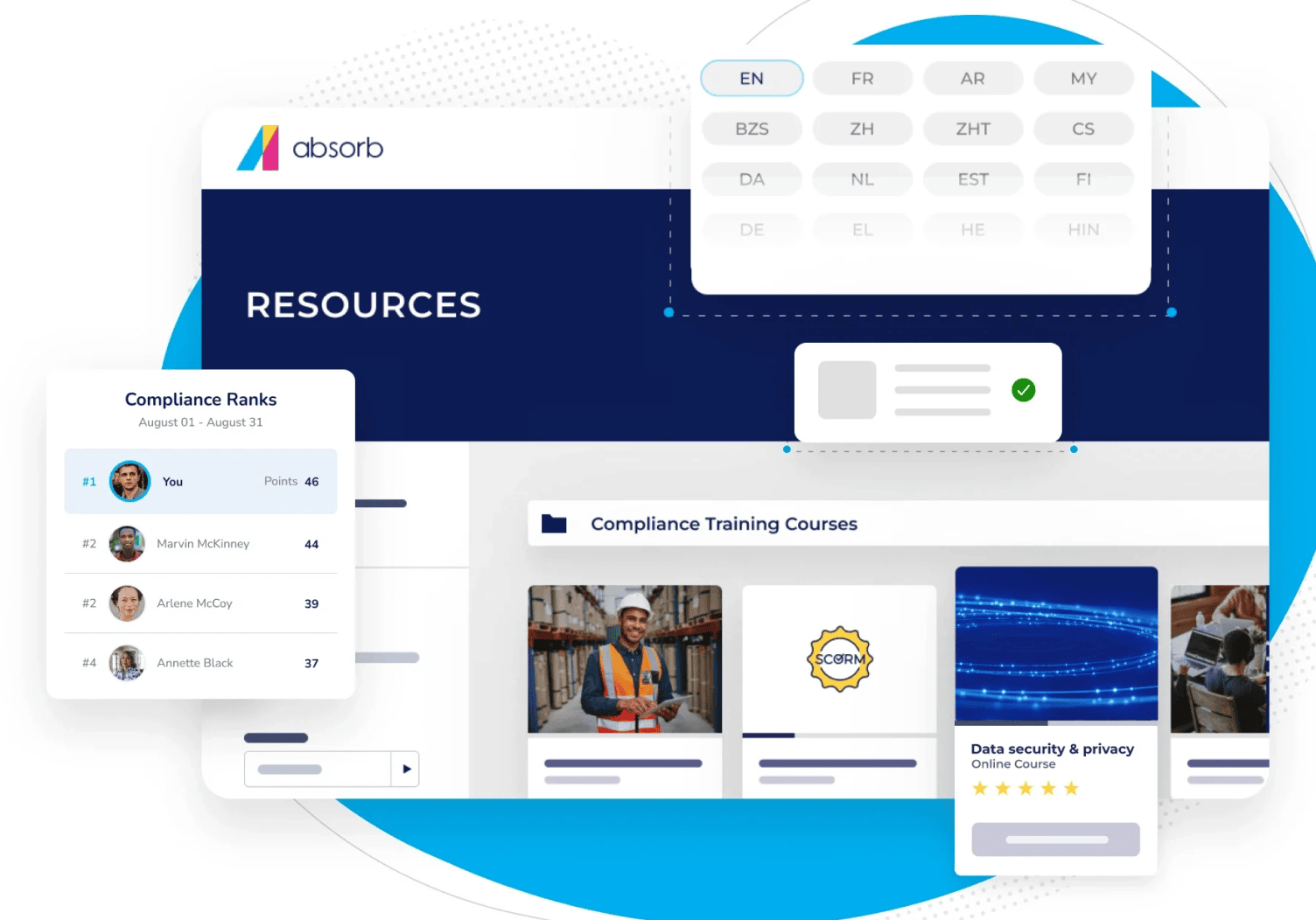
Absorb is known for ease of use and an admin-friendly experience, with solid support for compliance training and certifications. It has built out AI-assisted features for content creation and course recommendations in recent releases.
The trade-off: Absorb’s content authoring is generally considered lighter than platforms with a dedicated built-in tool, so many customers pair it with a separate authoring solution.
5. 360Learning
Best for: organizations that want to build a culture of peer-created, collaborative learning rather than centrally authored courses alone.
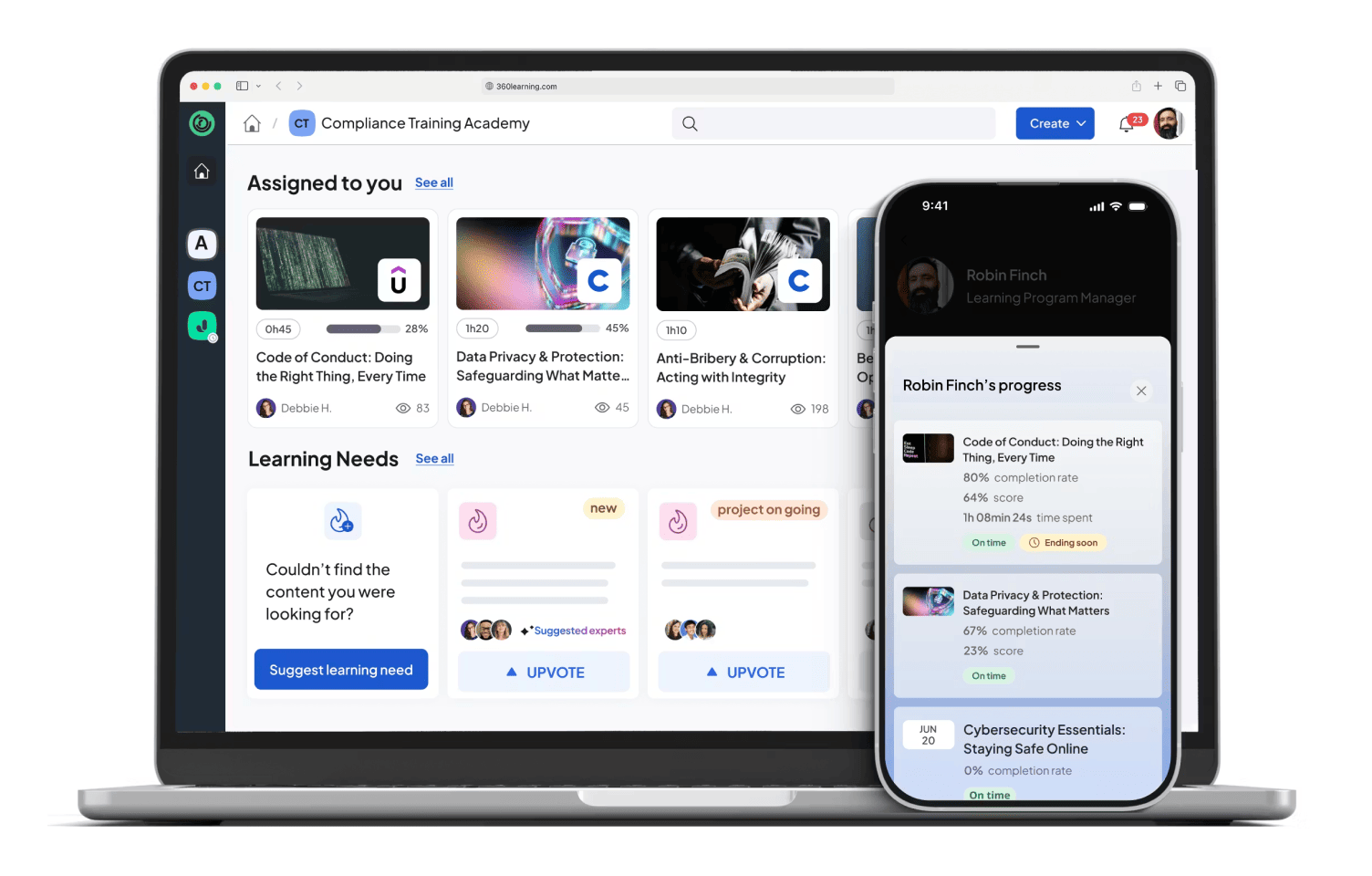
360Learning’s core differentiator is collaborative course creation: subject matter experts across the business can build and refine content together, which suits companies that want training to come from internal experts rather than L&D alone.
The trade-off: that peer-driven model works best when an organization already has engaged internal experts willing to create content; it is less suited to organizations wanting a fully vendor- or L&D-authored program.
6. LearnUpon
Best for: organizations training multiple distinct audiences (employees, customers, partners) who want separate, brandable portals for each.
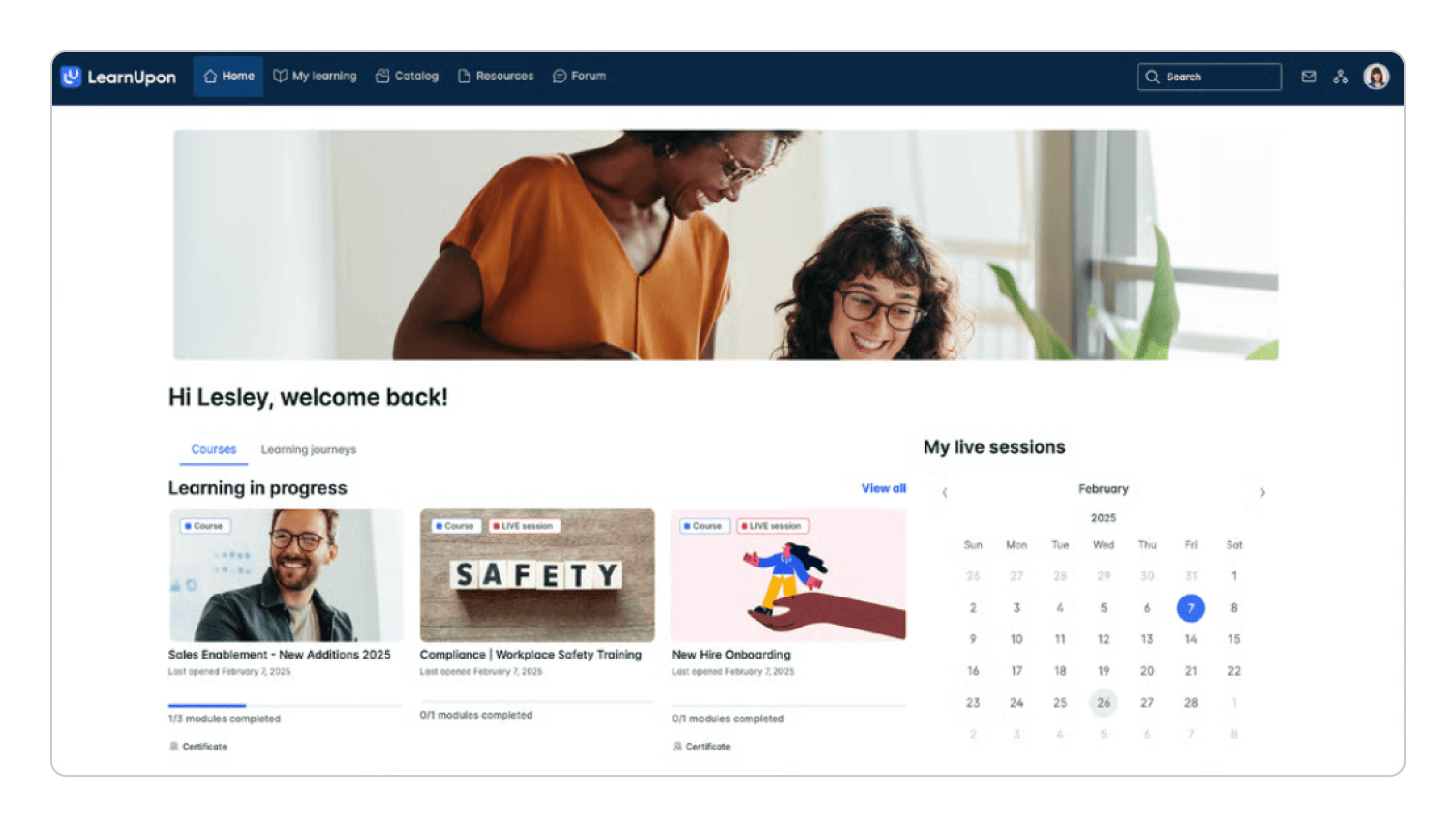
LearnUpon is popular for extended enterprise and customer training use cases, with multi-tenancy and multi-portal management as a core strength, letting you run separate branded training environments for employees, customers, and partners from one back end, and a reputation for responsive support.
The trade-off: its analytics and reporting are generally seen as functional rather than deep, which matters if audit-ready, granular compliance reporting is the priority.
7. TalentLMS
Best for: small to mid-sized businesses that want a fast, low-complexity setup without a long implementation project.
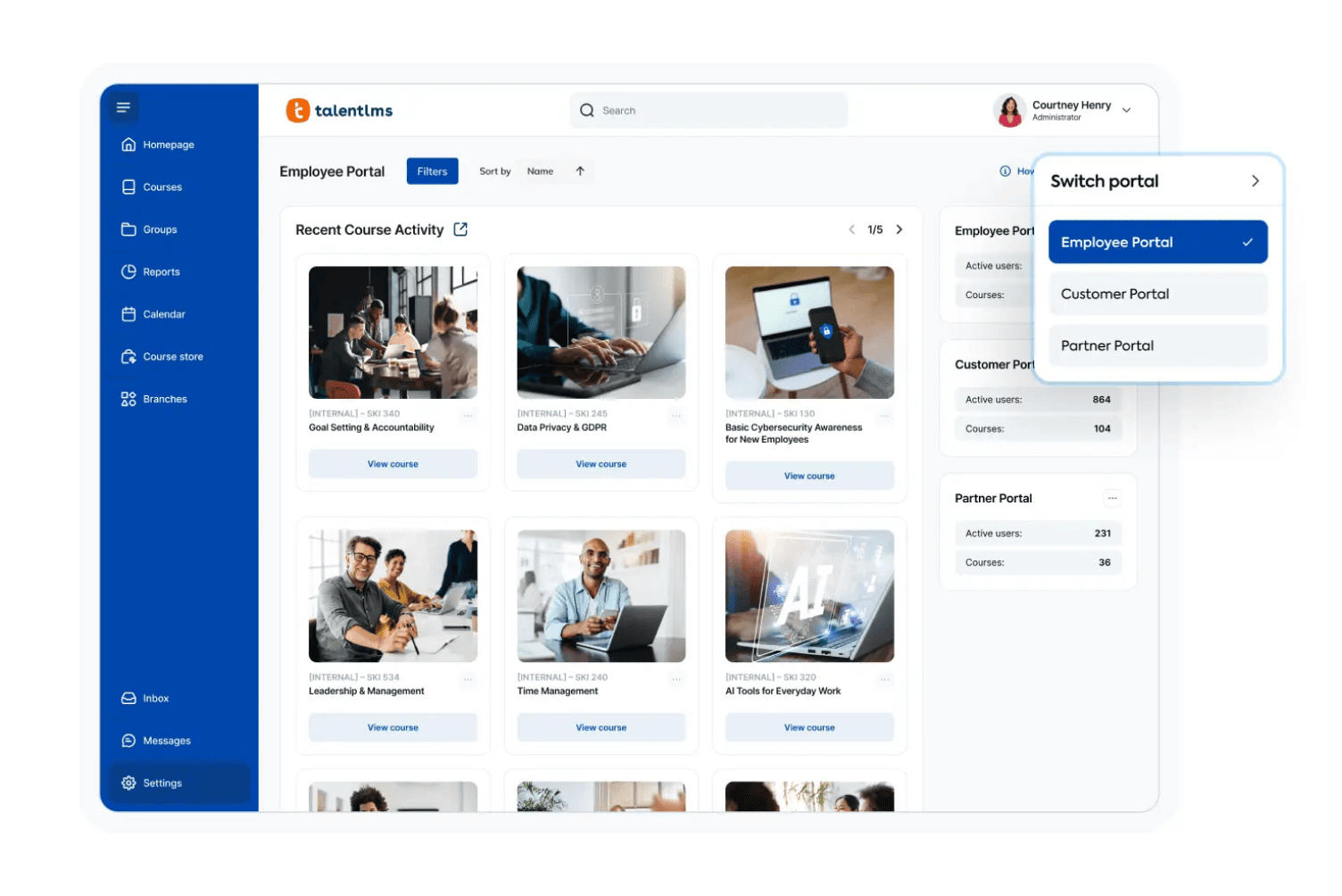
TalentLMS is built for simplicity and quick time-to-value, with simple course creation and a lighter feature set than enterprise-focused platforms.
The trade-off: that same simplicity can be a limitation for large, complex organizations with heavy compliance or multi-department reporting needs.
8. iSpring Learn
Best for: organizations already using iSpring’s authoring tools (built on PowerPoint) that want an LMS from the same vendor.
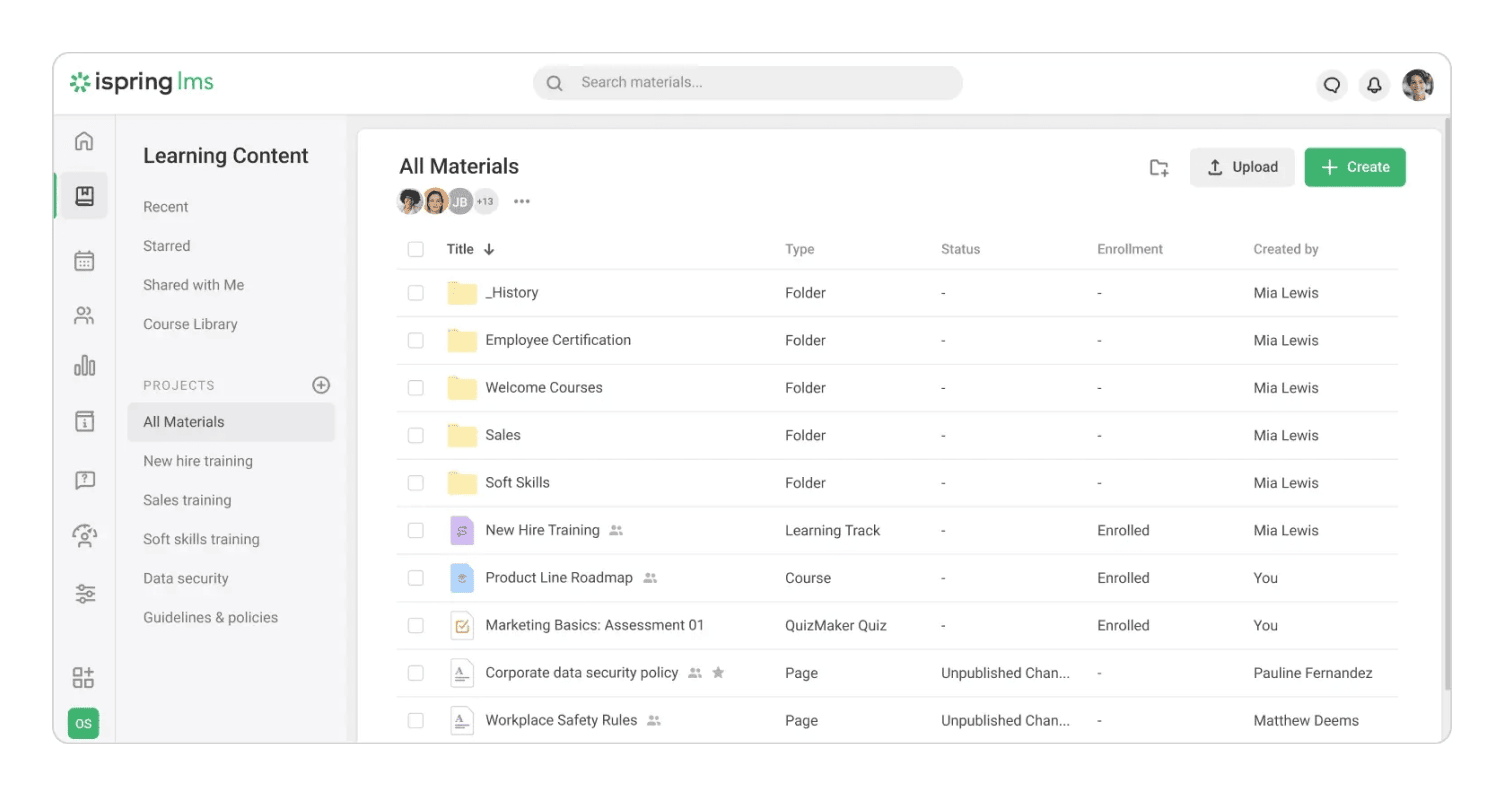
iSpring Learn pairs naturally with iSpring Suite, a well-known content authoring tool, making it a comfortable choice for teams already building courses in that ecosystem.
The trade-off: its LMS feature set is generally lighter on advanced analytics and enterprise integrations compared to platforms built LMS-first.
9. Litmos
Best for: organizations, often in the SAP ecosystem, wanting a straightforward compliance and skills training platform.
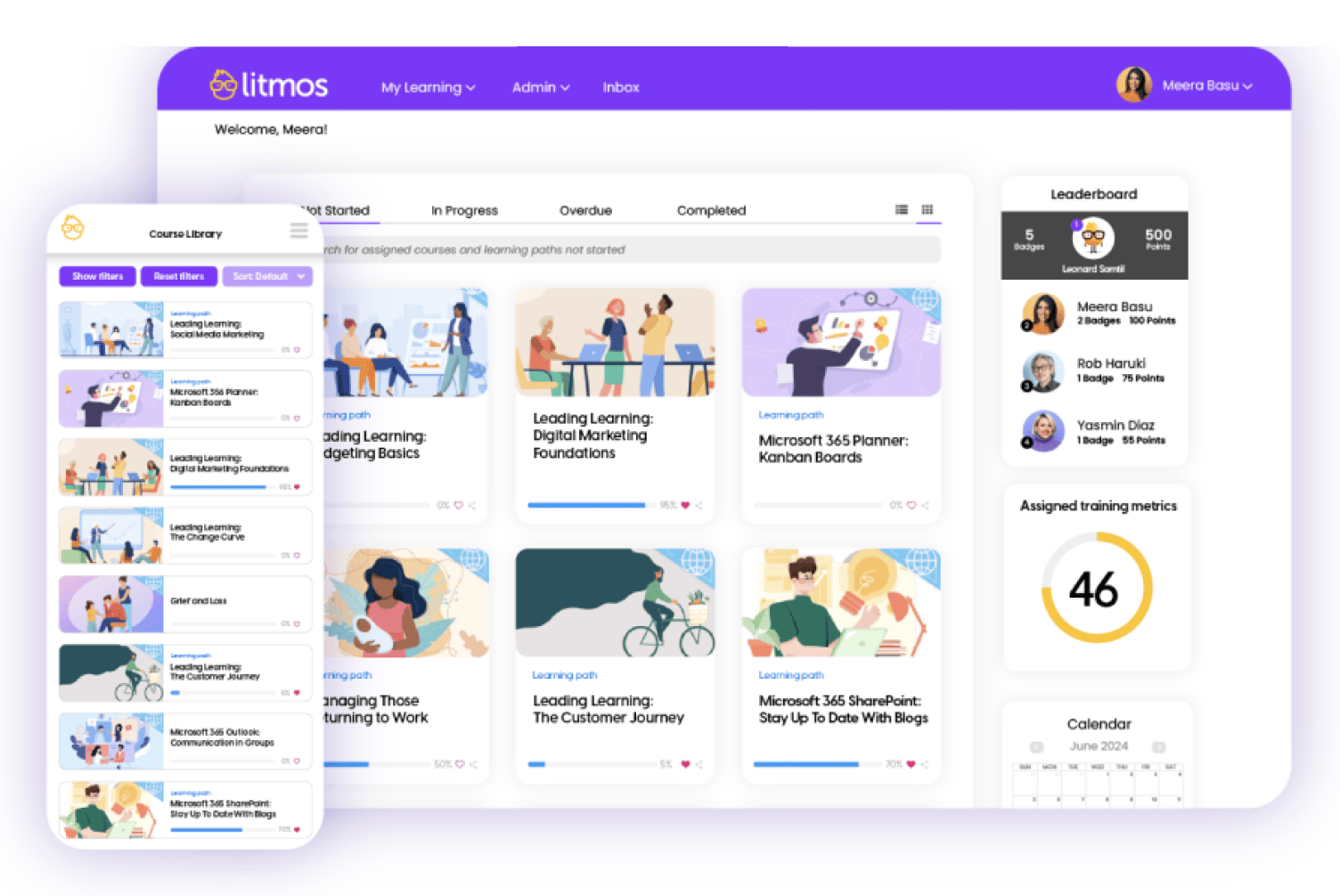
Litmos (now independent of SAP) has a long history in compliance and customer training, with a large pre-built content library available as an add-on.
The trade-off: some long-time customers have reported uncertainty around product direction following its separation from SAP; a fair question to put to them directly during evaluation.
10. Moodle
Best for: budget-conscious organizations, particularly those with in-house technical resources, that want full control over an open-source platform.
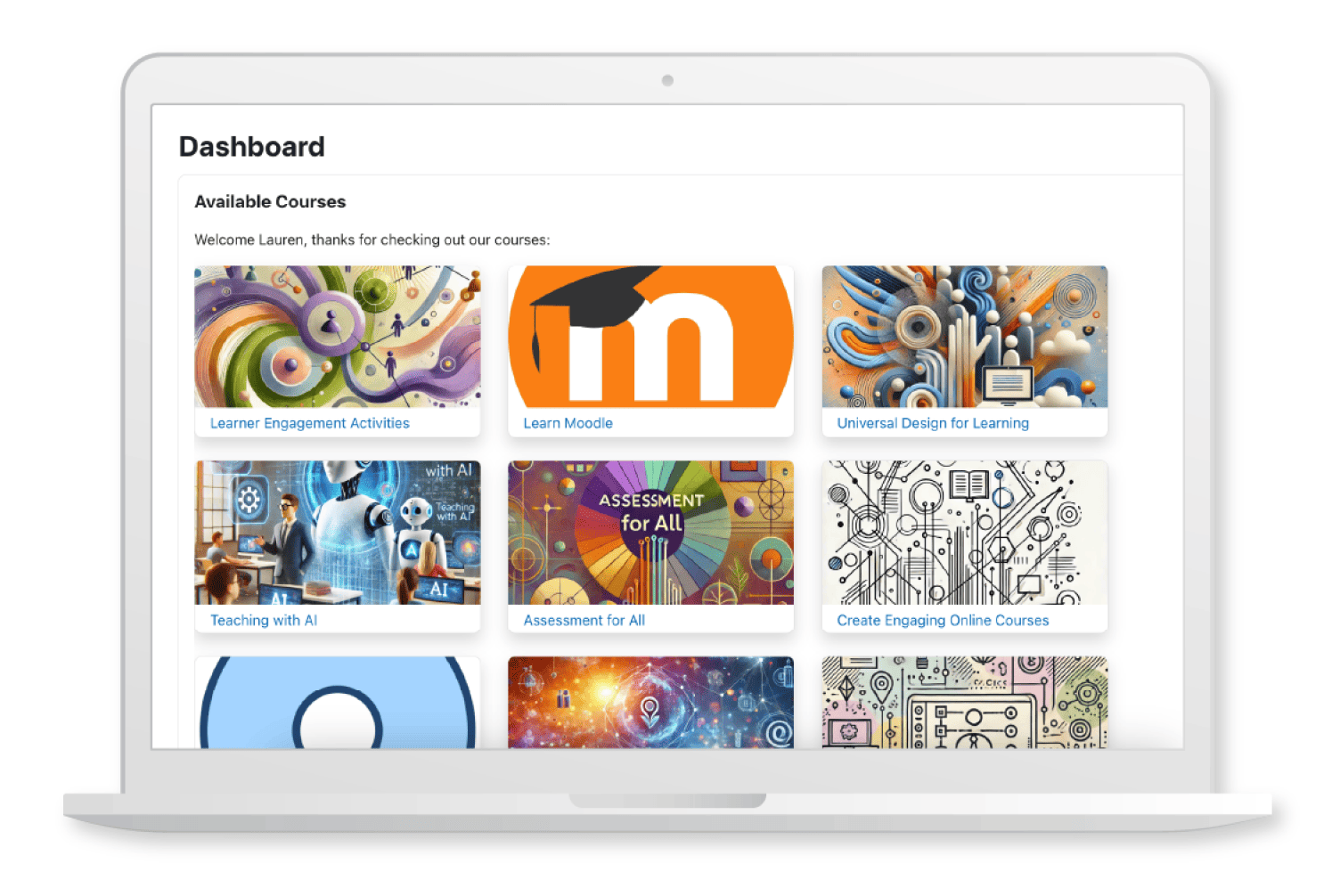
Moodle is free, open source, and highly customizable, with a large global community and plugin ecosystem. It has strong roots in education but is also used corporately.
The trade-off: “free” refers to the software; hosting, customization, security, and support typically require either in-house technical staff or a paid Moodle partner, so total cost of ownership varies widely.
11. D2L Brightspace
Best for: organizations that value a platform with deep roots in structured, academic-style course design, now expanding into corporate training.
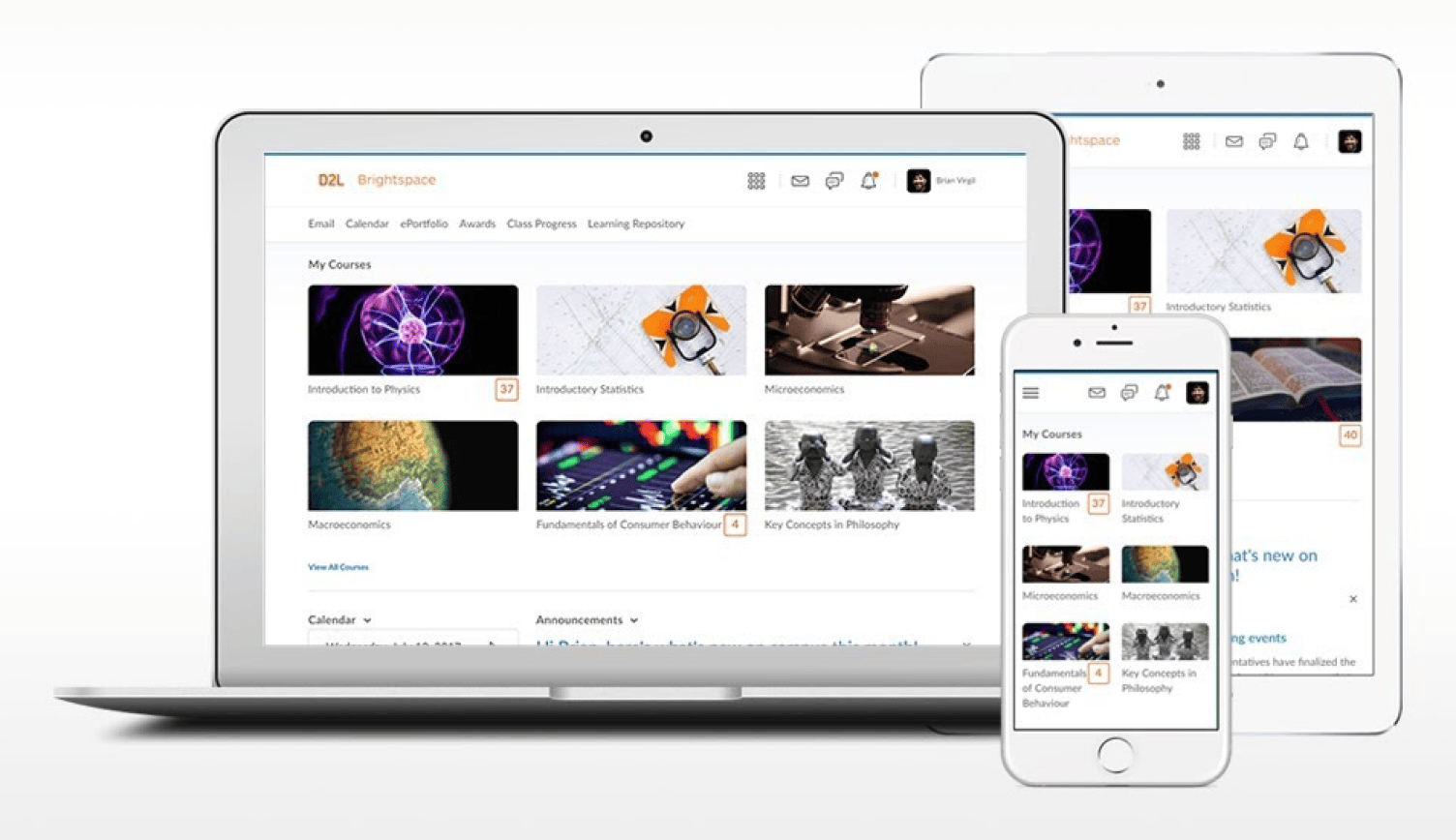
D2L Brightspace, originally built for higher education, brings strong course structuring and adaptive learning paths, and has been building out enterprise training use cases.
The trade-off: its enterprise/corporate feature depth and market presence in that segment are newer than platforms built corporate-first from the start.
12. CrossKnowledge
Best for: European enterprises wanting a blended learning approach with a strong existing content catalog.
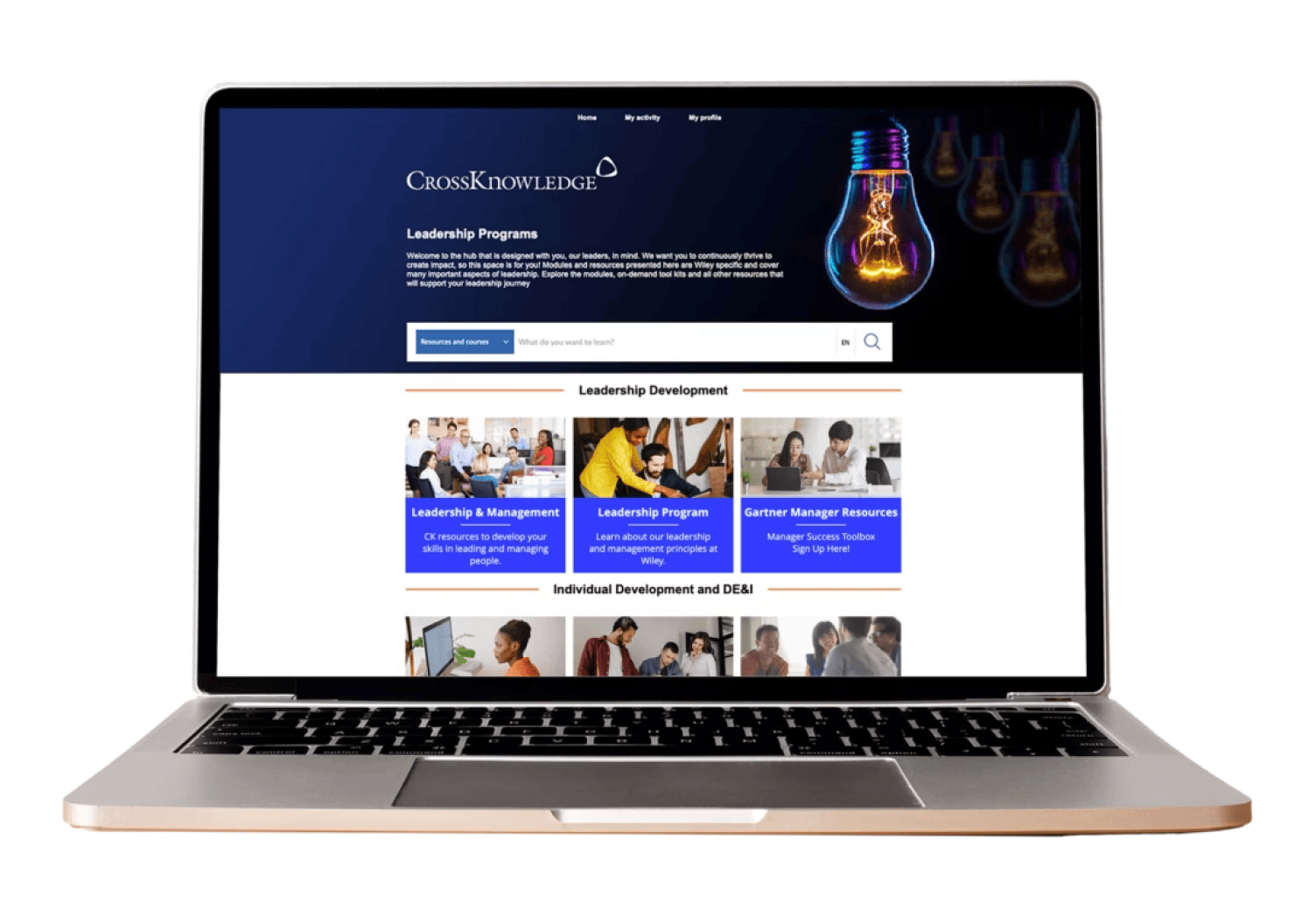
CrossKnowledge is known for its off-the-shelf leadership and soft-skills content library alongside its LMS, useful for organizations wanting content and platform from one vendor.
The trade-off: organizations wanting deep, native compliance workflow automation may find other platforms on this list more purpose-built for that use case.
13. SAP SuccessFactors Learning
Best for: organizations already running SAP SuccessFactors for HR who want learning natively inside that ecosystem.
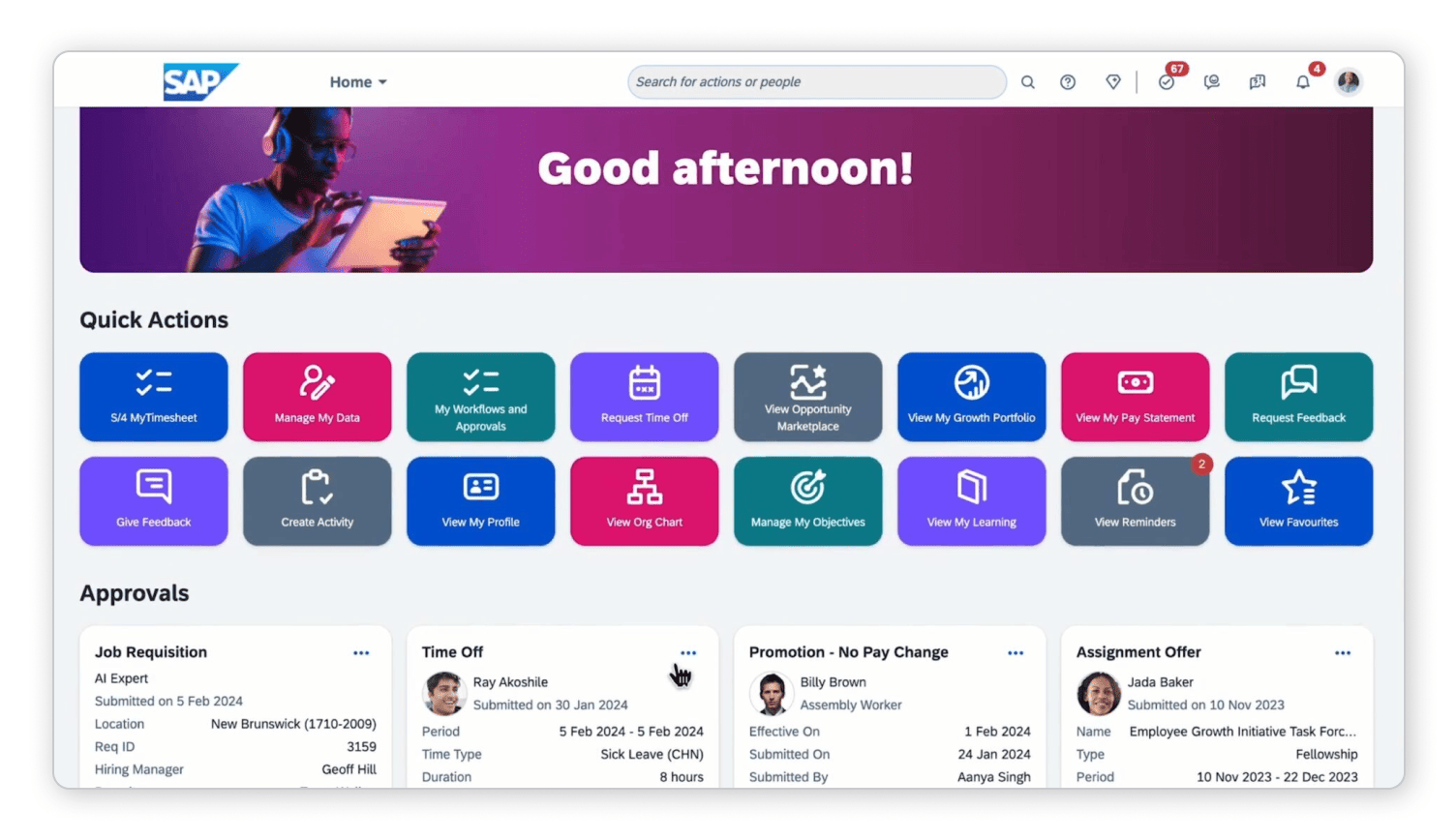
SuccessFactors Learning’s main advantage is tight native integration with the rest of the SuccessFactors HR suite, useful for large SAP-standardized enterprises wanting one HRIS-and-learning environment.
The trade-off: Organizations not already on SAP SuccessFactors for HR are unlikely to choose this LMS in isolation, since much of its value comes from that existing ecosystem. Organizations that are on SAP but find the learning experience dated have a third option — keeping SuccessFactors as the system of record and running a modern learning experience on top of it.
How do these platforms compare on compliance training?
Compliance is rarely the only reason to buy an LMS, but for regulated industries it’s often the reason a shortlist gets built at all. Here’s how the field breaks down on that one dimension specifically.
| Platform | Compliance depth | Best fit |
|---|---|---|
| Valamis | Native LRS, xAPI tracking, automatic recertification and audit trails | Manufacturing, healthcare, professional services |
| Docebo | Solid compliance features; some reviewers note certification logic can need multiple attempts to configure correctly | Large enterprises where compliance is one priority among several |
| Cornerstone | Long track record in regulated industries via the wider talent suite | Enterprises wanting compliance tied to broader HR processes |
| Litmos | Established compliance and customer-training content library | Organizations wanting pre-built compliance courses |
| LearnUpon | Functional but lighter reporting depth | Multi-audience training where compliance is secondary |
| Absorb, TalentLMS, iSpring, Moodle, 360Learning, D2L, CrossKnowledge, SuccessFactors | Compliance handled competently but not the platform’s primary design focus | Organizations where compliance is a feature, not the driving requirement |
If compliance is your organization’s primary evaluation criterion rather than one factor among several, our dedicated compliance training LMS guide goes deeper on this specific comparison.
How do these platforms compare on cost?
Two pricing patterns show up repeatedly across this list, and knowing which one you’re looking at matters more than any single number.

Base price plus modules. Several platforms, including Docebo, price a core tier and charge separately for capabilities many organizations consider essential: advanced analytics, extended enterprise, deeper automation. The quoted starting price and the real annual cost can diverge significantly once those are added.
One quoted price, most capability included. Other platforms, Valamis among them, price the full platform as a single annual subscription, so the number in the initial conversation is closer to the number on the actual invoice. See our pricing page for how that model works.
Neither pattern is inherently wrong, but they answer different questions. A modular platform can suit an organization that only needs core features today and wants to add capability later. A single-price platform suits one that wants budget certainty from the outset. Ask any vendor on this list directly: what’s included as standard, and what would our specific requirements add on top?
Implementation cost and timeline vary the same way. Platforms requiring extensive custom configuration tend to run two to four months and can add meaningfully to first-year cost in services; more configuration-led platforms are typically faster to launch, with lower ongoing dependency on external consultants.
Which LMS is right for your organization?
- You’re in a regulated industry (manufacturing, healthcare, finance, professional services or the public sector) and compliance is a daily operational requirement, not an annual checkbox: Valamis, Cornerstone, or Litmos are worth close evaluation.
- Learner engagement and a modern interface are your top priority, and you’re managing a large, dispersed knowledge-worker population: Docebo or Absorb.
- You want learning built into a broader HR and talent system rather than standalone: Cornerstone or SAP SuccessFactors Learning, if you’re already on that HR stack.
- You want your content created by internal subject matter experts collaboratively, rather than centrally authored: 360Learning.
- You’re a smaller organization wanting fast setup without a long implementation project: TalentLMS or LearnUpon.
- Budget is the primary constraint and you have in-house technical resources: Moodle.
- Your organization already uses AI assistants like Copilot and wants training data and skills information accessible through them directly, not locked inside a separate portal: Valamis and Docebo both connect learning data to AI assistants over MCP. The difference is what sits behind the connection: Valamis offers single-tenant deployment with your own model endpoint and in-region inference, so prompts stay inside your perimeter, and a native Learning Record Store means the assistant reasons over your organization’s own learning record rather than platform-wide patterns. Our take on the AI readiness gap covers why that matters.
Whichever platforms make your shortlist, ask each one the same three questions: what’s included in the quoted price versus what’s an add-on, how long does implementation typically take for an organization your size, and can you speak to a customer reference in your industry.
See Valamis in action
Book a call and we’ll walk through the platform against your own requirements.
Book a demoFrequently asked questions
What is the best LMS for corporate training?
There’s no single best LMS for corporate training; the right choice depends on your industry, company size, and whether compliance, learner engagement, or integration with existing HR systems matters most. Platforms like Valamis suit compliance-heavy enterprises wanting built-in analytics and authoring, while platforms like Docebo suit organizations prioritizing learner experience and scale.
How much does an enterprise LMS typically cost?
Enterprise LMS pricing is usually quote-based rather than published, and varies by user count, features, and implementation scope. Some platforms price a base tier and charge separately for capabilities like advanced analytics or extended enterprise training, so confirm with any vendor what’s included as standard versus billed as an add-on.
What’s the difference between an LMS and an LXP?
An LMS (learning management system) is built around structured, often mandatory training with tracking, certification, and compliance at its core. An LXP (learning experience platform) is built around discovery-driven, self-directed learning, closer to a content recommendation experience. Many modern platforms, including several on this list, blend elements of both.
How long does LMS implementation usually take?
Implementation timelines vary widely by platform and organization complexity, from a few weeks for configuration-led platforms up to six months or longer for heavily customized enterprise deployments. Ask any vendor for a realistic timeline based on your specific requirements, not their fastest possible case.