How to close the AI readiness gap
Most organizations already have access to AI. The real gap is a workforce that knows how to use it well. Here’s how L&D teams can close it and turn AI investment into measurable results.

Most organizations are not sitting on the sidelines of AI anymore. More than 80% report regular AI use in at least one business function. Yet, only 12% of employees in organizations using AI strongly agree that it has fundamentally changed how work gets done.
That doesn’t mean AI isn’t delivering value. Employees are increasingly using AI to draft content faster, summarize documents, analyze information, and automate repetitive tasks. These are meaningful productivity gains, but they are often isolated to individual tasks rather than driving broader organizational change.
AI is no longer the limiting factor. For most companies, the technology is already available.
The real challenge is building a workforce that knows how to use AI responsibly. As AI capabilities continue to advance, competitive advantage will come from how quickly organizations can develop the skills needed to put it to work.
This is the AI readiness gap: the gap between investing in AI technology and having a workforce that’s ready to use it.
Closing that gap requires targeted upskilling and reskilling initiatives that build AI literacy, develop practical skills, and give employees the confidence to integrate AI into their everyday workflows. When learning and development is embedded into the AI adoption process, organizations are far more likely to realize the business outcomes they set out to achieve.
In this guide, we’ll explore what the AI readiness gap is, why it matters, and how L&D teams can build the capabilities needed for successful AI adoption.

What is the AI readiness gap?
The AI readiness gap is the difference between adopting AI technology and having a workforce that’s prepared to use it effectively.
Many organizations might assume that once AI tools are available, their employees will naturally integrate them into their work. In reality, successful AI adoption depends on more than just access to the technology.
Employees need to understand where AI can add value in their day-to-day work, how to use it responsibly, and when human judgment remains essential.
Several factors contribute to the AI readiness gap, including:
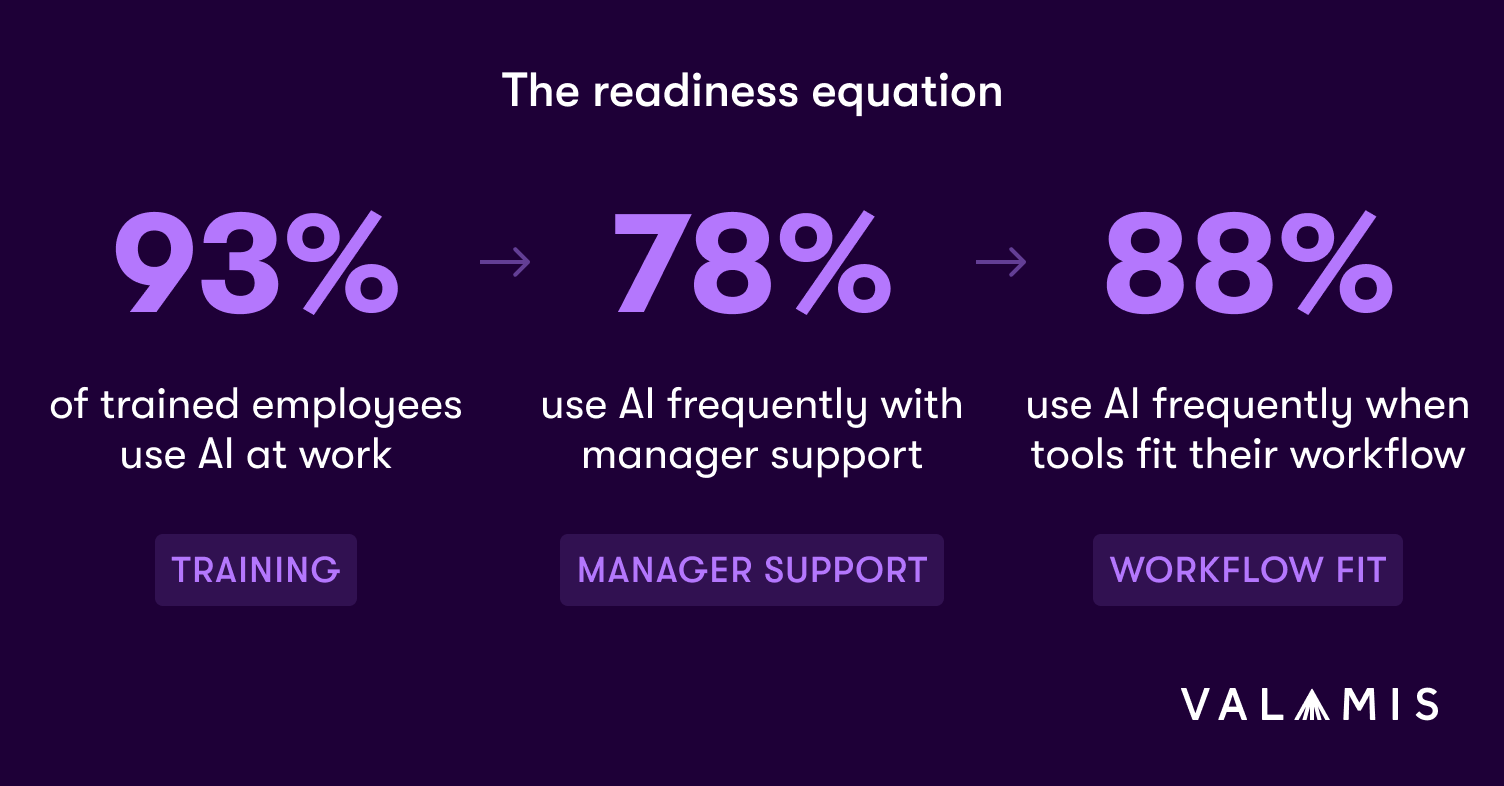
- Lack of training: Employees need training to build the skills and confidence to use AI. In fact, 93% of employees who receive AI training use AI in their roles, compared with just 57% of those who don’t.
- Limited AI literacy: Employees may understand how to use AI tools but lack a broader understanding of their capabilities, limitations, and risks.
- Skills gaps: Many employees are unsure how to put AI to best use within their specific roles and workflows.
- Resistance to change: Employees often default to familiar ways of working. Without clear guidance and opportunities to experiment, they may hesitate to adopt AI or struggle to incorporate it.
- Leadership readiness: Managers play a critical role in embedding AI into everyday work, yet many lack the knowledge to lead that change.
Closing the AI readiness gap doesn’t require every one of your employees to be an AI specialist. Rather, it involves giving your people the skills and confidence to use AI within their roles and adapt as the technology continues to develop.
Why does the AI readiness gap matter?
When organizations overlook workforce readiness, AI initiatives often struggle to move beyond isolated use cases. Employees may save time on individual tasks, but those productivity gains rarely scale across teams or translate into measurable business outcomes. In fact, despite an estimated $30–40 billion invested in generative AI, an MIT report found that 95% of organizations have seen no measurable impact on profits.
One reason for this is that AI adoption often remains fragmented. While some employees confidently integrate AI into their daily work, others use it infrequently or not at all. Research by Gallup shows that even in organizations that have made AI tools widely available, frequent AI use varies considerably by role level, with leaders adopting AI more often than managers and individual contributors.
This matters because if managers aren’t equipped to lead AI adoption, it becomes much harder to embed AI into workflows and scale its benefits across your organization.
Closing the AI readiness gap helps organizations move past isolated wins and toward AI’s full potential. By investing in workforce capability alongside the technology itself, organizations can scale successful use cases, improve decision-making, and generate stronger returns on their AI investments.
What capabilities does an AI-ready workforce need?
While the specific skills will vary by role, there are several core capabilities your organization should focus on.
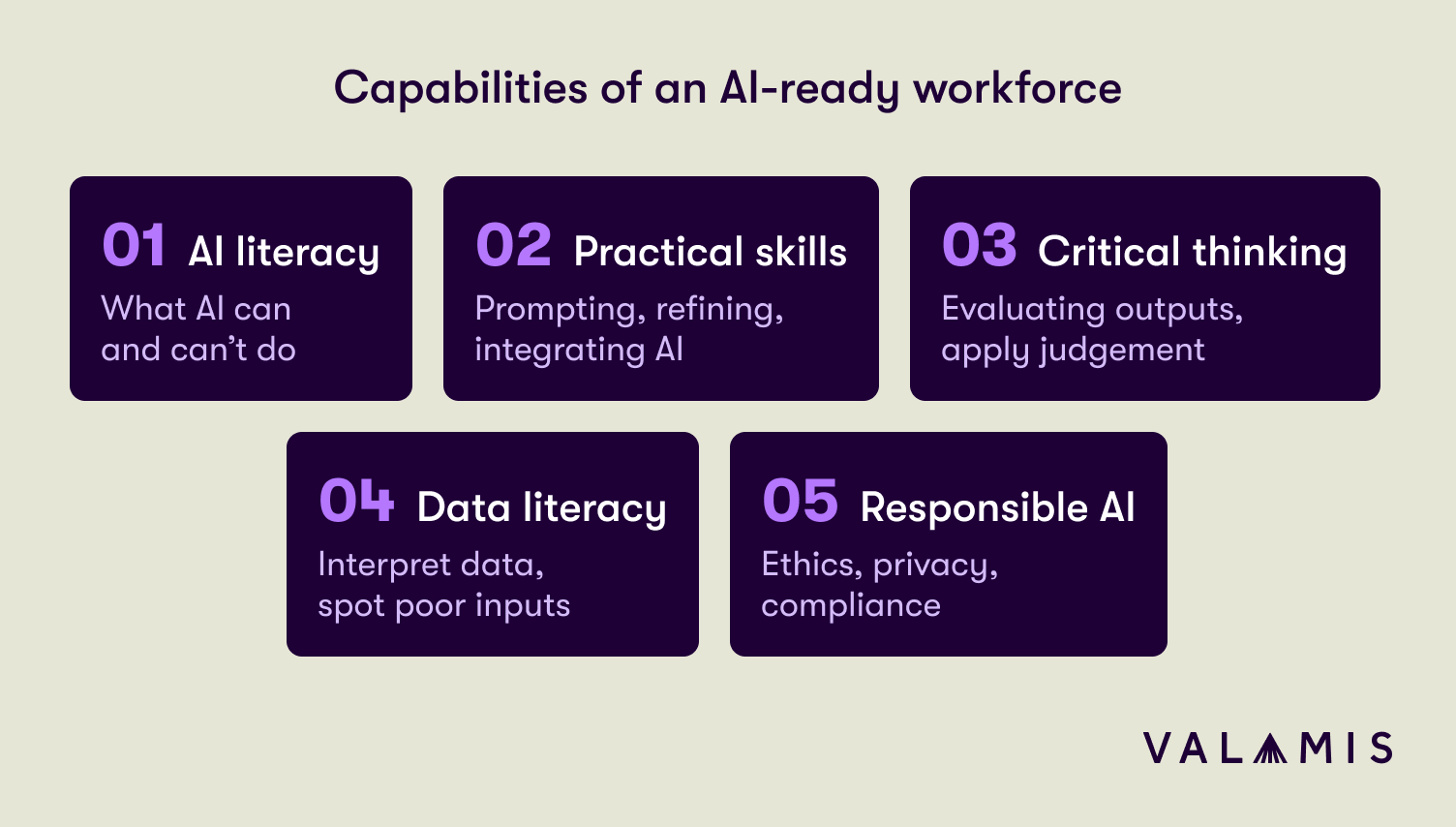
- AI literacy: A basic understanding of what AI can and can’t do, where it adds value, and when human judgment remains essential.
- Practical AI skills: Writing effective prompts, refining AI-generated outputs, and integrating AI into everyday workflows.
- Critical thinking: The skills to evaluate AI outputs, verify information, and recognize when further review is needed.
- Data literacy: Understanding how to interpret data and recognizing how poor-quality inputs affect AI-generated outputs. AI is only as useful as the information it works with.
- Responsible AI: Awareness of the ethical, legal and security implications of AI use, including privacy, bias, intellectual property and compliance.
What are five strategies for closing the AI readiness gap?
Closing the AI readiness gap requires a long-term learning and development strategy that builds capability across the organization. Here are five practical ways to get started.
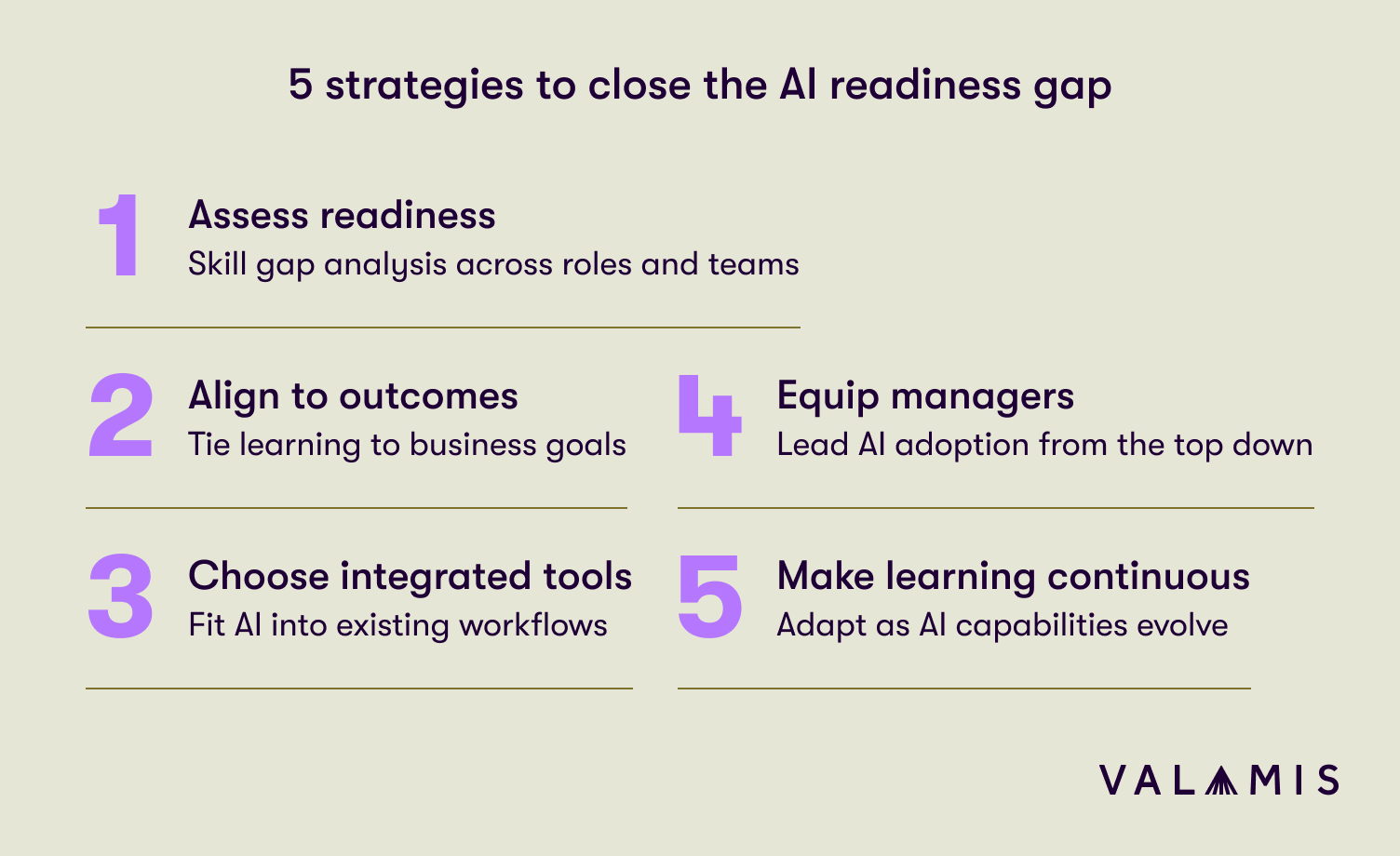
Assess your current AI readiness
Before designing any learning programs, you need to understand where your workforce actually stands. That means going beyond assumptions and gathering real data: how AI literate are your employees, how confidently are they using AI tools, and where are the gaps most pronounced across different teams and roles?
A skills gap analysis gives L&D teams a clear picture of where to focus. It also makes it easier to prioritize learning investment where it will have the greatest impact, rather than rolling out generic training that may not address the challenges people are actually facing.
Align learning to business outcomes
AI training is most effective when it directly supports what your organization is trying to achieve. Rather than measuring success by course completions or participation rates alone, design learning initiatives that contribute to specific business objectives.
To achieve this, identify the AI capabilities your workforce needs to deliver those outcomes and build learning around them. For example, if your goal is to improve customer service, focus on helping employees use AI to respond to and resolve queries faster. If your objective is to increase operational efficiency, prioritize skills that enable teams to automate repetitive processes and simplify workflows.
When learning is aligned with business priorities, it becomes easier to measure its impact and ensure AI investments translate into meaningful improvements across the organization.
Choose AI tools that integrate with existing workflows
Even the best AI tools won’t deliver value if employees have to significantly change the way they work to use them. Successful AI adoption depends on choosing technologies that integrate naturally into existing workflows and the systems employees already use every day.
Among employees who strongly agree that AI works well with the systems and processes they already use, 88% report using AI frequently.
When choosing AI tools, consider how well they integrate with the systems your employees already use, including your LMS.
Organizations should also think beyond today’s requirements. Choose AI solutions that are flexible enough to evolve as your business and AI capabilities change. As more organizations begin experimenting with agentic AI, selecting technologies that can adapt over time will keep your workforce ready for what’s next.
Equip managers to lead AI adoption
Successful AI adoption depends as much on leadership as it does on technology.
While executives set the vision, managers shape how teams respond to change and can either accelerate or slow down adoption through their own behavior.
Gallup research highlights just how influential managers are. Among employees who strongly agree that their manager actively supports their team’s use of AI, 78% report using AI frequently.
That’s why managers need targeted learning and development too, so that they can champion its use within their teams. This includes identifying opportunities to use AI, helping employees adopt new ways of working, addressing concerns, and creating an environment where experimentation is encouraged.
By equipping managers to lead AI adoption, organizations can accelerate workforce readiness and scale AI more productively across the business.
Make learning continuous
AI capabilities are not standing still, and neither are the skills needed to use them well. One-off training programs may build awareness, but they are rarely sufficient on their own.
Continuous learning might look like bite-sized content that employees can engage with regularly, personalized learning paths that evolve as AI tools develop, forums where people can share what they are learning, or regular updates that reflect new capabilities and best practices. The goal is a workforce that does not just adapt to AI change reactively but builds the habit of continuous learning that makes adaptation easier over time.
Development should also extend to the soft skills that make AI effective. Critical thinking, emotional intelligence and sound judgment are just as important as knowing how to use the technology itself. These capabilities help employees decide when to use AI, when to challenge it, and when human expertise should take the lead.
Readiness is one half of the picture. The other is knowing where AI is already being used across the people process, which our guide to how AI is being applied across talent management covers across hiring, skills, learning, and workforce planning.
How does Valamis help organizations close the AI readiness gap?
Valamis helps organizations build AI-ready workforces by combining skills management, personalized learning, and AI-powered capabilities in a single platform. From assessing workforce skills and delivering role-based learning to measuring capability over time, we help L&D teams align learning with business goals and prepare employees for successful AI adoption.
As AI capabilities advance, learning should progress alongside. We are laying the foundation for agentic AI in workplace learning by connecting skills, learning, and AI-powered insights across the tools employees already use every day.
Through integrations with AI assistants such as Microsoft Copilot, Claude, and ChatGPT, employees can discover learning, check training progress, and access support without leaving their workflow. This creates a more connected, adaptive learning experience that helps organizations continuously develop the skills their workforce needs as AI continues to grow. For a wider comparison of how corporate training LMS platforms handle this, see our 13-platform comparison.
Ready to close the AI readiness gap?
Book a 30-minute demo to see how Valamis can help build a workforce that’s ready for what’s next.
Schedule a call with usFrequently asked questions
What is the AI readiness gap?
The AI readiness gap is the difference between adopting AI technology and having a workforce that is prepared to use it effectively. Most organizations already have access to AI tools, but employees often lack the training, literacy and confidence to apply them consistently in their day-to-day work.
Why does the AI readiness gap matter?
When workforce readiness is overlooked, AI adoption tends to stay fragmented: a few employees use it well, most don’t, and productivity gains never scale into measurable business outcomes. Closing the gap is what turns individual AI use into organization-wide impact.
What skills make a workforce AI-ready?
An AI-ready workforce needs five core capabilities: AI literacy, practical AI skills such as prompting and refining outputs, critical thinking to evaluate what AI produces, data literacy, and an understanding of responsible AI practices including privacy, bias and compliance.
How can L&D teams start closing the AI readiness gap?
Start with a skills gap analysis to see where your workforce stands, then align learning to specific business outcomes rather than completion rates. Choose AI tools that fit existing workflows, equip managers to lead adoption within their teams, and treat AI learning as continuous rather than a one-off rollout.