Looking for Docebo alternatives? Here is what to compare beyond the feature list
An honest look at how Docebo and Valamis compare on compliance, content authoring, analytics, and total cost.

Docebo offers a polished learner experience, strong social learning features, and a content marketplace. It is publicly traded and widely adopted across enterprise organizations.
Valamis focuses on compliance, onboarding, skills management, and learning analytics, with built-in content authoring and xAPI-based tracking with a built-in LRS, and API-first, headless connectivity for AI assistants like Copilot, Claude, and ChatGPT.
Docebo is best suited for large enterprises that prioritize learner experience, social learning, and a broad content marketplace. Valamis is best suited for mid-market to large organizations (500 to 7,500+ employees) in regulated industries where compliance, built-in authoring, analytics depth, and predictable pricing are the priority.
Discover:
- The parts we are not going to argue with
- Valamis as a Docebo alternative: what is different?
- The comparison table
- When Docebo is the right call
- When Valamis is the right call
- What the Fosway 9-Grid tells you (and what it does not)
You know the format. Two logos side by side. A table full of checkmarks. One company mysteriously wins every category. You scroll, you learn nothing, you close the tab.
We are going to do this differently.
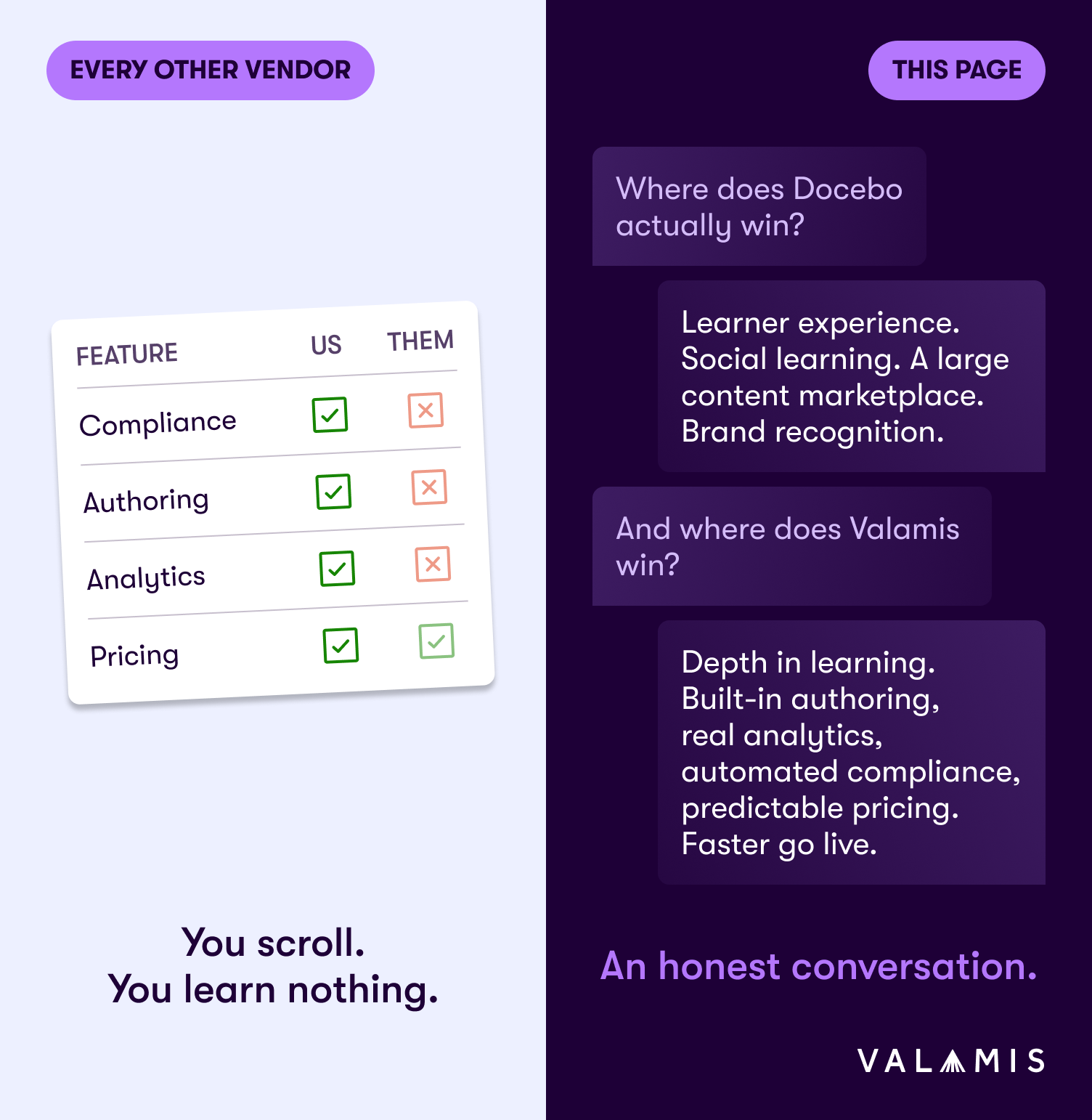
We are Valamis. We make a learning platform (LMS). Docebo also makes a learning platform. If you are reading this, you are either evaluating both or you are already on Docebo and wondering whether something better exists.
Here is an honest look at both, including the parts where Docebo wins. If Cornerstone is the other name on your shortlist, we’ve done that comparison too.
Read our guide on 20 best employee training software for 2026
The parts we are not going to argue with
Docebo is a well-built learning platform with serious market traction. It sits in the Strategic Leader zone of the 2026 Fosway 9-Grid for Learning Systems, which means strong customer performance and broad capability.
The company is publicly traded, heavily funded, and has invested more in AI marketing than almost anyone in the learning space.
The interface is modern. The learner experience is polished.
If you asked ten people in L&D to name a cloud-based LMS off the top of their head, Docebo would come up in most of those conversations.
That is earned, not lucky.

Checklist on how to choose the best LMS
The checklist will keep your focus on what really matters when choosing an LMS.
DownloadWhy people look for Docebo LMS alternatives right now
A few reasons keep coming up.
The price tag grows after you sign
Docebo starts at roughly $25,000 per year. That is the base. The reality for most organizations looks different.
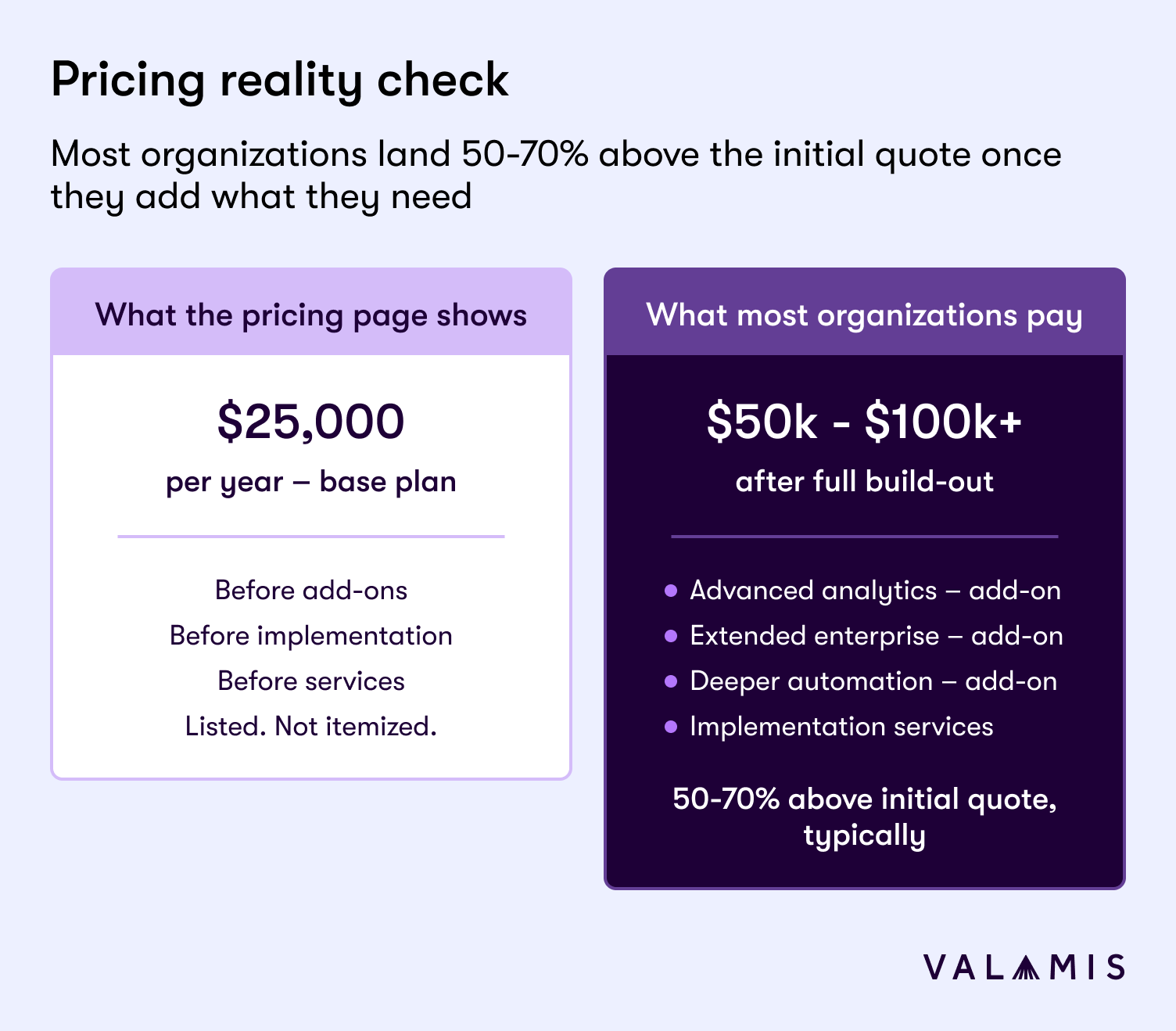
The platform is modular. Features that many teams consider essential (advanced analytics, extended enterprise, deeper automation) are add-on modules priced separately.
Customer reports suggest total costs often land 50 to 70 percent above the initial quote once you add what you need. Enterprise deployments regularly cross six figures.
Implementation adds to that. Docebo’s average setup timeline runs 3 to 6 months, and complex implementations can add 20 to 40 percent of first-year platform costs in services.
None of this is hidden in the fine print. But it is not on the pricing page either. If you are mid-market (500 to 5,000 employees), these numbers change your shortlist.
Support has become a pain point
This comes up repeatedly in recent customer reviews. Support ticket backlogs. Two-week response times for straightforward technical issues. Features that get released before they are fully developed, creating bugs that linger.
The pattern is familiar in fast-growth SaaS: the product scales faster than the support team.
Docebo is aware of this and has been investing in self-service resources. But if your L&D team is small and relies on vendor support to troubleshoot, this is worth asking about directly.
The AI gap between marketing and reality
Docebo has leaned heavily into AI positioning. Their marketing is aggressive on this front, and the product does include AI features for content recommendations, auto-tagging, and enrollment automation.
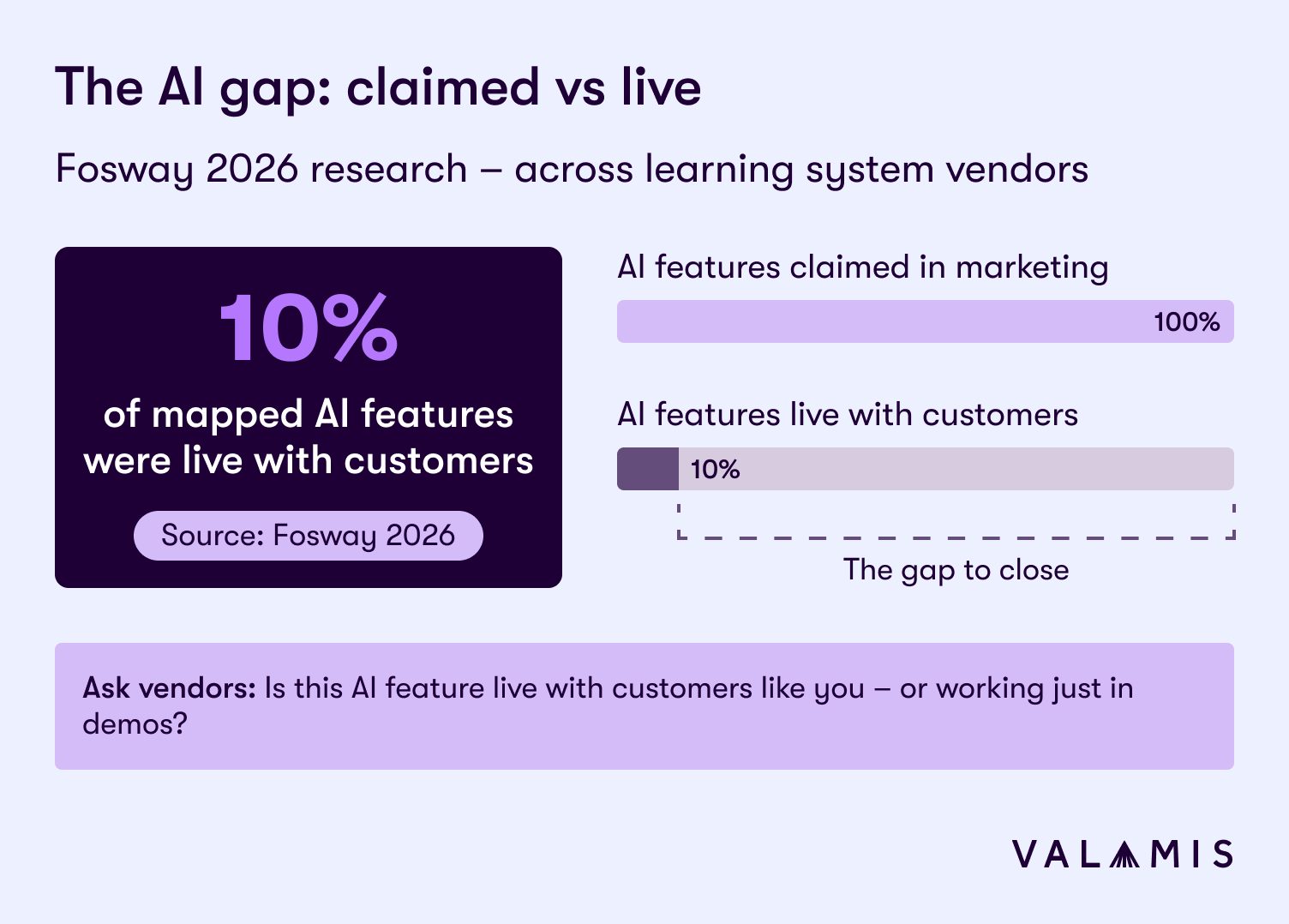
Fosway’s 2026 research puts a number on this: “whilst nearly every learning systems vendor claimed AI-enhanced functionality, only 24% of mapped AI features were live with customers.”
Docebo’s trajectory rating in the 2026 Fosway 9-Grid is “Moderating,” which means the pace of progress is leveling off relative to their position and the market.
The AI features exist. The question is whether they are working in production for customers like you, or whether they are working in demos.
Valamis as a Docebo alternative: what is different?
We are a learning platform too. Same Fosway 9-Grid. Same “Suite” classification. Same “Mid” total cost of ownership rating.
Here is where we are not the same.
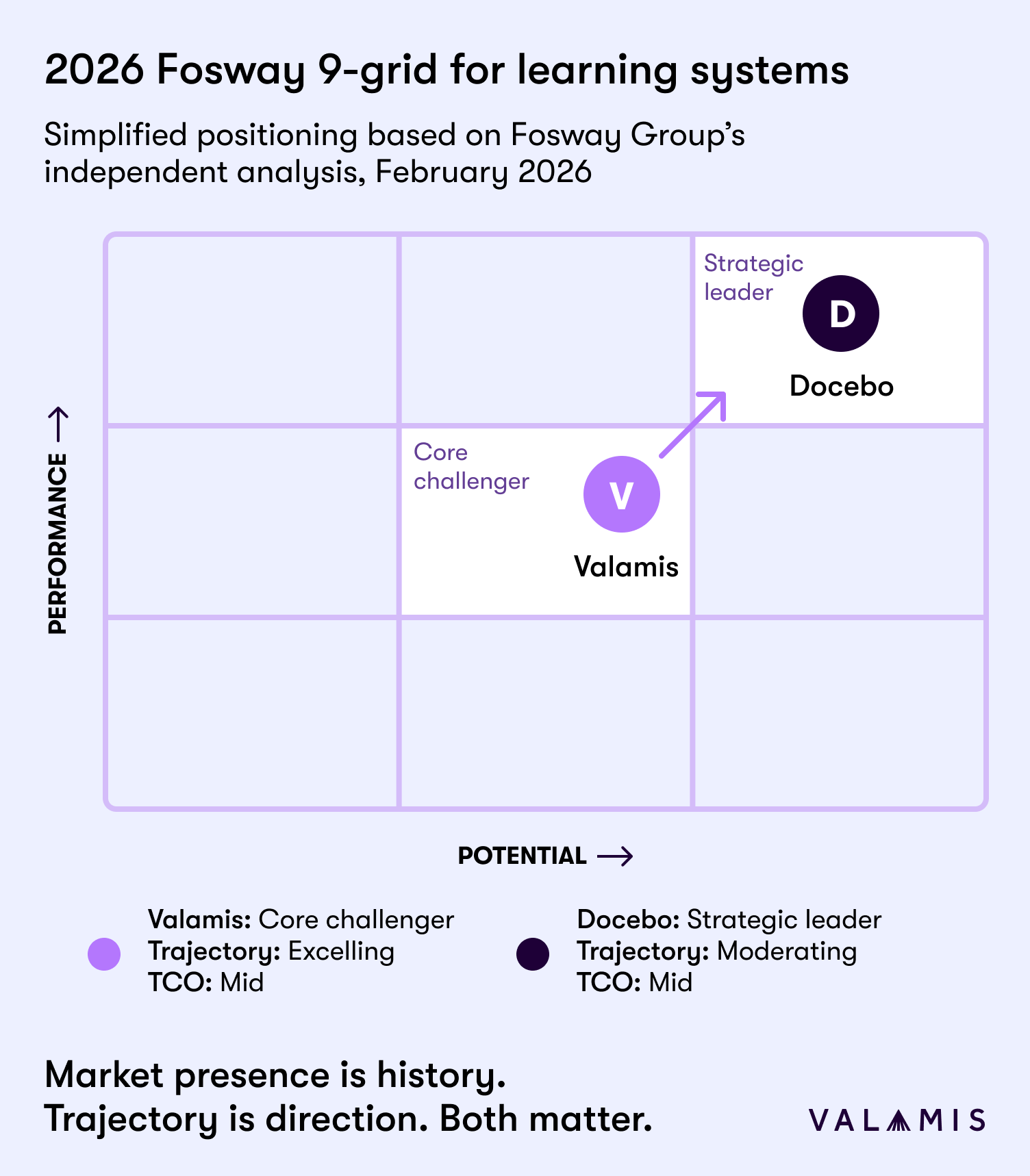
Fosway rates Valamis with an “Excelling” trajectory. That is the strongest positive momentum rating in the framework. While Docebo is moderating, Valamis is accelerating. Different directions.
But trajectory is an analyst’s word. What does the difference feel like when you are running L&D day to day?
Pricing that does not change shape after you sign
Valamis does not play the base-price-plus-add-ons game.
The platform is modular and configurable, but the pricing conversation happens up front. No separate line items for analytics, compliance features, or extended enterprise. No discovering at month six that the reporting you need costs extra.
For mid-market organizations (our core buyer: 500 to 7,500 employees), predictable cost matters more than a low starting number.
Content authoring is built in. Not bolted on.
This is a concrete difference.
Valamis includes Valamis Studio, a built-in authoring tool. Your team can create interactive lessons, quizzes, presentations, and assessments inside the platform. Import a PowerPoint or PDF. Add video and audio. Build question-based assessments. Publish.
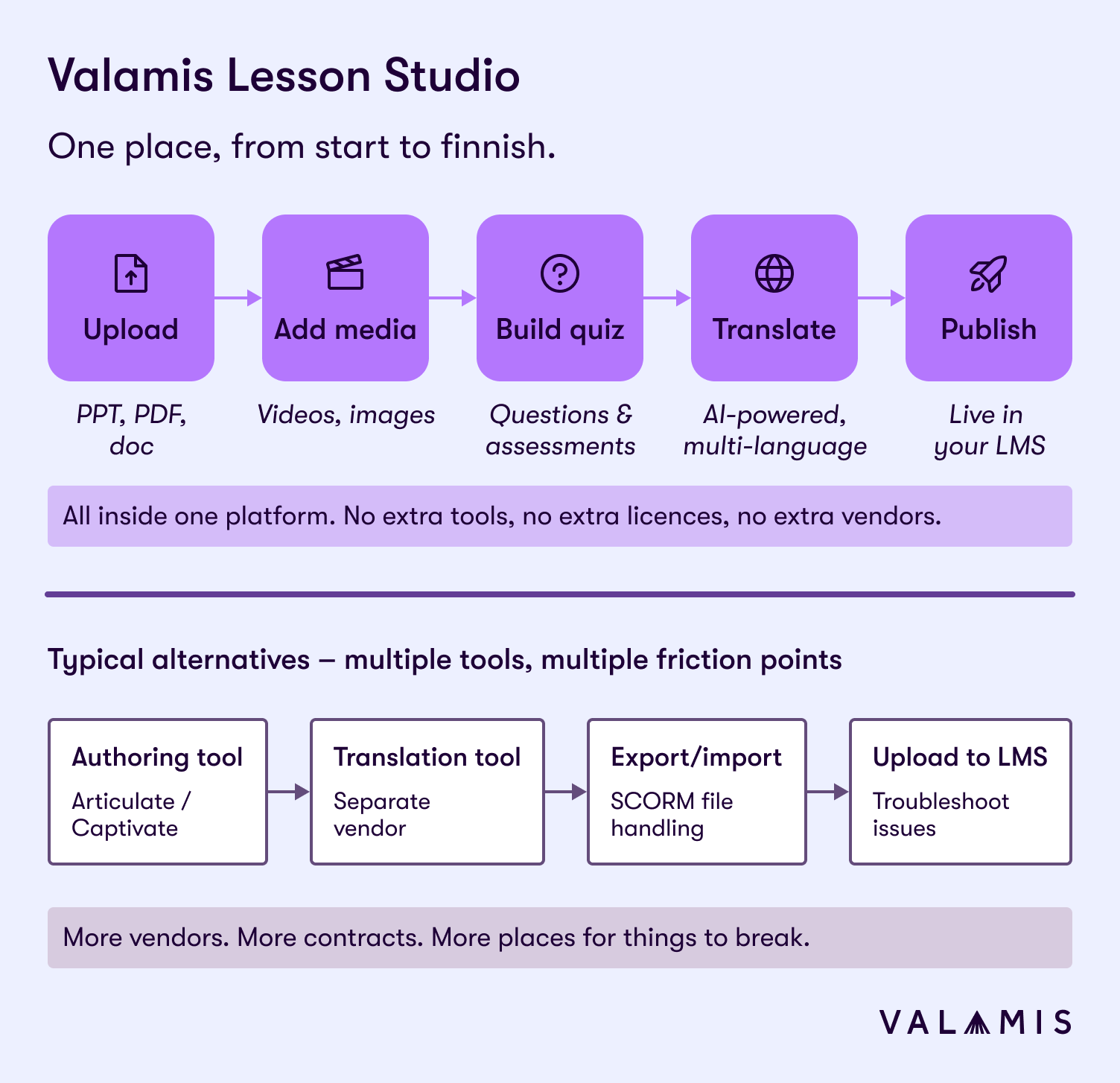
AI-generated lesson content and AI-powered translation into multiple languages are part of the same tool.
For organizations operating across Benelux, Nordics, DACH, or other multilingual markets, content localization is not an add-on conversation. It is built into the authoring workflow.
Docebo has content creation capabilities and a marketplace, but authoring has not been their primary strength.
Most Docebo customers rely on third-party authoring tools (Articulate, Adobe Captivate, etc.) to build content and then upload it.
If you already own and love an authoring tool, this difference may not matter. If you want your L&D team creating and publishing content in one place without extra licenses, it does.
Compliance is the whole job, not a checkbox
Both platforms handle compliance training. The question is how deep it goes.
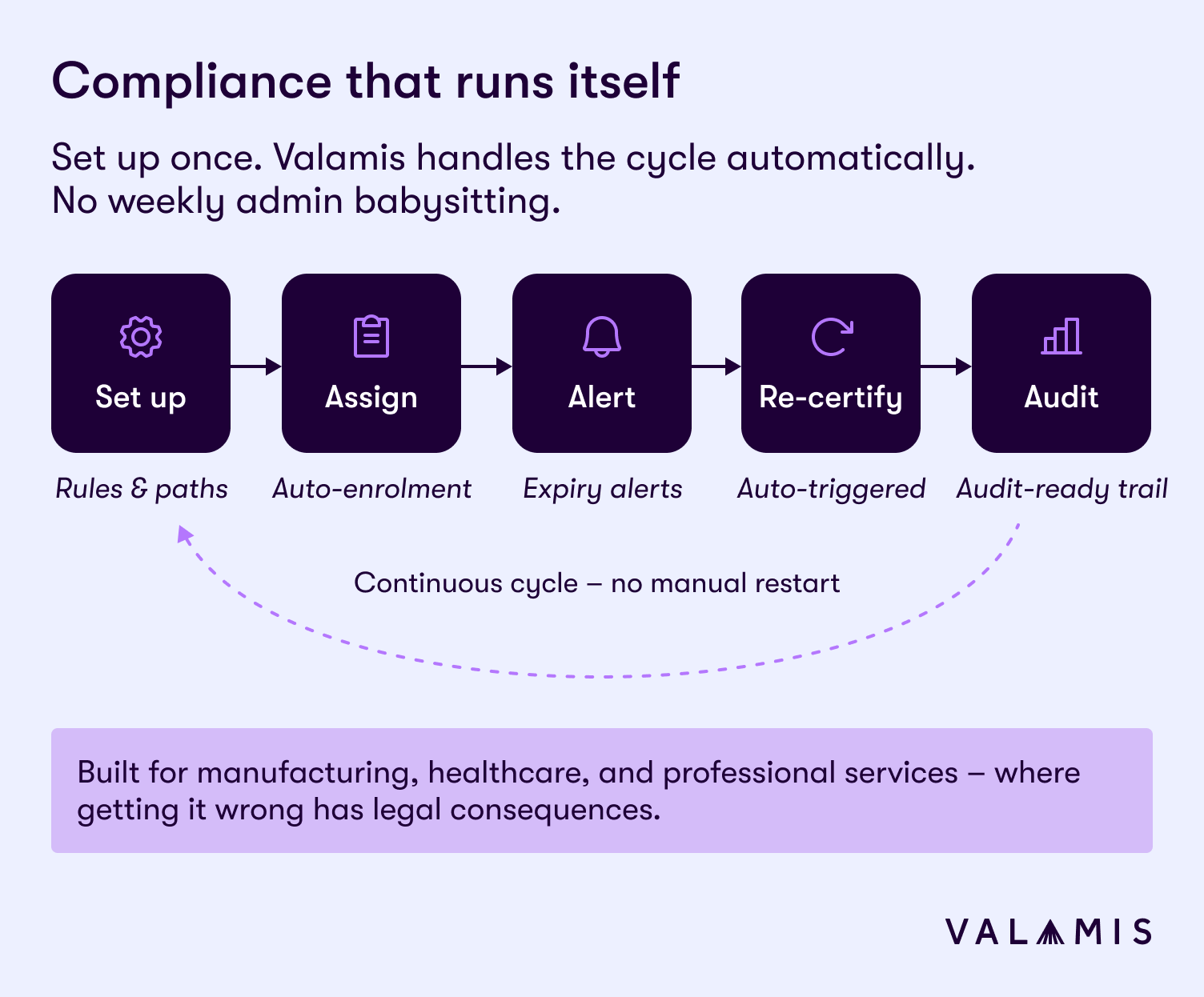
Valamis was built with compliance-heavy industries in mind: manufacturing, professional services, healthcare.
That means mandatory learning paths with deadlines, automatic recertification workflows, certificate expiration alerts, and audit trails that hold up under scrutiny.
Docebo covers compliance too.
But customer reviews note that certification logic can be hard to get right, often requiring multiple attempts before workflows behave as expected. In regulated industries where getting this wrong has legal consequences, that is a risk worth weighing.
Read our guide that reviews 20 compliance training software platforms for 2026
Analytics built around xAPI, not reports built around activity
Valamis uses xAPI-based tracking with a built-in Learning Record Store (LRS) and Superset-powered reporting. This means your data captures learning activity beyond course completions: simulations, on-the-job activities, informal learning.
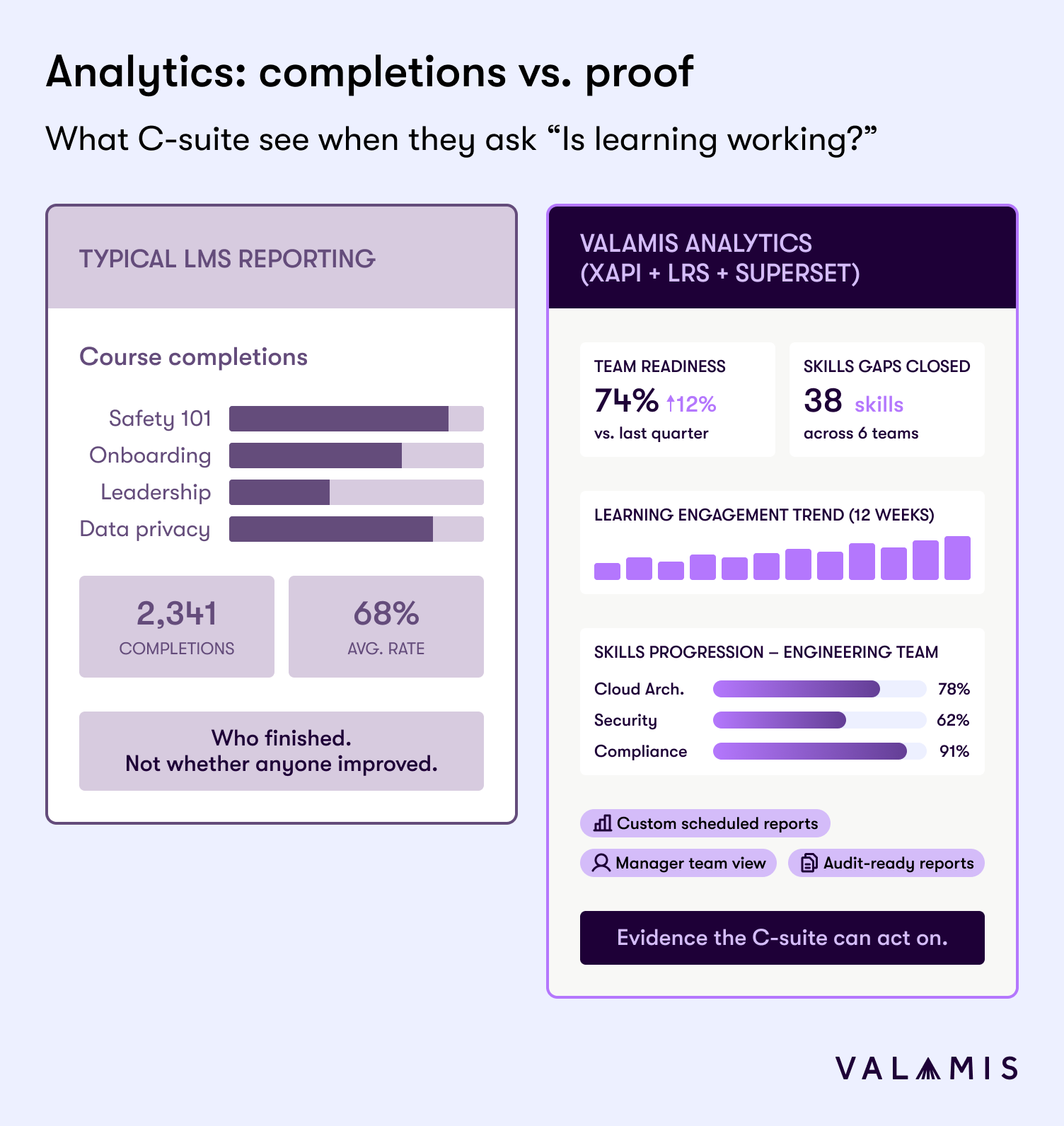
Docebo’s reporting has improved over the years, but reviews consistently flag it as a weak spot.
Reports are hard to tailor, scheduling is inflexible, and pulling specific data often takes more effort than the platform suggests.
If your HR leaders need to present learning outcomes to the C-suite, or your compliance officers need audit-ready reports, the analytics layer is where many Docebo customers hit friction.
Checklist on how to choose the best LMS
The checklist will keep your focus on what really matters when choosing an LMS.
DownloadBuilt for how AI is entering the workplace
Docebo’s AI investment has focused on content recommendations and automation inside its own interface. Valamis has taken a different approach: making learning data accessible to the AI tools your employees already use.
Valamis is API-first, with a headless deployment option. Through MCP (Model Context Protocol) connectivity, employees can check training status, find relevant learning, and get skills guidance through Microsoft Copilot, Claude, or ChatGPT, without opening a separate application.
For organizations already standardizing on Copilot or an internal AI assistant, this matters more than another in-platform recommendation engine. It means learning data can work wherever your employees are already asking questions.
Implementation measured in weeks, not months
Docebo’s average implementation runs 3 to 6 months.
Valamis is designed to be configured, not custom-built. The platform is modular and your team can adjust layouts, branding, workflows, and application selection without rebuilding the environment.
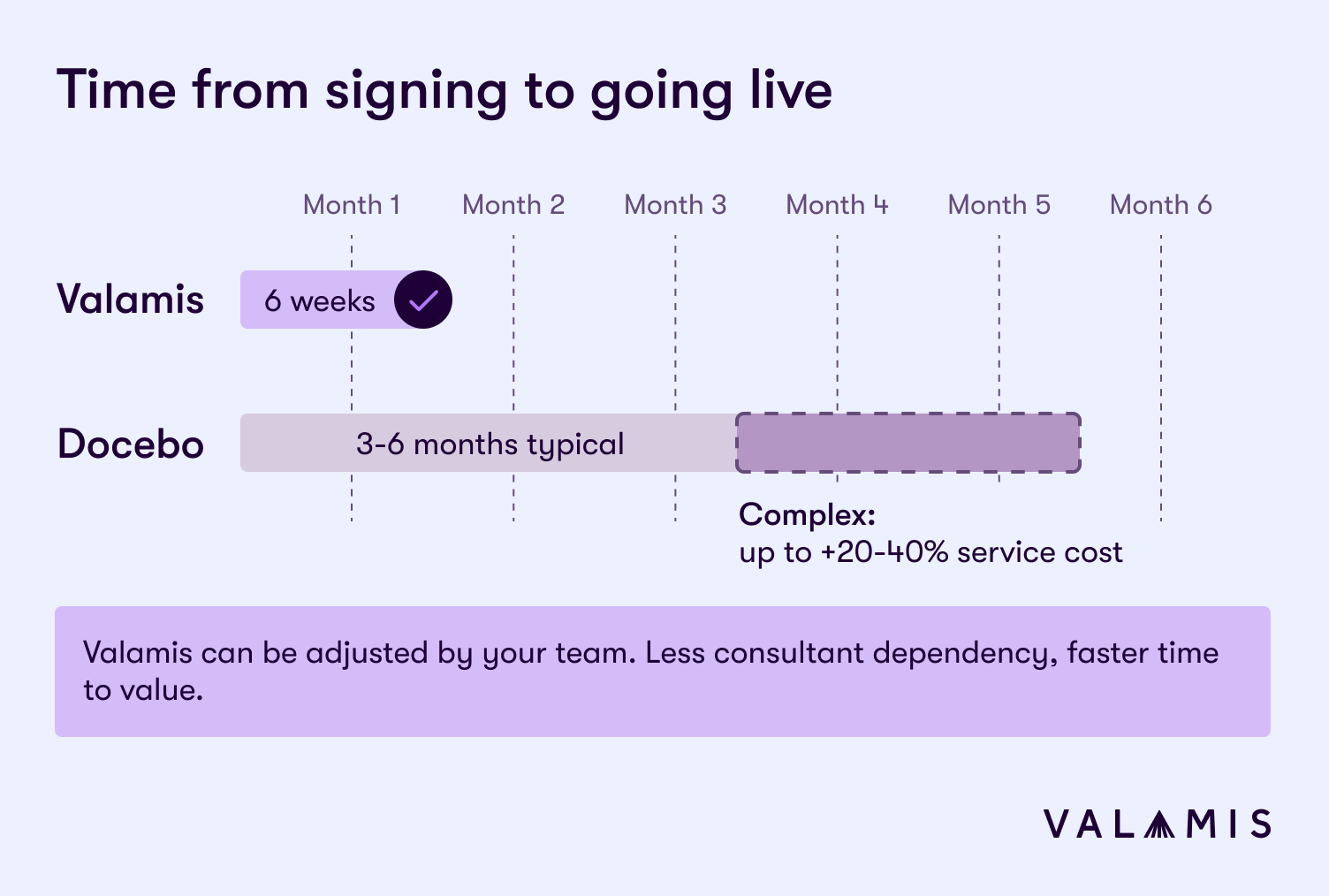
This does not mean setup is instant. But the gap between signing and going live is smaller, and your ongoing dependency on external consultants is lower.
The comparison table
| Capability | Valamis | Docebo |
|---|---|---|
| Fosway 9-Grid position | Core Challenger | Strategic Leader |
| Fosway trajectory | Excelling | Moderating |
| Total cost of ownership | Mid (Fosway) — no surprise add-ons | Mid (Fosway) — grows with add-ons |
| Starting price | Contact for quote | ~$25,000/year (before add-ons) |
| Built-in content authoring | Yes — Valamis Studio, AI-assisted, no-code | Limited built-in; 3rd-party tools typical |
| AI content generation | Lessons + questions from uploads | Course creation + auto-tagging |
| AI translations | Built-in content localization | Available |
| Compliance tracking | Auto-recertification, expiry alerts, audit trails | Compliance tracking; complex to configure |
| Analytics & reporting | xAPI + LRS + Superset; skills progression, readiness | Reporting suite; complexity flagged in reviews |
| Skills management | AI-assisted frameworks, linked to learning paths | Yes |
| Average implementation | Weeks | 3–6 months |
| Social learning | Forums, wikis, blogs, messaging | Yes |
| Content marketplace | Skillsoft, Go1, Pluralsight, LTI integration | Docebo Content Marketplace |
| On-premises deployment | Available | No |
When Docebo is the right call
We said we would be honest. Here it is.
Pick Docebo if you are a large enterprise that prioritizes learner experience above everything else. The Docebo learner interface looks good and feels modern.
If your primary challenge is learner adoption and engagement in a population of knowledge workers, Docebo does that well.
If your organization relies heavily on social learning and peer-generated content, Docebo has invested more in this area than most competitors.
If you need a content marketplace with pre-built courses from multiple providers in one storefront, Docebo’s Content Marketplace covers a lot of ground.
And if your evaluation criteria heavily weight brand recognition and market presence, Docebo is a safer pick on paper. It is publicly traded and widely adopted. For some procurement processes, that matters.
When a Docebo alternative like Valamis is the right call
Valamis is built for organizations where learning solves a business problem, not where learning is a perk.
You are in a regulated industry. Manufacturing, professional services, healthcare. Compliance is not a feature you configure once. It is a system that runs every day, and it needs to work every time. Valamis compliance workflows are built for that.
Your L&D team needs to author content, not manage vendors. If you want your team creating, publishing, and translating learning content inside the platform without buying Articulate separately, Valamis gives you that. Docebo does not, at the same depth.
You need analytics that go beyond completions. xAPI-based tracking, a built-in LRS, and reporting that produces evidence for leadership. Not another dashboard full of completion rates.
You want predictable costs. If your organization has 500 to 5,000 employees and the Docebo quote came back higher than expected, look at the total picture. Fosway rates both platforms at “Mid” TCO, but the route to that number is different. Valamis gets there without surprise add-ons.
You need to be live faster. Months of implementation is not a timeline every organization can absorb. Valamis is designed to be configured by your team, not rebuilt by consultants.
You operate across languages and borders. Built-in AI translation and content localization across the whole platform. For European organizations, this is a baseline requirement.
You want learning data available to AI assistants, not locked in a portal. If your organization is rolling out Copilot or building on AI agents, Valamis connects training and skills data through MCP so those tools can answer directly.
What the Fosway 9-Grid tells you (and what it does not)
Both Valamis and Docebo are Learning System Suites in the 2026 Fosway 9-Grid. Both have a “Mid” total cost of ownership. Docebo is in the Strategic Leader zone. Valamis is in the Core Challenger zone.
Docebo has the bigger market presence. More customers, more visibility, more brand recognition. That is real.
But the trajectories point in different directions. Docebo is “Moderating.” Valamis is “Excelling.” Trajectory measures where a vendor is headed relative to their own position and the market. “Moderating” means the pace of improvement is leveling off. “Excelling” means it is accelerating.
Presence tells you where a vendor has been. Trajectory tells you where they are going. If you are choosing a platform for the next three to five years, both data points matter.
The honest closing
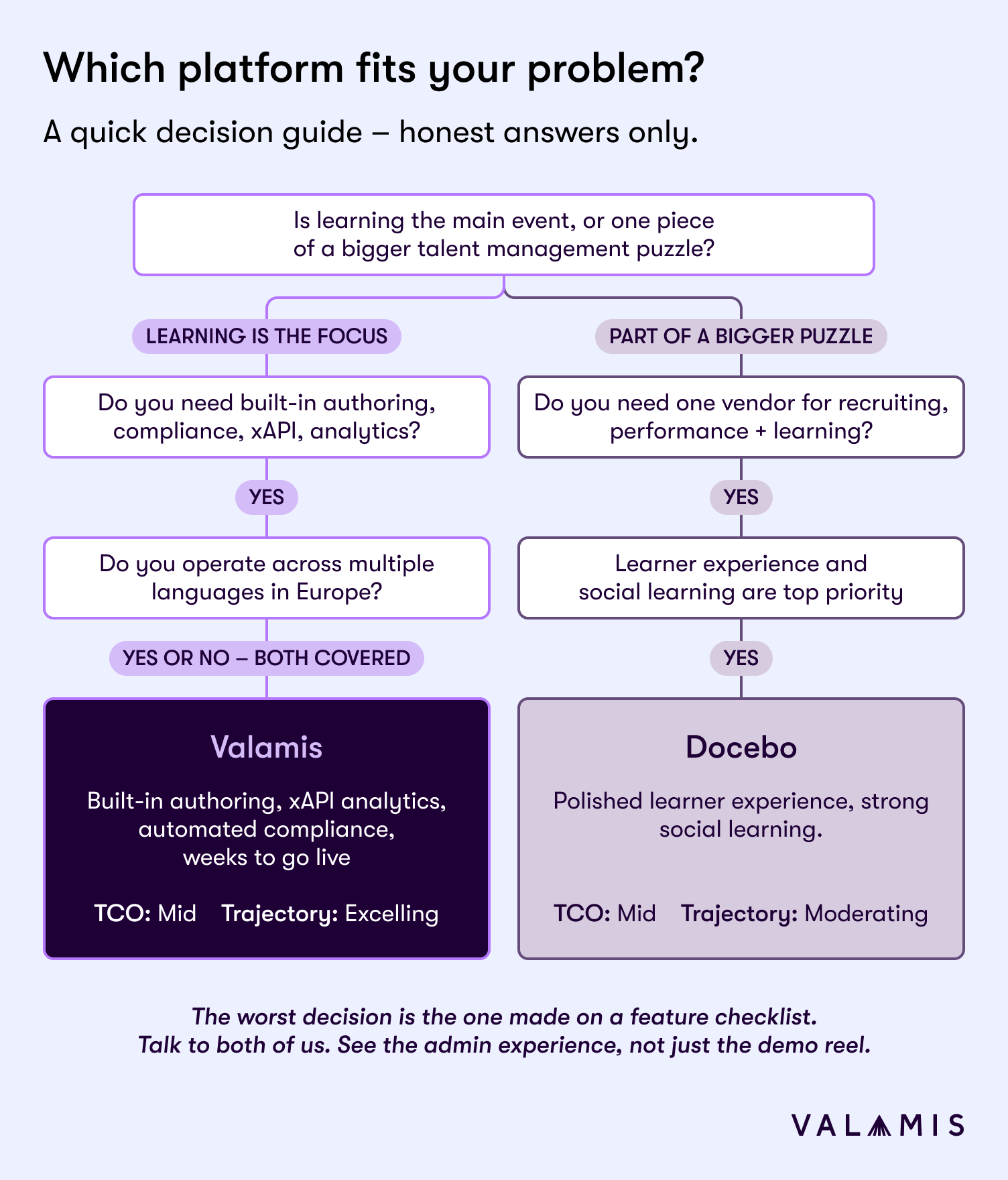
Docebo is a good platform. We are not here to tell you otherwise.
But “good platform” and “right platform for your organization” are different questions. If you need deep compliance, built-in authoring, xAPI analytics, predictable pricing, and faster time to launch, Valamis was built for that specific set of problems.
If you need a polished learner experience, strong social learning, and a big content marketplace, Docebo deserves a serious look.
Talk to both of us. Ask to see the admin experience, not the demo reel.
Ask about total cost after add-ons. Ask how long it takes to go live. And ask for customer references in your industry.
See how Docebo compares to 12 other platforms in our best LMS for corporate training roundup.
See Valamis in action →
Checklist on how to choose the best LMS
The checklist will keep your focus on what really matters when choosing an LMS.
Download