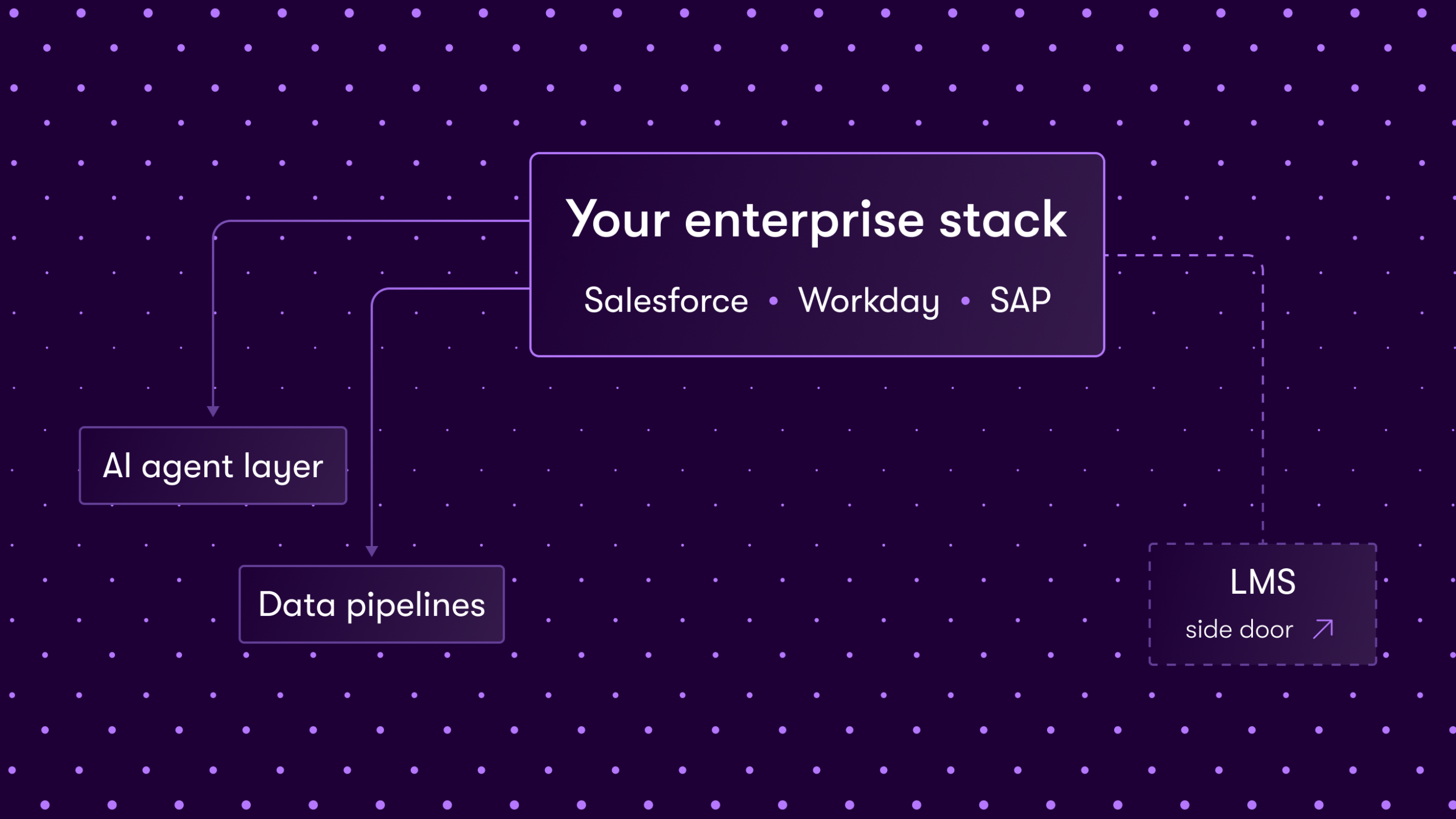
The LMS UI is becoming a side door
Enterprise AI agents don’t log in, they call data. Yet most learning platforms can’t be called. Here’s why the LMS UI is becoming a side door, and what a compliance-grade headless architecture makes possible.

Every learning management system on the market was built around the same assumption: a person logs in.
They open a portal, find a course, complete it, and check their progress. A manager logs into the admin UI to review team compliance. An L&D team pulls a report by navigating to the right screen and clicking export.
This model is not broken. It just describes a world that is becoming a minority use case.
Enterprise AI agents do not log in, they call data. Yet most learning platforms cannot be called.
What is a headless LMS?
A headless LMS decouples the learning logic from the interface. The platform continues to manage enrollment, completion, compliance records and certification, but none of those processes require a user to open a browser. Every workflow is accessible via API, MCP tool, or CLI. The UI becomes one surface among many, not the only way in.
This is distinct from a traditional LMS in one specific way: the data and logic are designed to be called, not just viewed.
The agent stack is being assembled without us
Right now, enterprise teams are deploying AI agents built in Microsoft Copilot Studio, Salesforce Agentforce, or developed in-house. These agents are being connected to CRM systems, ticketing platforms, email, HR records, financial data. Their job is to act on behalf of users: answer questions, trigger workflows, surface data, complete tasks.
To do any of this usefully in the context of people, roles and work, they need to know who has been certified for what, what expires when, what a role requires in which country, and what is auditable.
That data lives in the LMS. Nowhere else in the enterprise stack.
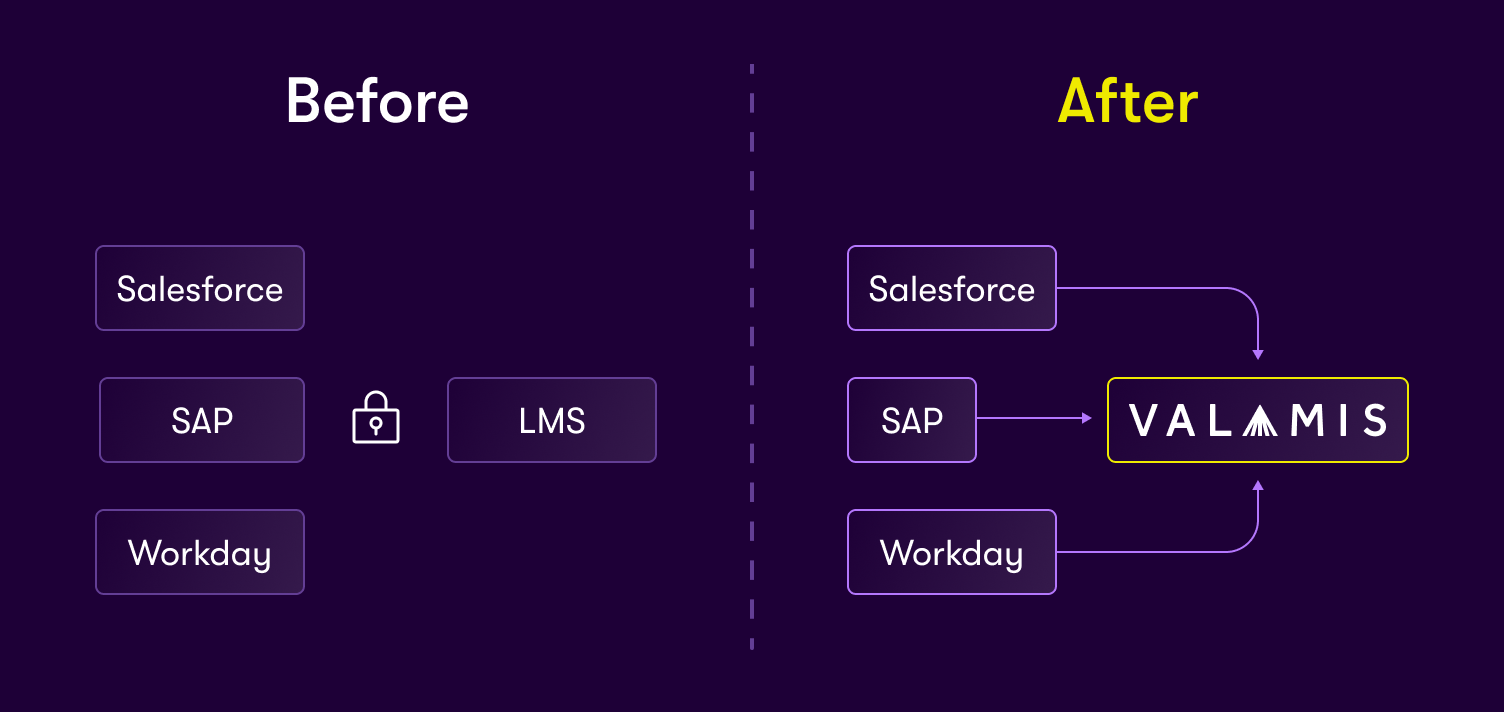
If an agent cannot reach it through an API or MCP tool, one of two things happens. The customer builds the integration themselves, at which point the LMS becomes a data source rather than a platform. Or the agent works without it, at which point the LMS becomes irrelevant to the most important new workflow category in enterprise software.
Neither outcome is good for anyone who wants to remain a platform vendor.
The market data is clear, and the gap is widening
This is not a prediction about the distant future, it is happening now.
Fosway Group, Europe’s leading HR technology analyst, published their 2026 AI in Learning Systems benchmarking this year. Live AI capability across the LMS market has more than doubled year-on-year, from 10% to 24% of mapped features. The total AI feature set expanded 67% in a single year.
But 41% of all AI features in their model are still not on any vendor roadmap. The distribution of vendors by live AI capability has spread out sharply, with a small group moving quickly, a larger middle group advancing, and a meaningful tail barely engaged.
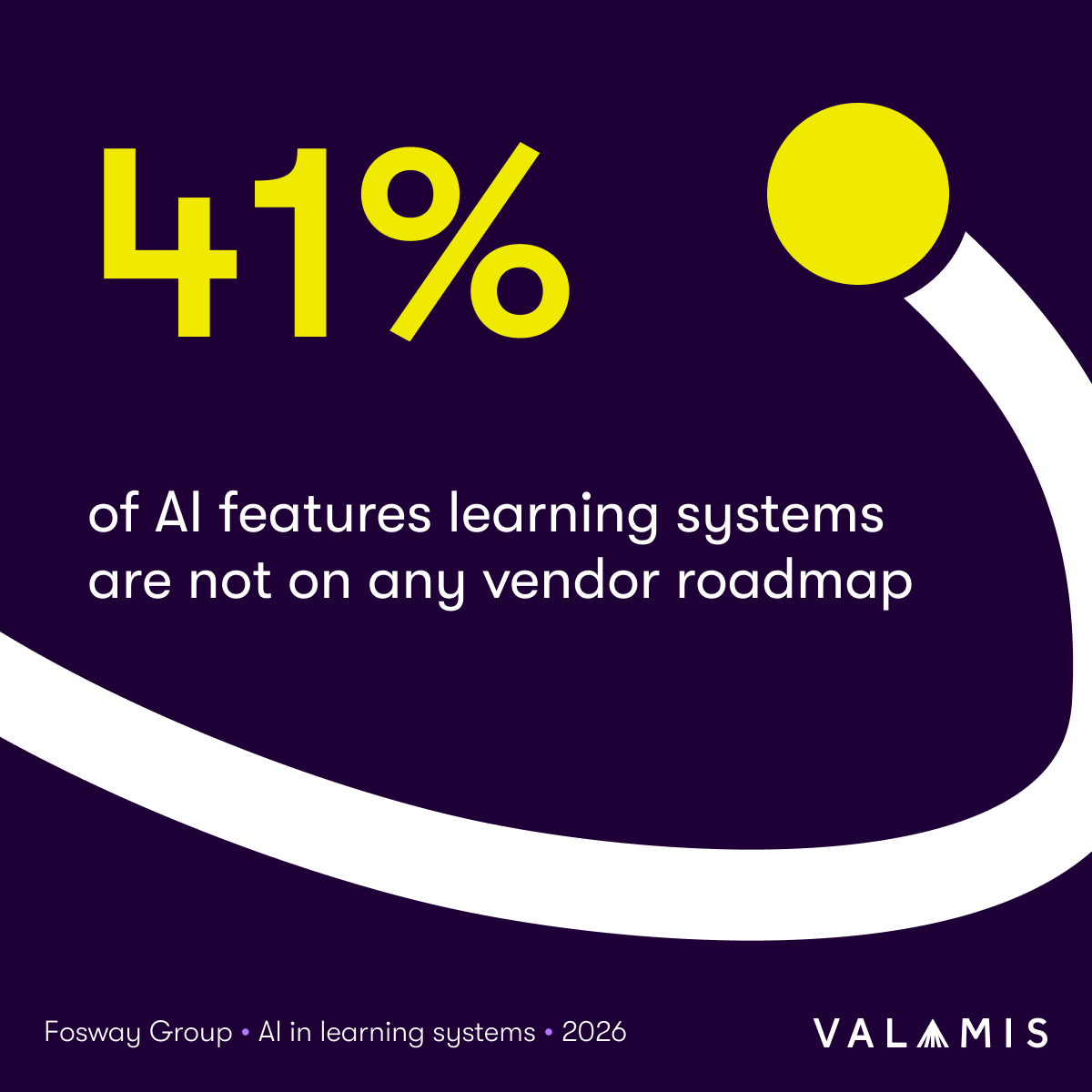
Source: 2026 Fosway AI Market Assessment for Learning Systems
The MCP integration layer specifically sits in what Fosway calls an Edge Advantage category: 78% of vendors have it on their roadmap, but only 17% have it live with customers. Fosway describes Edge Advantage features as “potentially more transformational” than the mainstream capabilities most vendors are currently focused on.
Most vendors are building AI that lives inside their own UI. Few are developing AI that makes their platform reachable from everywhere else.
What a headless LMS makes possible
A compliance-grade headless layer delivers three things a traditional LMS cannot. It makes learning data available to every system in the enterprise stack without manual export. It allows AI agents to act on live compliance status rather than stale reports. And it creates an audit trail that remains valid regardless of whether a human or an agent triggered the action. The integration surface is standardised from the start.
What headless means in practice
It means every process that can be done in the UI is also doable via API, MCP tool, or CLI. Enrollment. Completion tracking. Compliance status. Certificate issuance. Skills gap analysis. Manager confirmation. Attestation. Audit log query. All of it, accessible without anyone opening a browser.
The UI does not disappear. It becomes one surface among many.
The same compliance logic that runs when a user clicks through a portal also runs when an agent verifies team certification status before releasing a customer service ticket. The same learning record that a manager views in a dashboard is also available in a single API call to a Slack bot, a Copilot workflow, or a custom enterprise application.
In practice this means:
A manager asks their AI assistant in Slack to check whether everyone on their team has completed mandatory GDPR training before a client launch. The agent queries the LMS directly, returns a live compliance summary, and flags the two people who have not completed it, without opening a browser or sending a report request to L&D.
A new employee joins a regulated role. An agent provisions their mandatory learning path based on role and country, enrolls them on the first module, and sets calendar reminders for certification deadlines, all triggered by the HR system on day one.
A field service technician completes a short safety refresher by voice on the way to a site visit. The completion is recorded against their certification record, timestamped and linked to the specific content version, without the technician ever logging into a portal.
None of these require a new product. They require a platform designed for it.
Challenges and considerations
Making an LMS headless is not a configuration change. It requires architectural decisions that cannot be retrofitted cleanly. Governance is the hardest part. Agent identity must be a first-class concept from the start (not added later into an existing audit log). Compliance customers in regulated industries will ask whether an agent-recorded completion carries the same legal weight as a human one. The answer must be yes, by design.
Why compliance makes this harder than it looks
Making an LMS headless goes well beyond API coverage. Compliance training adds a dimension that most vendors have yet to address.
If an agent records a completion, who signed it off? If an attestation is submitted programmatically, is there a verification chain that proves genuine content consumption? If a regulator audits the record, can you distinguish agent action from human action?
These are live questions, arriving in real commercial discussions right now. Regulated industry customers are already asking them. And the honest answer, at almost every LMS vendor today, is that the governance layer is absent from the stack entirely.
This is the real distinction. The API matters. The MCP server matters. But the audit-grade governance layer that makes agentic completion trustworthy in a regulated environment: agent identity as a first-class concept in every log entry, guardrails on critical compliance calls so that attestation requires genuine content consumption, a verification chain that would satisfy a regulator. This is what separates a platform from a data source.
Establishing this correctly from the start is the only viable approach. Retrofitting agent identity into an existing audit log breaks existing customer records. It must be designed as a first principle.
The window is closing fast
Several large LMS competitors already have a first limited MCP server in production. “We have an API” will be table stakes within 12 months.
The position that remains open is a compliance-grade headless layer: full API and MCP coverage across learning, competence and compliance workflows, headless identity with agent identity as a first-class audit concept, and a governance framework designed for regulated industries from the start.
Salesforce built Headless 360 because they understood that the UI was becoming one surface among many. The same logic applies to learning platforms. The question is which vendors deliver it before customers start making replacement decisions based on it.
This is the work we are doing now. I believe it is the core architectural decision of the next 24 months.
Frequently asked questions
What is a headless LMS?
A headless LMS decouples the learning logic from the interface. Every workflow — enrolment, completion tracking, compliance status, certificate issuance — is accessible via API, MCP tool or CLI without requiring a user to open a browser. The UI becomes one surface among many, not the only way in.
What is MCP in learning systems?
Model Context Protocol (MCP) is a standard that lets AI agents call external tools and data sources in a structured, predictable way. In learning systems, it allows agents to query enrolment status, compliance records, certification data and skills frameworks directly, without custom integrations or browser automation.
Why does compliance make a headless LMS harder to implement?
Compliance training requires an audit trail where agent actions are distinguishable from human actions. This means agent identity has to be a first-class concept in the data model from day one. An agent-recorded completion must carry the same legal weight as a human one, which requires verification guardrails, session tracing, and a governance layer built into the architecture from the start.
How is a headless LMS different from a traditional LMS?
A traditional LMS was built for humans logging in. A headless LMS is built to be called. The data and logic are designed to be accessed programmatically — by AI agents, third-party applications, Slack bots, voice interfaces, or any other surface — without the LMS serving as the interface the user interacts with.
Is Valamis a headless LMS?
Yes. Valamis is built API-first, with every workflow: enrollment, completion tracking, compliance status, certificate issuance, accessible via API, MCP tool, or CLI, not only through the browser UI. This makes it suited to large enterprises that need to embed learning and compliance data into AI agents, HR systems, or custom applications, particularly in regulated industries where audit-ready records matter as much as API access itself.
When does a headless LMS make sense?
A headless LMS makes sense when learning data needs to work outside the learning platform’s own interface. Common signals include deploying AI agents built in tools like Microsoft Copilot Studio or Salesforce Agentforce that need live compliance or certification data, embedding training into products, portals, or applications, automating enrollment from HR systems, and operating in regulated industries where audit records must remain valid however they were triggered. If learning data only ever needs to be viewed by people logging into one portal, a traditional LMS is enough.
Does a headless LMS mean giving up the user interface?
No. In a headless LMS the interface becomes one surface among many rather than disappearing. Learners and administrators can keep using the portal as before, while the same enrollment, completion, and compliance logic is also available to AI agents, integrations, and other applications through APIs and MCP tools. Headless describes how the platform can be accessed, not what gets removed.
See Valamis in action
Book a call and we’ll walk through the platform against your own requirements.
Book a demo