AI in talent management
AI is helping organizations make faster, more informed decisions about hiring, skills, and career development. Here’s what that looks like across six specific areas of talent management.

Organizations today face a growing challenge: building and keeping the skills they need to stay competitive. According to Deloitte’s 2026 Global Human Capital Trends survey, 7 in 10 business leaders say their primary competitive strategy over the next three years is to quickly adapt to and capitalize on changing business, customer, or market needs.
The ability to adapt, however, depends on your people. As business priorities change and new technologies arrive, organizations need employees who can develop new skills and move into evolving roles. At the same time, HR and L&D teams are expected to make decisions faster by using increasing amounts of workforce data.
AI is changing how talent management works, allowing organizations to understand workplace skills better, identify talent gaps, personalize learning, and support employees throughout their careers. Rather than relying on time-consuming manual processes or intuition alone, AI-powered insights enable better decisions across the employee lifecycle.
In this article, we’ll explore what AI in talent management is, the benefits it offers, and six specific areas where organizations are using AI to improve it.
What is AI in talent management?
AI in talent management refers to the use of artificial intelligence to support organizations in the process of attracting, developing, and retaining talent. By analyzing large amounts of workforce data, AI can identify patterns, generate insights, and automate routine tasks that would otherwise require significant time and manual effort.
AI in talent management involves a range of technologies, including machine learning, natural language processing (NLP), predictive analytics, and generative AI. Each plays a different role, but in practice these technologies are usually combined rather than used on their own.
More recently, many organizations are beginning to explore agentic AI. In talent management, AI agents could proactively recommend learning pathways, surface internal career opportunities, or assist HR and L&D teams with routine workflows to deliver more personalized employee experiences at scale.
As AI capabilities continue to evolve, organizations are increasingly using them not only to improve efficiency but also to build a more agile workforce that can adapt to new business priorities and future skill requirements.
What are the benefits of AI in talent management?
Some of the main benefits of AI in talent management include:
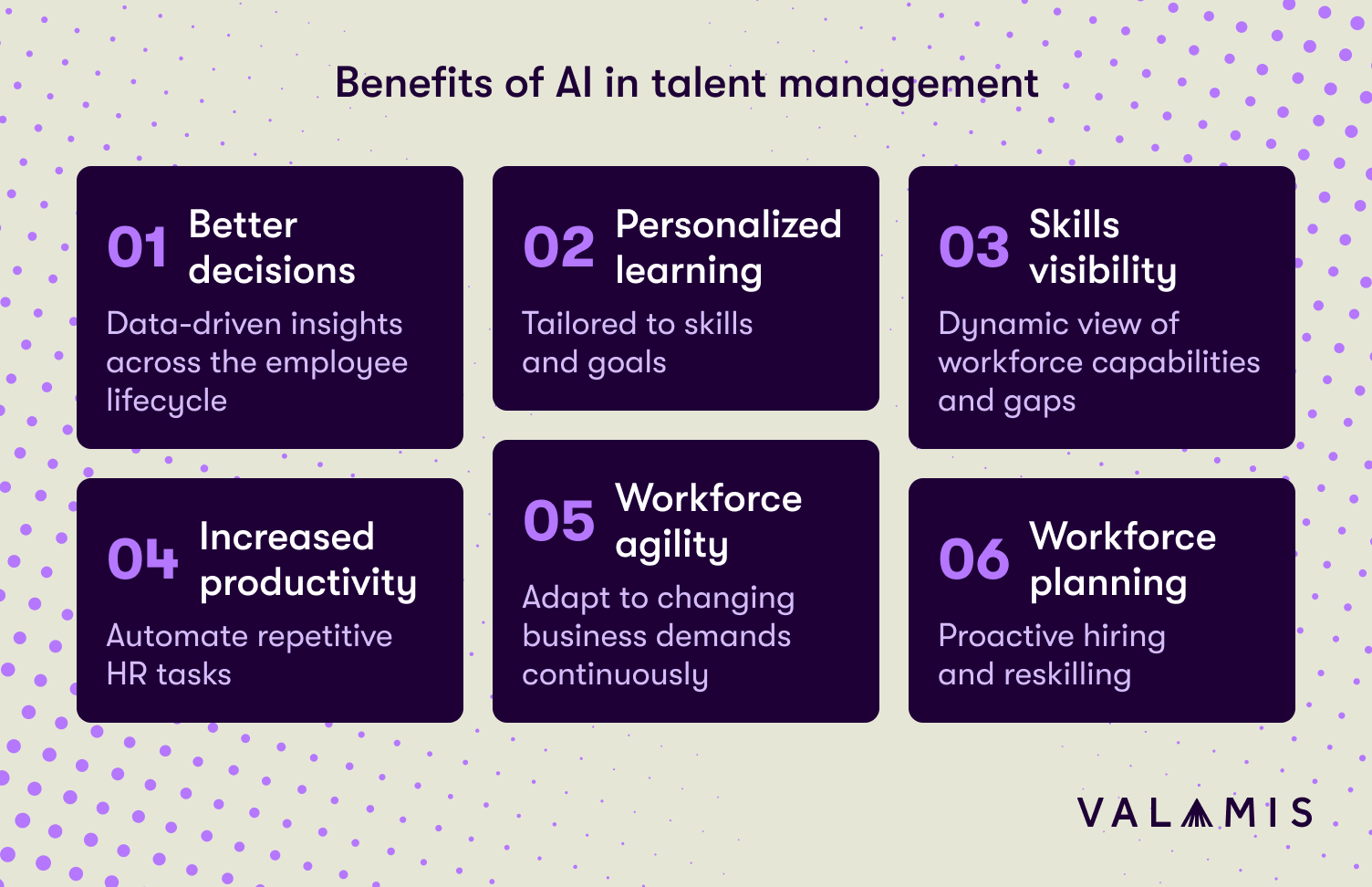
- Better decisions: Analyzing large volumes of data to spot patterns that inform hiring, employee skills development, and workforce planning decisions.
- Personalized learning: Recommending relevant learning opportunities and career paths matched to each employee’s skills, goals, and aspirations.
- Greater visibility into employee skills: Building dynamic skills inventories that give a clearer view of workforce capabilities and gaps.
- Increased productivity: Automating repetitive administrative tasks like resume screening and performance summaries, freeing HR and L&D teams for more strategic work. 75% of surveyed workers say AI has improved the speed or quality of their output.
- Workforce agility: Identifying emerging skill needs and encouraging continuous learning to support teams in adapting to change.
- Workforce planning: Analyzing workforce trends and business objectives to support proactive hiring, reskilling, and succession planning decisions.
How are organizations using AI in talent management?
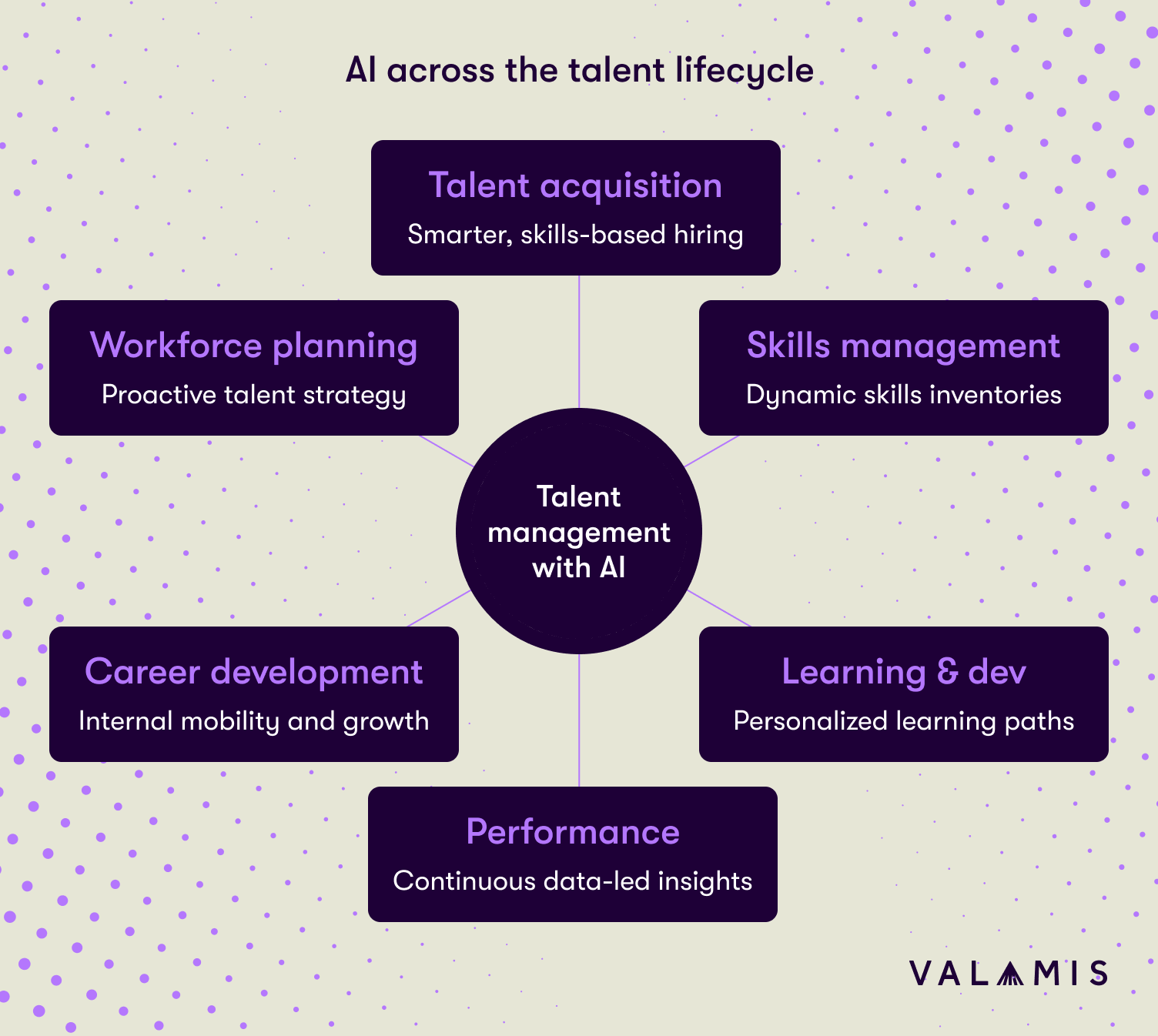
Here are six areas where organizations are using AI to improve talent management.
Talent acquisition
AI helps recruitment by automating repetitive tasks and providing data-driven insights throughout the hiring process. For example, AI can screen resumes, match candidates’ skills against job requirements, generate job descriptions, summarize candidate profiles, and suggest interview questions. This reduces administrative work, allowing recruiters to spend more time engaging with candidates and making informed hiring decisions.
AI can also help organizations expand their talent pools by supporting skills-based hiring. Rather than relying solely on job titles, qualifications, or years of experience, AI can identify candidates with transferable skills who may be well suited to a role, and recruiters uncover talent that might otherwise be overlooked.
Human judgment remains essential when evaluating soft skills such as communication, collaboration, and motivation. Organizations should also regularly review AI-powered hiring tools to check that recruitment processes stay transparent, fair, and free from unintended bias.
Responsible AI in recruitment has fast become a regulatory requirement. Many AI systems used for recruitment are classified as high-risk under the EU AI Act, with full compliance obligations being phased in as implementation timelines continue to evolve, introducing stricter requirements for both AI providers and the organizations that use them.
Skills management
Understanding your employees’ skills is fundamental to effective talent management. Yet many organizations still rely on outdated skills inventories or self-reported data, making it difficult to identify capability gaps.
Organizations using AI can build a more accurate and dynamic view of workforce skills by connecting data from across the employee lifecycle. Learning data from your LMS can be combined with information from HR systems, performance reviews, and work history to create up-to-date skills profiles.
This gives HR and L&D teams greater visibility into the capabilities that already exist within the organization, as well as the skills that need further development.
By comparing employee capabilities with changing business priorities, AI can anticipate future skill needs and prioritize reskilling and upskilling initiatives. This enables a more proactive approach to talent management, so employees keep developing the skills the business needs to remain competitive.
Learning and development
Learning and development plays a central role in helping employees build the skills they need today while preparing for future roles. AI supports this by personalizing learning experiences, recommending relevant content, and providing data-driven insights into learner progress.
For L&D teams, AI can also trim administrative tasks and improve decision-making through learning analytics. However, realizing these benefits depends on high-quality data and investing in AI literacy so teams can use the technology effectively.
Want to learn more? Explore our guide to AI in Learning and Development, where we take a deeper look at how AI is changing workplace learning.
Performance management
Traditional performance reviews often provide only a snapshot of employee performance. AI helps organizations move toward a more continuous approach by analyzing performance data, identifying trends, and providing managers with timely insights throughout the year.
For example, AI can summarize feedback from multiple sources and highlight changes in employee performance over time. By combining performance data with information from learning, skills, and career development, organizations gain a more complete understanding of an employee’s progress and readiness for new opportunities.
These insights can guide managers in conducting more meaningful performance appraisals and discussions around coaching, promotions, succession planning, and training. Employees also benefit from more timely feedback and clearer development pathways.
Career development
Employees are more likely to stay with an organization when they can see opportunities to progress in their careers. At the same time, filling roles internally allows organizations to retain knowledge, reduce recruitment costs, and respond more quickly to business needs.
Some AI tools have the ability to identify employees with transferable skills who may be ready for new opportunities. Mastercard, for example, uses AI to match employees with short-term projects, mentoring opportunities, open roles, and learning pathways based on the skills they have and the skills they want to develop. They found that one-third of employees who participated in a project or mentoring opportunity went on to change roles or receive a promotion.
For HR and L&D teams, this creates a more skills-based approach to career development. Employees receive personalized learning recommendations to prepare for future roles, while organizations are better equipped to retain talent and build the capabilities they need from within.
Workforce planning
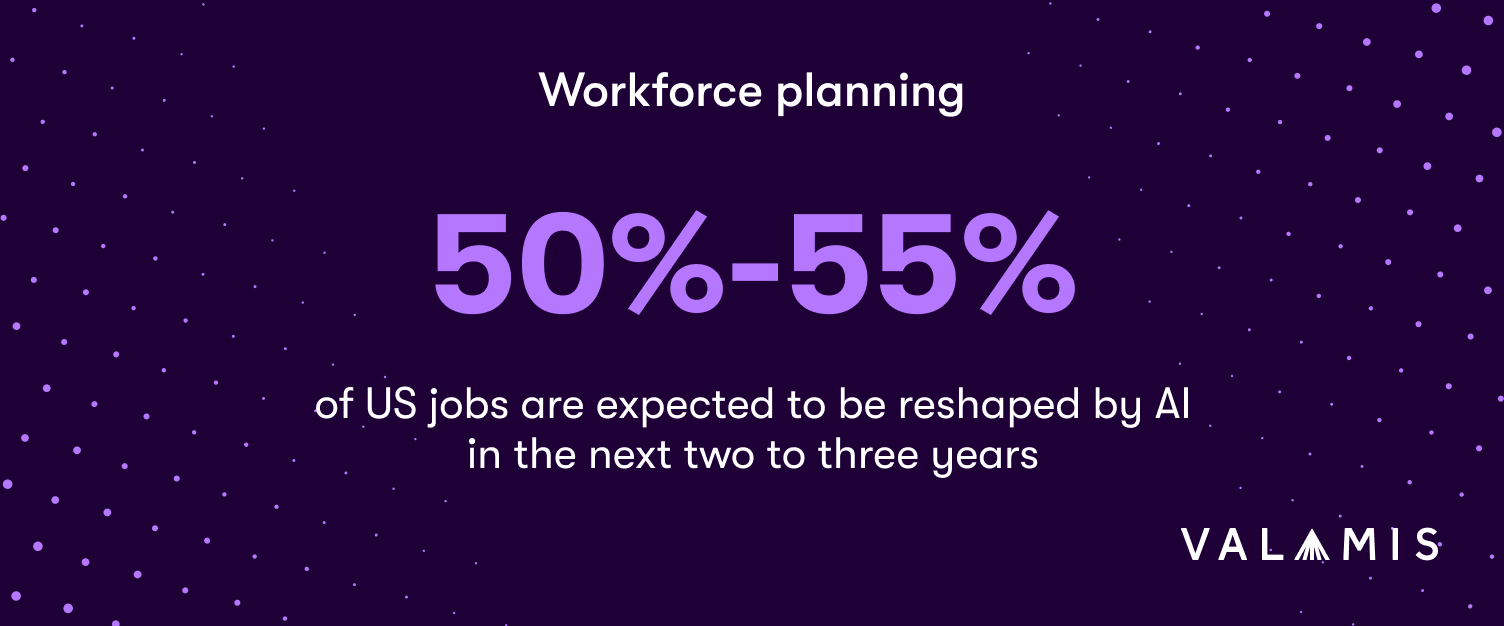
Between 50% and 55% of jobs in the US are expected to be reshaped by AI over the next two to three years, increasing the need for organizations to continuously assess workforce capabilities and prepare employees for their next role.
By analyzing workforce data, skills trends, business objectives, and labor market insights, AI can identify emerging skill gaps, predict future talent needs, and highlight areas where hiring, reskilling, or upskilling may be required. These insights enable organizations to consider where best to invest in talent development and how to align workforce capabilities with long-term business goals.
AI also supports scenario planning through modelling the potential impact of changes such as business growth, restructuring, or evolving skills requirements. This allows leaders to evaluate different workforce strategies and respond more quickly as priorities change.
Combined with human expertise and a clear understanding of business objectives, AI can help organizations build a more resilient workforce.
What should you consider before using AI in talent management?
While AI offers significant opportunities to improve talent management, successful adoption requires more than just implementing new technology. Here are some things to consider if you are thinking of using AI in talent management.
- Data quality: Incomplete, outdated, or inaccurate workforce data can lead to poor recommendations. Keep inputted data accurate, consistent, and regularly updated.
- Bias: AI models can unintentionally reinforce existing biases, particularly in recruitment, promotions, and performance management. Regularly review AI outputs and keep human oversight in the process.
- Employee trust and transparency: Be transparent about what data is collected, how AI supports talent decisions, and where human judgment is applied.
- Security: Talent management involves sensitive employee information, so AI tools need to comply with data protection regulations and clear data-handling policies.
- AI literacy: HR and L&D teams, managers, and employees all need to understand what AI can and cannot do, and when human judgment should take precedence.
- Decision-making: Establish clear governance defining where AI can act independently, where human approval is required, and who is accountable for the outcome.
How does Valamis support AI-powered talent management?
Most L&D teams do not lack learning content. They lack a reliable view of which skills exist in the business and which ones are missing. Valamis connects learning data with skills profiles so HR and L&D teams can see where the gaps are, then route people to the learning that closes them. AI-driven recommendations and personalized paths are the mechanism, not the point.
We are building AI further into the platform, including agentic AI, so teams can see what to learn next and get there faster.
Book a demo to see how Valamis can support your AI-powered talent strategy.
Frequently asked questions
What is AI in talent management?
AI in talent management refers to using artificial intelligence to help organizations make better decisions about attracting, developing, and retaining talent. It analyzes workforce data to identify patterns, generate insights, and automate routine tasks across recruitment, skills management, learning, performance, and career development.
What are the main benefits of using AI in talent management?
Better decisions through data analysis, personalized learning recommendations, greater visibility into workforce skills, increased productivity through automation, workforce agility, and more proactive workforce planning.
Where are organizations using AI in talent management today?
Six areas: talent acquisition, skills management, learning and development, performance management, career development, and workforce planning.
What should organizations consider before adopting AI in talent management?
Data quality, bias, employee trust and transparency, security, AI literacy, and how AI fits into decision-making. Human oversight should remain part of the process throughout.
See Valamis in action
Book a call and we’ll walk through the platform against your own requirements.
Book a demo