Training needs analysis: A complete guide
Learn what a training needs analysis is, why it matters, and how to conduct one in six steps, with tools and worked examples.


Article summary: Most training budgets go on programs no one confirmed were needed. A training needs analysis compares the skills your workforce has against the skills it needs, at organization, role, and individual level, so you can see where training will make a difference and where it will not. This guide covers the three levels of analysis, a six-step process, the tools to use, and three worked examples.
Investing in employee training is one thing. Making sure that training addresses the skills your workforce needs is another.
Too often, organizations rely on one-size-fits-all learning programs that consume time and budget without delivering measurable results. Employees might complete courses, but performance doesn’t improve, business goals remain out of reach, and L&D teams struggle to demonstrate return on investment (ROI).
A training needs analysis (TNA) helps solve this challenge. By identifying the skills employees need and determining where training can have the greatest impact, organizations can build learning programs that are relevant and aligned with business objectives.
What is a training needs analysis?
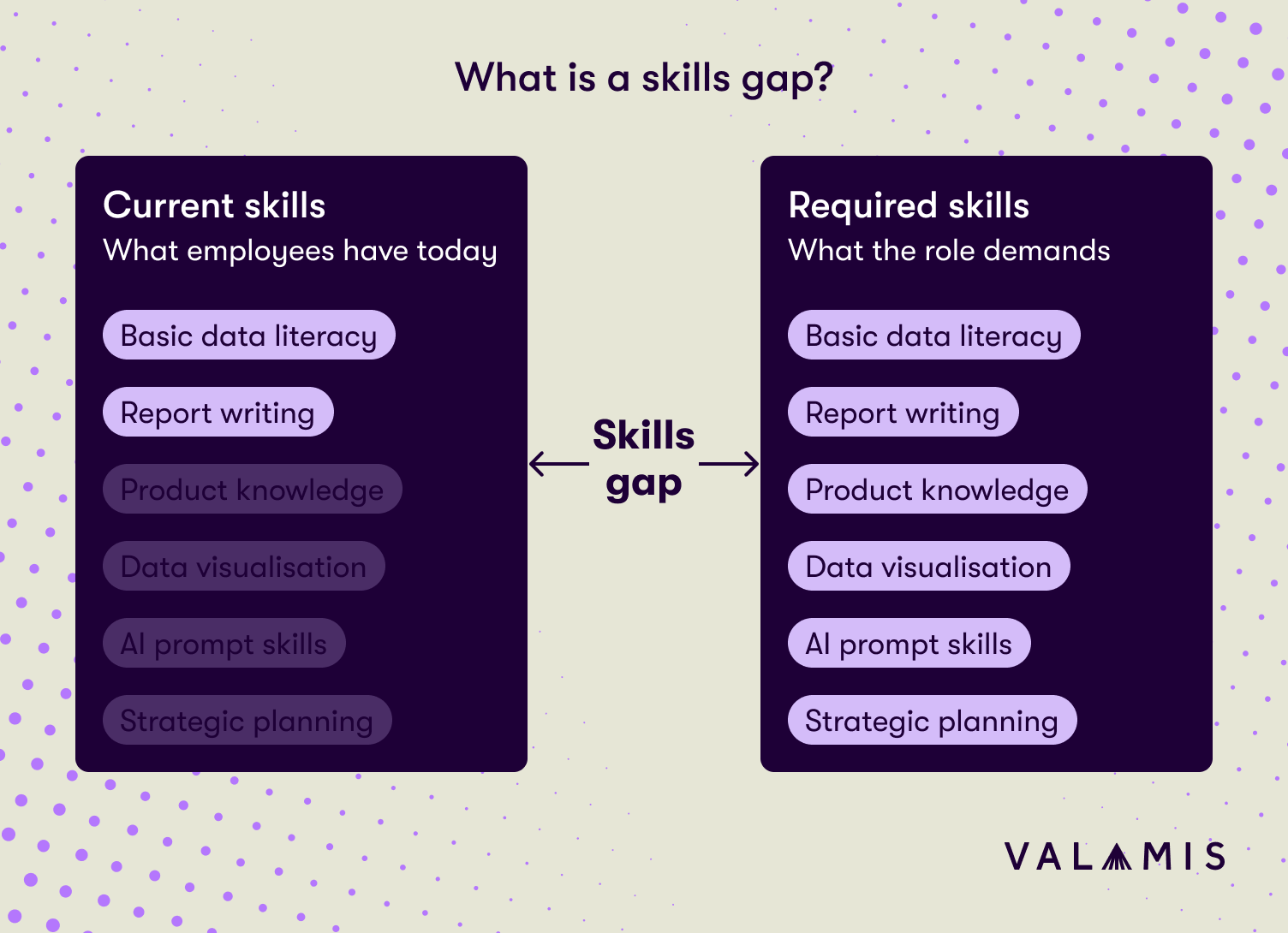
A training needs analysis is a structured process used to identify the gap between current and required knowledge, skills, and competencies across an organization, role, or individual employee. It helps determine who needs training, what they need to learn, and whether training is the most effective way to improve performance.
Rather than assuming what training employees need, a TNA uses data to assess current capabilities, identify development needs, and inform learning decisions. The result is training that supports both individual development and organizational goals.
A training needs analysis draws on a range of data sources, including:
- Performance appraisals
- Skills assessments
- Employee and manager feedback
- Surveys
- Workforce planning data
- Learning analytics from your LMS
What are the three levels of training needs analysis?
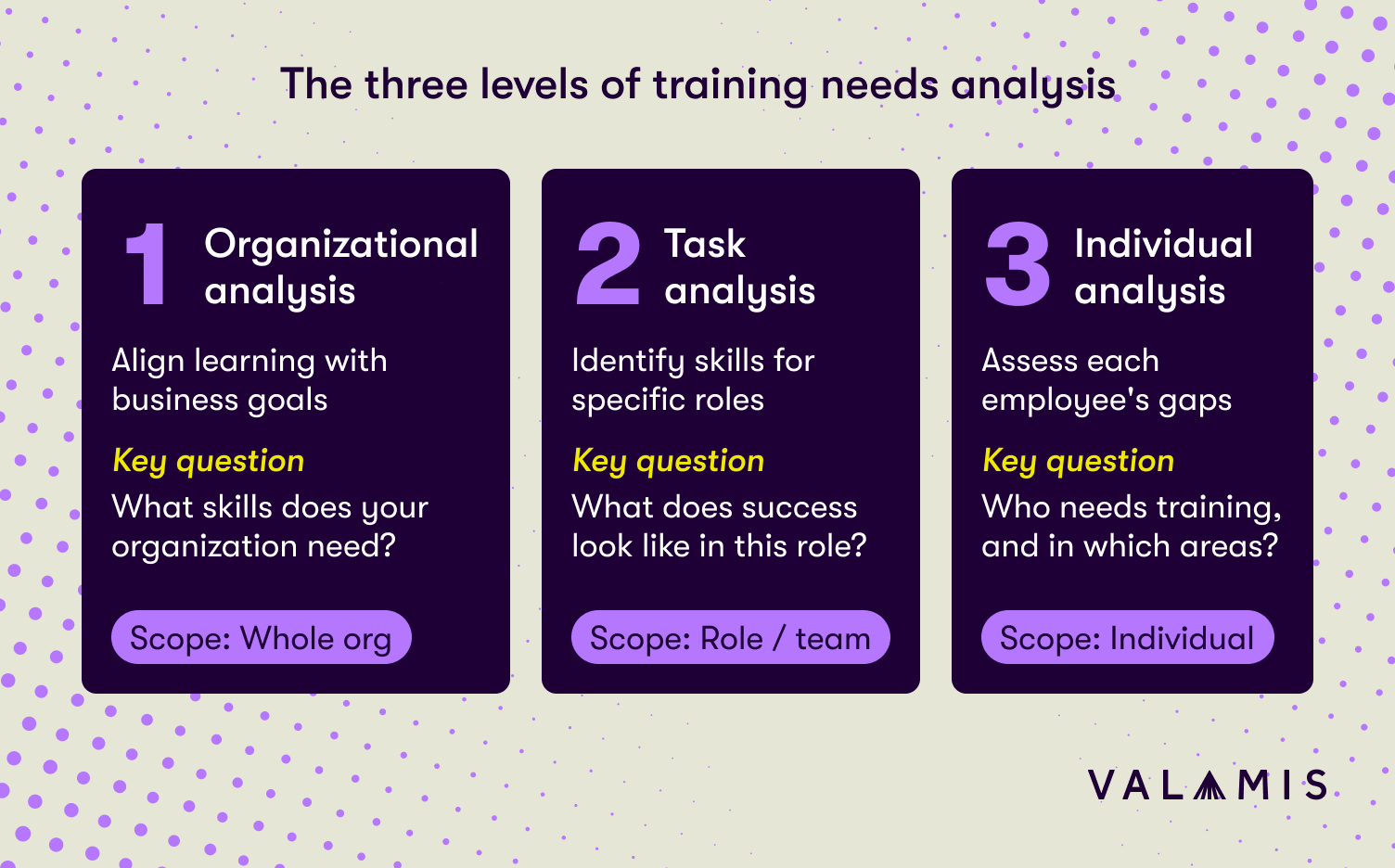
Training needs don’t exist in a vacuum. An individual’s skills gap can affect team performance and, ultimately, business outcomes. That’s why an effective training needs analysis looks at learning needs across three connected levels.
| Level | Purpose | Questions to ask | Typical inputs | Example finding |
|---|---|---|---|---|
| Organizational analysis | Align learning with business goals. | What skills does the organization need to achieve its objectives? | Business plans, workforce data, leadership interviews | Employees across sales, marketing, and customer support need training on using approved generative AI tools to support the organization’s AI adoption strategy. |
| Task analysis | Identify the knowledge and skills required for specific roles. | What does successful performance look like? | Job descriptions, process documentation, observations, subject matter experts | Customer service advisors need training on the new support platform before the system goes live. |
| Individual analysis | Assess each employee’s current capabilities. | Who needs training, and in which areas? | Performance reviews, skills assessments, manager feedback, self-assessments | A particular manager would benefit from coaching on how to give constructive feedback. |
Organizational analysis
Organizational analysis looks at the bigger picture. It focuses on your organization’s strategic goals and asks what capabilities your workforce needs to achieve them. This might include supporting digitalization, entering new markets, improving customer experience, or meeting new compliance requirements.
For example, if your organization is introducing AI-powered tools, employees may need new technical skills to use them effectively, while managers may need guidance on leading teams through change. A training needs analysis helps L&D teams determine which learning initiatives will best support these priorities, so training aligns with long-term business objectives.
Task analysis
Task analysis examines the knowledge, skills, and behaviors employees need to perform a specific role successfully.
Without relying solely on job descriptions, it breaks a role down into its daily responsibilities and identifies the competencies required to complete them effectively. This helps L&D teams determine what employees need to learn, whether existing training is still relevant, and where new or updated learning content is required. The result is training that reflects how people work.
Individual analysis
Even when employees share the same role, their learning needs can differ. Individual analysis looks at each employee’s current capabilities to identify where development is needed.
This insight comes from a combination of performance appraisals, skills assessments, manager feedback, certifications, and other learning data. Together, these sources provide a more complete picture of each employee’s strengths and development opportunities.
Why is conducting a training needs analysis important?
A training needs analysis helps organizations move from reactive training to strategic workforce development. The benefits include:
Better alignment with business goals: Learning becomes a strategic investment when it supports measurable business outcomes, whether that’s improving customer satisfaction, increasing productivity, strengthening leadership, or supporting digitalization.
Effective learning experiences: Employees are more likely to engage with training that feels relevant to their roles and career development. Personalized learning also reduces unnecessary training time.
More efficient use of training budgets: 65% of L&D teams cite limited budget and resources as a top challenge in aligning learning with corporate goals. Without a clear understanding of training needs, organizations risk spending their budget on courses that don’t solve the underlying problem. A TNA helps prioritize initiatives that deliver the greatest value, so resources go where they will have the most impact.
Easier measurement of ROI: A training needs analysis establishes a clear baseline by identifying existing skills gaps and the training needed to address them. This makes it easier to evaluate whether learning has closed those gaps and delivered a return on your training investment.
Improved employee retention: According to LinkedIn’s Workplace Learning Report 2025, 88% of organizations are concerned about employee retention.
Employees want opportunities to learn and grow. Demonstrating a clear commitment to professional development helps organizations support internal mobility and retention.
How to conduct a training needs analysis
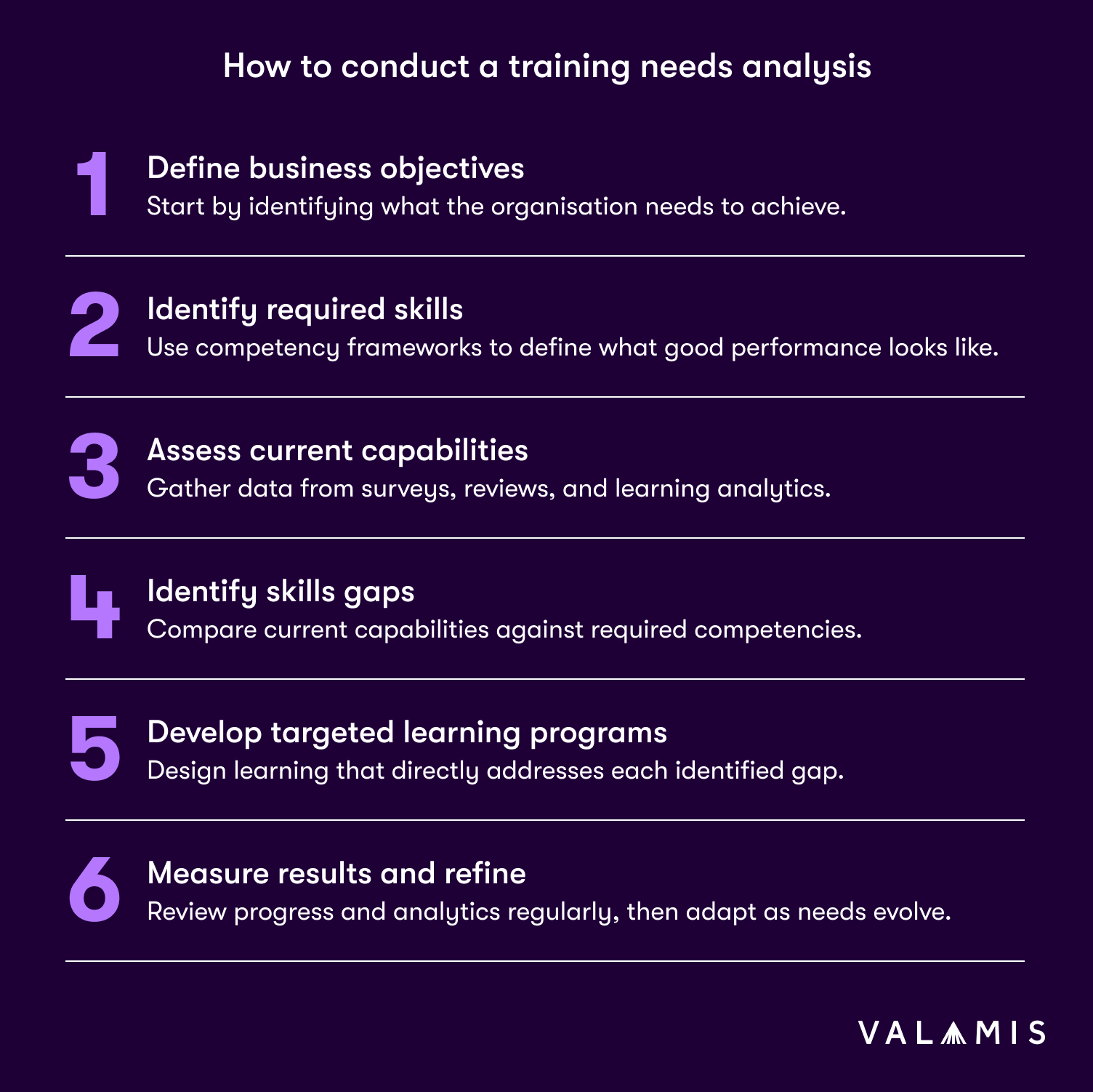
A structured approach helps your analysis lead to meaningful action.
Define your business objectives
Start by identifying what your organization wants to achieve.
For example, your goals might include:
- Improving customer satisfaction
- Supporting digitalization
- Increasing sales performance
- Preparing future leaders
Clear objectives help determine which skills matter most.
Identify the required skills and competencies
Next, define what success looks like.
Review job descriptions, competency frameworks, business processes, and conversations with department leaders to understand the knowledge and behaviors employees need.
This creates the benchmark against which current capabilities can be measured.
Assess current capabilities
Collect data from multiple sources to build an accurate picture of your workforce.
Common methods include:
- Skills assessments
- Surveys
- Interviews
- Performance reviews
- Manager feedback
- LMS learning analytics
Using multiple data sources reduces bias and helps identify trends across teams.
Identify skills gaps
Compare current capabilities with the required competencies.
Some gaps may affect the entire organization, while others will be role or department specific.
Not every gap will require training. If employees already understand the task but lack the right tools or processes, another solution may be more appropriate.
Develop targeted learning programs
Design learning experiences that directly address the identified gaps.
Depending on the need, this could include:
- Self-paced online learning
- Instructor-led training
- Coaching and mentoring
- Microlearning
- Collaborative learning
- On-the-job practice
An LMS makes it easier to assign personalized learning paths, automate enrollments, and recommend relevant content based on each learner’s needs.
Measure results and refine your approach
Training needs change as organizations evolve.
Regularly review learner progress, business outcomes, employee feedback, and learning analytics to understand what’s working and where improvements are needed.
Treat your training needs analysis as an ongoing process and not a one-time project.
Training needs analysis tools
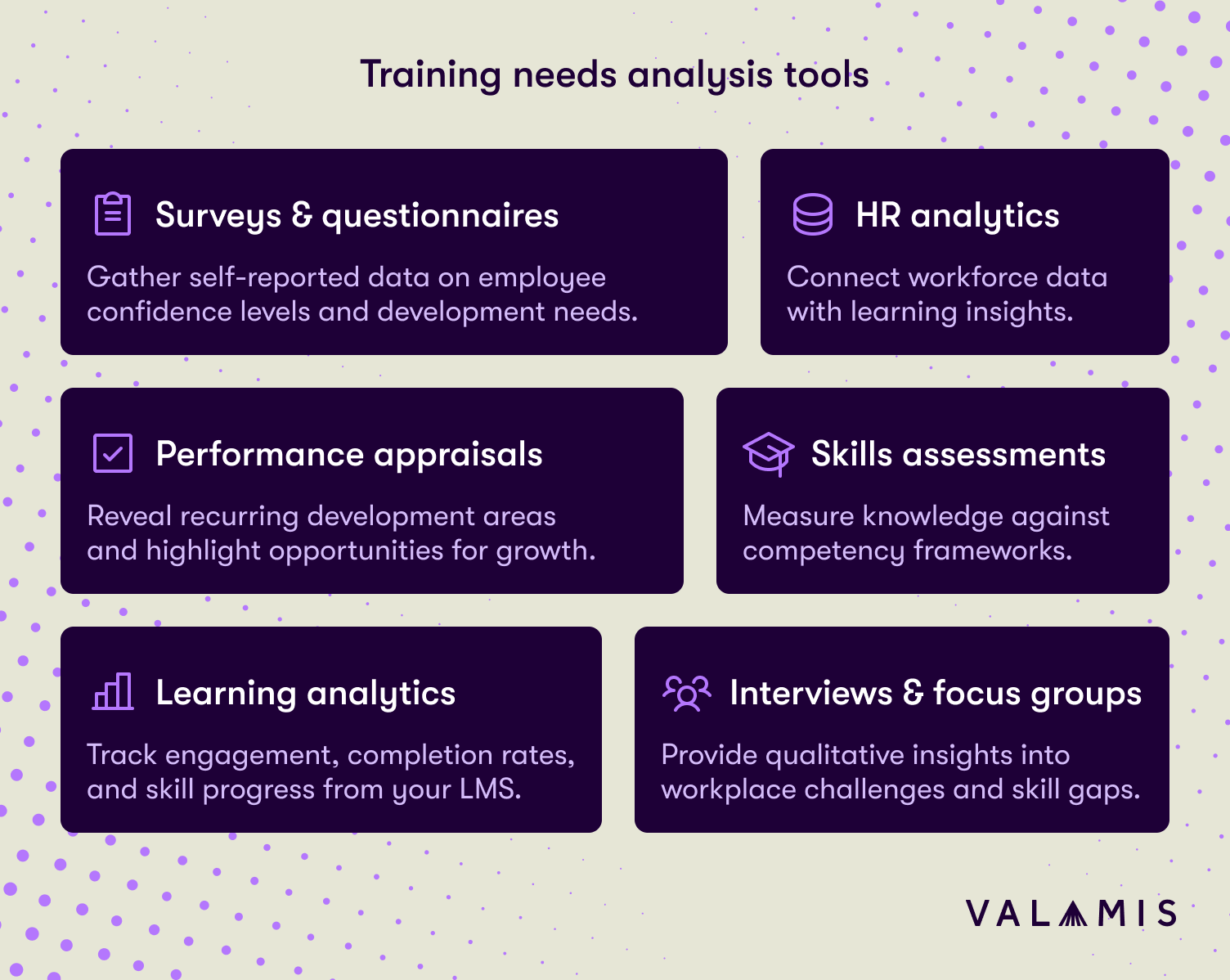
The right tools make it easier to collect reliable data and turn insights into action. Some of the most effective methods include:
- Surveys and questionnaires. Gather feedback directly from employees about confidence levels, development goals, and perceived learning needs.
- Interviews and focus groups. Provide qualitative insights into workplace challenges and skills requirements.
- Performance appraisals. Reveal recurring development areas while helping managers identify opportunities for growth.
- Skills assessments. Measure current knowledge against defined competency frameworks.
- Learning analytics. Your LMS can provide valuable information about learner engagement, completion rates, assessment results, and skill progress from training already delivered.
- HR analytics. Integrating HR data with learning data creates a more complete view of employee performance and development across the organization.
Training needs analysis examples
Example 1: organizational analysis for AI adoption
Business objective: Improve employee productivity by introducing generative AI into day-to-day workflows.
Required skills: Employees need to use generative AI fluently to complete routine work more efficiently. This includes writing effective prompts, reviewing AI-generated outputs, and knowing where AI can add value without compromising quality.
Current capabilities: Employee surveys and manager interviews showed that while many employees were already experimenting with generative AI, they lacked confidence applying it consistently in their daily work. AI was often used for ad hoc tasks and not integrated into established workflows, limiting productivity gains.
Training needs identified:
- Writing effective prompts to generate more accurate and relevant outputs.
- Identifying everyday tasks where generative AI can improve productivity.
- Reviewing and refining AI-generated content before using it.
Training solution:
- Online course on prompt engineering basics.
- Role-specific practice sessions demonstrating how AI can support common workflows within different business functions.
- Dedicated time for employees to experiment with AI.
How to measure success:
- Reduced time spent completing routine administrative and content creation tasks.
- Increased employee confidence using AI in everyday work, measured through employee surveys.
- Increased use of approved AI tools for routine work.
- Manager feedback showing more consistent and effective use of AI across teams.
Example 2: task analysis for a new customer support platform
Business objective: Improve customer satisfaction by introducing a new customer support platform that enables faster case resolution.
Required skills: Customer service advisors need to use the new platform expertly, follow the updated support workflow, and apply the organization’s revised complaint-handling procedures.
Current capabilities: Observations and manager feedback showed that advisors were highly experienced with the existing platform but had little familiarity with the new system. Task analysis also identified several new workflows and features that would change how customer inquiries were managed.
Training needs identified:
- Navigating the new customer support platform efficiently.
- Following updated complaint-handling procedures using the new workflow.
- Using automation features to resolve customer inquiries more quickly.
Training solution:
- Interactive system walkthroughs using a sandbox version of the new platform.
- Scenario-based exercises where advisors resolve realistic customer cases from start to finish.
- Quick reference guides and knowledge checks covering the new workflows.
How to measure success:
- Reduced average case handling time.
- Increased first-contact resolution rates.
- Higher employee confidence using the new platform.
- Fewer support requests relating to the new system after training.
Example 3: individual analysis for a new manager
Business objective: Strengthen leadership capability by preparing a newly promoted manager to lead their team effectively.
Required skills: The manager needs to conduct effective one-to-one meetings, provide constructive feedback, delegate work appropriately, and support employee development.
Current capabilities: A 360-degree review and manager observations showed that the individual had strong technical expertise but lacked confidence in performance conversations and coaching team members. Feedback also highlighted a tendency to solve problems independently rather than delegate.
Training needs identified:
- Delivering constructive feedback and conducting performance conversations.
- Delegating work effectively while supporting employee development.
- Coaching team members to improve performance and engagement.
Training solution:
- One-to-one leadership coaching focused on real workplace situations.
- Role-play exercises to practice feedback and performance conversations.
- A personal development plan with regular manager check-ins and reflection activities.
How to measure success:
- Improved 360-degree feedback scores after six months.
- Higher employee engagement within the manager’s team.
- Increased confidence in leadership responsibilities, measured through self-assessments and manager feedback.
- Successful completion of agreed leadership development objectives.
Frequently asked questions
What’s the difference between a training needs analysis and a skills gap analysis?
A training needs analysis tends to be broader, covering organizational, task, and individual levels, and includes deciding whether training is even the right solution. A skills gap analysis usually focuses more narrowly on comparing current and required skills at the individual or team level.
How often should we run a training needs analysis?
There’s no single right answer, but many organizations run a full analysis annually, alongside ongoing checks tied to specific triggers, such as a new system rollout, a strategy change, or a compliance update. The more your business or market changes, the more often it’s worth revisiting.
Who should be involved in a training needs analysis?
At minimum, senior leadership, line managers, and HR or L&D. Employees themselves are also a valuable source of insight, particularly for individual-level analysis, and involving them tends to improve buy-in once training is rolled out.
Can an LMS support a training needs analysis?
Yes. Modern LMS platforms help organizations collect learning data, monitor progress, identify skills gaps, personalize learning paths, and measure the effectiveness of training programs. This makes it easier to make evidence-based learning decisions and demonstrate the value of L&D initiatives.
Turn your training needs analysis into action with Valamis
A training needs analysis identifies the skills your workforce needs to develop. Delivering the right learning is what changes performance
Valamis helps organizations turn those insights into targeted learning experiences through personalized learning paths, role-based training, and learning tailored to individual development needs.
As employees progress, our reporting and analytics help L&D teams track engagement, measure learning outcomes, and demonstrate the impact of training against business objectives.
By connecting learning with your wider HR systems, we make it easier to continuously develop workforce skills and adapt learning as your organization’s priorities evolve.
See Valamis in action
Book a call and we’ll walk through the platform against your own requirements.
Book a demo